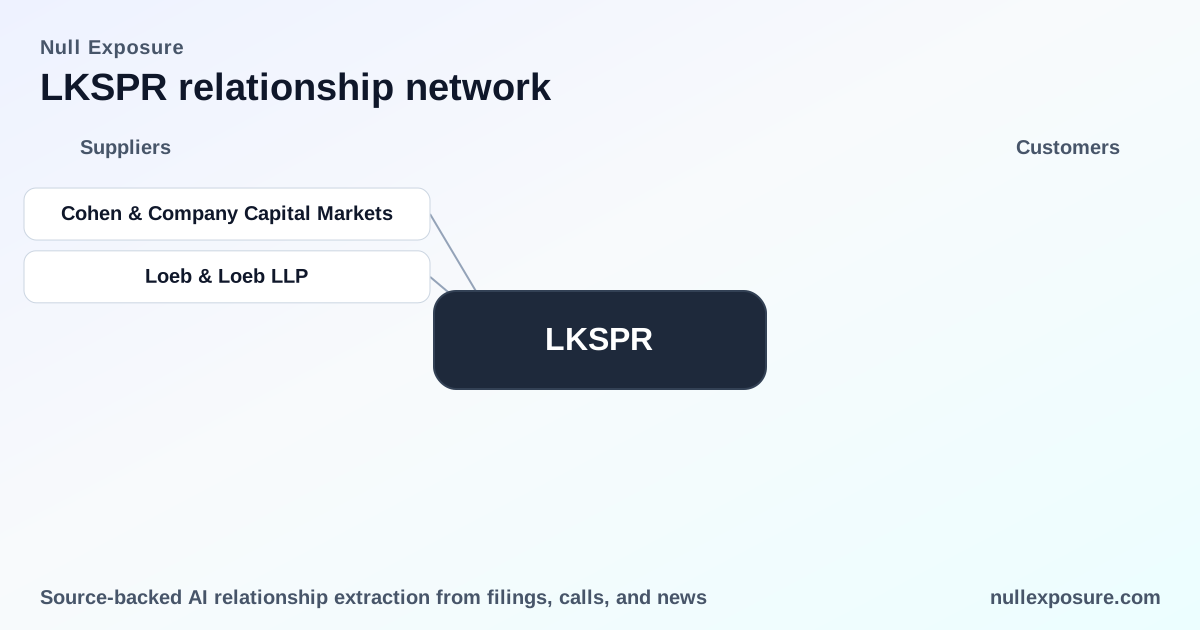
LKSPR supplier landscape — what investors need to know now
Lake Superior Acquisition Corp (LKSPR) operates as a blank‑check acquisition vehicle that monetizes primarily through sponsor arrangements, underwriting of its initial public offering, and ancillary service contracts that fund ongoing operating costs until a business combination or liquidation. Revenue to the sponsor and deal advisors comes from contractual monthly administrative fees and contingent underwriting commissions tied to a completed business combination, while other fees (transfer agent, trustee, audit) follow standard SPAC economic design. For investors evaluating counterparty risk and supplier relationships, the explicit hires and contractual posture tell a clear story about concentration, criticality, and the likely cost profile of running this vehicle through its lifecycle.
Explore the platform for deeper supplier-level intelligence: https://nullexposure.com/
Who LKSPR engaged on the offering — clear, named advisors
The public record identifies two named suppliers tied to the offering and formation process.
-
Cohen & Company Capital Markets — acted as the sole book‑running manager for the offering, handling syndicate and placement responsibilities for the IPO process (press release on Yahoo Finance, March 10, 2026). https://finance.yahoo.com/news/lake-superior-acquisition-corp-announces-200000053.html
-
Loeb & Loeb LLP — served as legal advisor to the company during the offering and registration process, providing transactional and securities counsel (press release on Yahoo Finance, March 10, 2026). https://finance.yahoo.com/news/lake-superior-acquisition-corp-announces-200000053.html
These named relationships are direct, short and precise: underwriting and legal advisory are the core external functions publicly disclosed for the offering.
What the contract language and filings reveal about how LKSPR is run
Company filings and the registration statement provide the operating context behind those advisors and several company-level supplier signals.
-
Sponsor administrative services are a recurring, long‑term commitment. The company entered an Administrative Services Agreement with its Sponsor to pay $10,000 per month for office space and administrative and support services, effective from the registration statement’s effective date until the earlier of a business combination or liquidation. The company recorded $27,742 in administrative service fees as of December 31, 2025, indicating active, ongoing payments through FY2025. (From the registration statement and FY2025 filings.)
-
Supplier role is primarily service provision rather than product delivery. Multiple filing excerpts identify the Sponsor, underwriter, transfer agent, auditor and trustee in a service‑provider posture: these contracts cover standard SPAC operational needs — office and admin services, underwriting, transfer agent processing, and audit/testimony obligations. (Company filings, FY2024–FY2025.)
-
Spend profile is mid‑sized and outcome‑contingent. The disclosed monthly fee places the Sponsor‑related spend in the $100k–$1m band on an annualized basis, while the underwriter has deferred underwriting commissions that are conditioned on completing an initial business combination, making a portion of compensation contingent on future deal execution. (Registration statement excerpts.)
-
Geographic and legal domicile are domestic/NA‑centric. The Sponsor is Lake Superior Investments LLC, a Delaware limited liability company, signaling a U.S. legal posture and North America operational anchoring. (Registration statement.)
-
Regulatory and custody constraints matter. Filings reiterate trustee investment restrictions and flag auditor inspection risk under PCAOB and the HFCAA — a potential delisting vector if inspection is obstructed by foreign jurisdictional stances. These are company‑level governance constraints that affect listing and liquidity outcomes, not individual supplier performance. (Registration statement and related filings.)
How those characteristics translate into investment risk and operational exposure
The contractual posture and named suppliers create an operational profile investors should parse carefully.
-
Concentration vs. redundancy. LKSPR’s named external dependencies are typical for SPACs: a single book‑running manager and a named legal advisor, with administrative services supplied by the Sponsor. Concentration is moderate — the Sponsor provides ongoing operational backbone, while underwriting and legal counsel are transaction‑specific and replaceable, but the Sponsor relationship is harder to substitute mid‑cycle without disruption.
-
Criticality and continuity. The Sponsor’s monthly administrative fee and the explicitly active status of that agreement indicate high criticality: these services are essential to day‑to‑day operations and will persist until the business combination or liquidation. The long‑term contracting posture (payments until combination or liquidation) signals operational continuity and predictable costs for the SPAC lifecycle.
-
Outcome dependence amplifies risk‑reward. Deferred underwriting commissions make part of the underwriter’s compensation contingent on a successful deal, aligning incentives but also linking future cash outflows to execution risk. Trustee and transfer agent arrangements impose standard transactional frictions (e.g., transfer agent fees near $80 per tendering broker) that can affect redeeming shareholder economics on a granular level.
-
Regulatory tail risk exists. The filing‑level disclosure on PCAOB inspection and the HFCAA constitutes non‑trivial regulatory risk: if auditor inspection cannot proceed, listing status and tradability could be affected. This is a company-level structural risk that flows from the auditing and cross‑jurisdictional environment rather than any single supplier.
Practical takeaways for investors and operators
-
Prioritize Sponsor assessment. Given the Sponsor supplies core administrative services through a long‑running paid agreement, evaluate its balance sheet, reputation, and willingness to continue services through a potential business combination or liquidation. The Sponsor is the single largest ongoing supplier relationship in practice.
-
Read contingent fee language closely. Deferred underwriting commissions and other contingent payments change the economics of a successful deal for both sponsors and investors; model both scenarios — with and without a completed business combination — to capture potential outflows.
-
Treat regulatory signals as non‑diversifiable risk. Auditor inspection issues under the HFCAA are company‑level risks that can directly affect listing status and market liquidity; monitor PCAOB inspection developments and related disclosures.
-
Supplier concentration is manageable but not trivial. With a sole book‑running manager and a named legal advisor, the supplier roster is lean; transaction execution relies on a small group of external providers, so evaluate their track record on speed, pricing, and deal execution.
For a deeper supplier‑level breakdown and to monitor changes over time, visit our platform: https://nullexposure.com/
Final perspective and next steps
LKSPR’s public record shows a standard SPAC supplier configuration: sponsor‑run operations funded by monthly admin fees, a single book‑running manager for the offering, and a named legal advisor. The economic structure is a blend of predictable operating outlays and outcome‑contingent deal fees, with regulatory inspection risk as a material company‑level constraint. Investors should weigh the Sponsor’s central role and the contingent nature of underwriting economics when assessing counterparty and execution risk.
For ongoing monitoring and supplier risk scoring, start your review at https://nullexposure.com/ — the platform aggregates supplier relationships, contract signals, and the filing evidence that drive investment decisions.