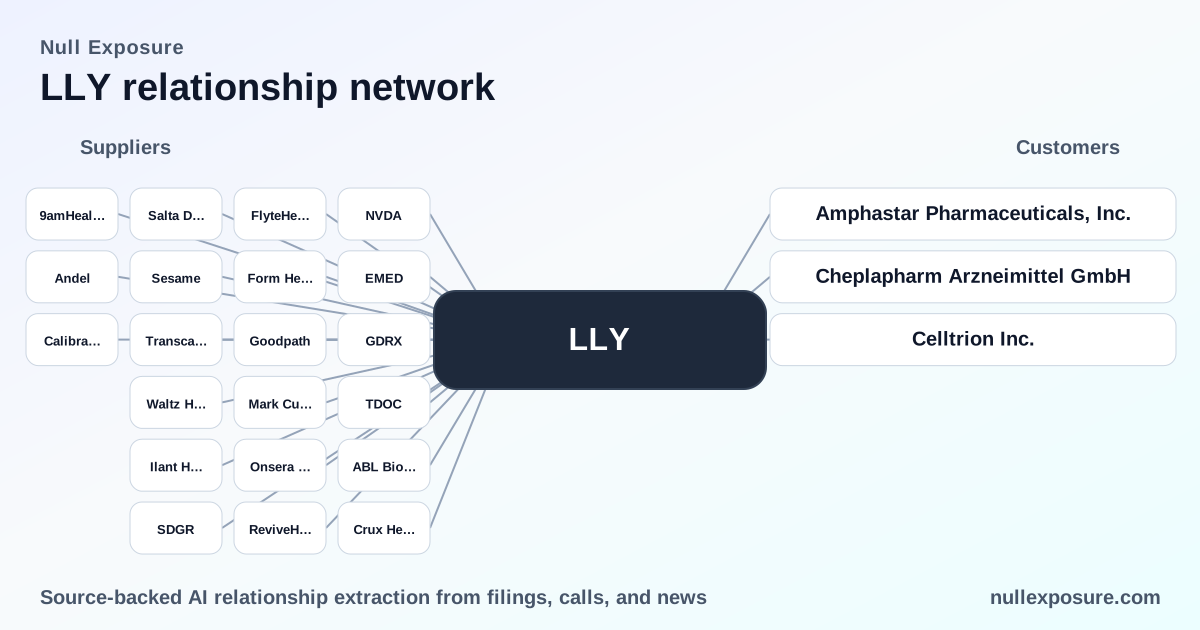
Eli Lilly (LLY) — the supplier map that underwrites growth and risk
Eli Lilly is a research-led, commercially scaled pharmaceutical company that monetizes through global drug sales, licensing and strategic collaborations, with a growing emphasis on obesity and metabolic therapies as commercial anchors. The company operates a hybrid model: it retains core R&D and commercialization while outsourcing manufacturing, distribution and selected clinical operations, and it monetizes both through product revenues and large-scale collaboration and licensing agreements. For a granular supplier view and continuous monitoring, visit https://nullexposure.com/ for enterprise-grade signals.
How suppliers fit into Eli Lilly's operating model and investor thesis
Eli Lilly runs a highly partnered operating model. The company uses third parties for active ingredient manufacturing, finishing, packaging, distribution and certain clinical services, which allows Lilly to scale launches and compress time-to-market while keeping R&D and commercialization in-house. That posture produces three structural investor implications:
- Operational leverage: outsourcing reduces fixed capital tied to manufacturing but creates dependency on third-party performance and contract terms.
- Concentration and contractual lock-in: company disclosures note that while many inputs are multi-sourced, certain materials are single-source, and some agreements include long-duration purchase commitments that can imply very large contingent spend.
- Strategic optionality via collaborations: licensing and co-innovation deals—particularly in AI-driven drug discovery and platform licensing—accelerate pipeline delivery without commensurate upfront capex.
These are company-level signals drawn from Lilly’s public comments and filings; they shape supplier risk and value capture across the relationships detailed below. If you manage supplier exposure or corporate procurement risk, explore more at https://nullexposure.com/.
The full relationship inventory — who Lilly is working with now
Below are every supplier and partner referenced in the recent coverage and calls, each with a concise plain-English summary and a source reference.
NVIDIA
Lilly announced a co-innovation AI lab with NVIDIA to support AI-enabled drug discovery and infrastructure, signaling a technology partnership that targets model-driven R&D acceleration. This was disclosed on Lilly’s 2025 Q4 earnings call in March 2026.
eMed
eMed is listed among the healthcare administrators on Lilly’s employer-oriented obesity drug platform, positioning the company as a distribution/administration partner in Lilly’s go-to-market for weight-management therapies. CNBC covered the program on March 5, 2026.
GoodRx
GoodRx appears as an administrator on Lilly’s new employer coverage platform, giving Lilly breadth in retail and digital pharmacy channels for benefits-managed access. CNBC reported this on March 5, 2026.
Teladoc Health
Teladoc is included among administrators on the Lilly platform, offering telehealth and virtual care channels that support therapy access and chronic care management. CNBC (March 5, 2026) lists Teladoc among the platform partners.
ABL Bio Inc.
ABL Bio signed a landmark licensing and joint research agreement with Lilly for a blood-brain barrier shuttle technology (Grabody-B) in a deal reported at approximately $2.6 billion, an example of Lilly’s large milestone-driven licensing activity. KED Global reported this licensing agreement in March 2026.
Crux Health
Crux Health is named on the list of administrators for Lilly’s employer coverage program, indicating a role in benefits administration or care coordination on Lilly’s platform. CNBC (March 5, 2026) identified Crux Health among the partners.
FlyteHealth
FlyteHealth is cited as one of the administrators on Lilly’s obesity coverage platform, providing employer-facing care solutions in Lilly’s distribution ecosystem. CNBC reported the inclusion on March 5, 2026.
Form Health
Form Health is included among Lilly’s listed platform administrators, representing a digital-first care administrator role for weight-management coverage. CNBC covered this on March 5, 2026.
Goodpath
Goodpath is noted as an administrator on Lilly’s platform, signaling integration into Lilly’s employer coverage lineup for chronic and metabolic conditions. CNBC (March 5, 2026) lists Goodpath among administrators.
Mark Cuban’s Cost Plus Drug Co.
Mark Cuban’s Cost Plus Drug Co. is listed as an administrator, giving Lilly a channel into lower-cost pharmacy distribution options within its employer program. CNBC reported this on March 5, 2026.
Onsera Health
Onsera Health is included on Lilly’s administrator roster for the employer program, suggesting engagement with alternative primary-care or direct-to-employer models. CNBC (March 5, 2026) documents Onsera’s participation.
ReviveHealth
ReviveHealth appears among Lilly’s platform administrators, indicating its use for employer-directed care and benefits management connected to Lilly’s obesity offerings. CNBC covered this on March 5, 2026.
Salta Direct Primary Care
Salta Direct Primary Care is listed as an administrator on Lilly’s platform, evidencing Lilly’s integration with DPC models to broaden access to therapies. CNBC reported Salta’s inclusion on March 5, 2026.
Sesame
Sesame is included among Lilly’s administrators, reflecting an effort to use diverse care marketplaces and pricing models for therapy access. CNBC (March 5, 2026) lists Sesame among partners.
Transcarent
Transcarent is named as an administrator for Lilly’s program, connecting Lilly’s therapies to employer benefit navigation and virtual-first care models. CNBC reported Transcarent on March 5, 2026.
Waltz Health
Waltz Health is on Lilly’s administrator list, representing another benefits management and care navigation partner in Lilly’s employer strategy. CNBC noted Waltz Health on March 5, 2026.
Ilant Health
Ilant Health appears among administrators named in Lilly’s employer coverage announcement, indicating focused partnerships with specialized benefit managers. CNBC covered Ilant Health in the March 2026 piece.
Schrödinger, Inc.
Schrödinger entered a collaboration with Lilly’s TuneLab (January 2026), highlighting Lilly’s investment in computational chemistry and AI-driven design through third-party platform partnerships. This was noted in financial commentary in early 2026, including Simply Wall St and Sahm Capital (Jan–Feb 2026).
9amHealth
9amHealth is listed among administrators on the Lilly employer platform, adding primary-care and chronic care management capacity to Lilly’s access strategy. CNBC reported this on March 5, 2026.
Andel
Andel is included in Lilly’s roster of administrators for its employer coverage rollout, signaling use of varied care delivery partners. CNBC cited Andel on March 5, 2026.
Calibrate Health
Calibrate Health appears on Lilly’s administrator list, underscoring Lilly’s use of specialized metabolic and weight-management care providers to support product uptake. CNBC reported Calibrate Health on March 5, 2026.
Strategic implications for investors and operators
- Supply-chain geography: Company disclosures signal meaningful reliance on APAC suppliers, including China, for chemical synthesis and starting materials; this is a structural supply risk to consider for margin and availability.
- Single-source and contractual exposure: Lilly confirms certain materials are single-source and that some agreements carry long-term purchase commitments and large contingent payments, which implies concentration risk and potential forced spend over multi-year horizons.
- Outsourced execution: Lilly’s routine outsourcing of manufacturing, finishing and distribution makes supplier performance and contract terms critical to launch cadence and cost control.
- Large-dollar relationships: The scale of licensing and procurement language in filings points to $100M+ commitment bands for certain programs and partners, shifting negotiation leverage and economic sensitivity to partner execution.
These factors combine to create a profile of high operational flexibility but material supplier dependency, which is central to any valuation, procurement diligence, or counterparty risk assessment.
What investors should do next
- Monitor execution against the NVIDIA and Schrödinger collaborations as leading indicators of R&D productivity and model-driven pipeline acceleration. Learn more and set alerts at https://nullexposure.com/.
- Prioritize vendor concentration metrics in diligence: focus on single-source inputs and long-duration purchase commitments that can create downside operational leverage. For a supplier-risk briefing tailored to portfolios, visit https://nullexposure.com/.
Bottom line: Lilly’s supplier network is broad and strategically aligned to rapid commercialization, but its operating leverage depends on third-party manufacturing, distribution and large licensing arrangements that introduce concentrated counterparty and geographic risks. Investors and operators should balance the upside of accelerated launches against the downside of supplier execution and contract exposure.