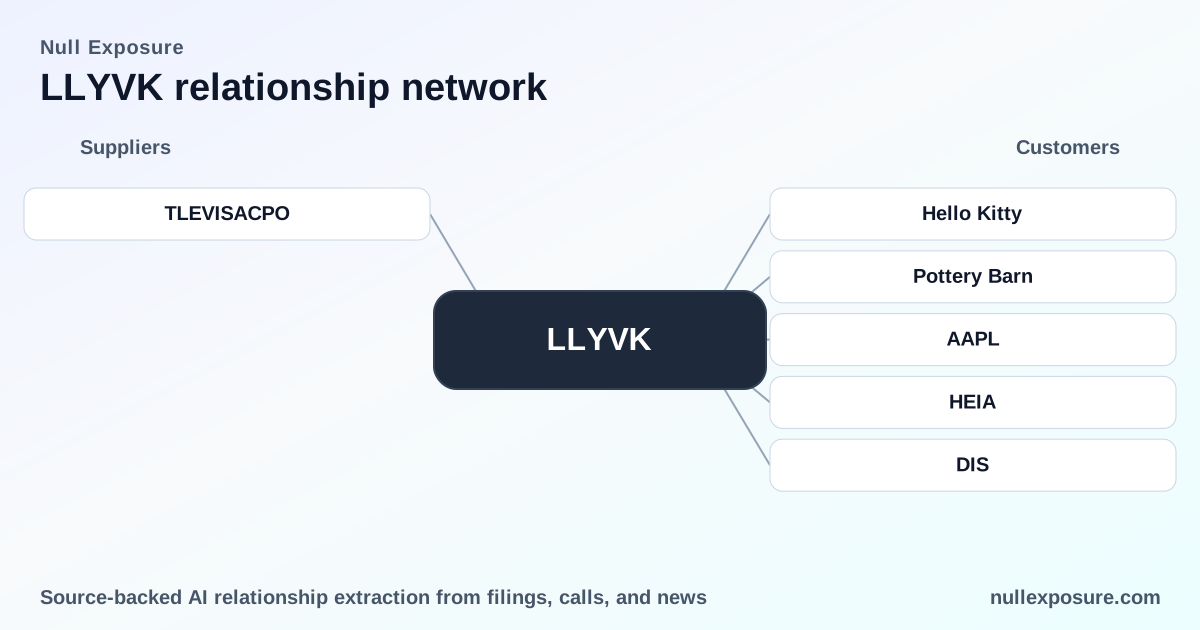
LLYVK supplier profile: broadcast partnerships, territorial rights, and what investors should price in
LLYVK monetizes content and distribution rights through multi-year licensing agreements with regional broadcasters and distribution partners, selling territorial exclusivity and streaming/broadcast packages that convert intellectual property into recurring licensing revenue. The company's commercial model is partner-driven: secure a limited set of high-value broadcast relationships, lock multi-year terms, and roll renewals and new-territory deals into predictable fee streams. For investors and operators, the commercial cadence—renewals, territorial coverage, and exclusivity—dictates revenue visibility and downside risk.
Discover more supplier intelligence at https://nullexposure.com/ — use the platform to validate counterparties and contract timing.
Relationship inventory: what the filings show
- Grupo Televisa (TLEVISACPO): LLYVK announced that Grupo Televisa is its official broadcast partner in Mexico through 2028, and that the company is close to finalizing remaining agreements for territories where rights expire at the end of the season, including Japan, Latin America, and Pan Asia. According to the company's 2025 Q3 earnings call transcript (reported March 7, 2026), Televisa will handle Mexican broadcast rights at least through 2028 and the firm is negotiating other regional deals. (Earnings call, 2025Q3 / first reported March 7, 2026.)
What the Televisa commitment implies for the business
The Televisa announcement is a high-confidence commercial milestone: a multi-year anchor in Mexico through 2028 materially increases short- to medium-term revenue visibility for the territory and signals an institutional route-to-market for LLYVK content in Latin America. The explicit mention of Japan, Latin America, and Pan Asia as remaining territories to be finalized shows a staged, territory-by-territory rollout rather than a simultaneous global sale of rights. The structure is consistent with a licensing model that sequences deals to maximize regional pricing and to preserve negotiating leverage as audiences and bidding dynamics become clear.
Company-level constraints and operating signals
There were no explicit contractual constraints or penalties disclosed in the reviewed records. From available disclosures, the following company-level signals describe LLYVK’s operating model and commercial posture:
- Contracting posture — partner-first, multi-year licenses. The firm secures long-dated exclusivity in core markets to anchor revenue, then layers secondary territories through follow-up negotiations.
- Concentration — selective partner reliance. Naming a major regional broadcaster as the official partner implies a concentrated counterparty set, which simplifies distribution but increases counterparty risk if a single large partner underperforms or renegotiates.
- Criticality — broadcaster relationships are revenue-critical. Broadcast and distribution partners function as the primary monetizers of LLYVK’s content; losing shelf space or exclusivity would have immediate top-line impact.
- Maturity — negotiated multi-year stability. Agreements through calendar 2028 provide at least intermediate-term cash-flow visibility for contracted territories.
These signals should be treated as company-level characteristics rather than constraints tied to any single relationship, because no constraint excerpt specifically names a counterparty.
Explore active supplier coverage and validate counterparties at https://nullexposure.com/.
Investor implications: how to price upside and risk
- Upside: Multi-year territorial deals create a base of recurring licensing revenue and reduce near-term headline volatility. Securing a major regional broadcaster like Televisa establishes distribution scale for Mexico and facilitates sublicensing or bundle sales across Latin America.
- Renewal and concentration risk: Dependence on a small set of large broadcasters elevates renegotiation and concentration risk—investors should stress-test scenarios where renewal pricing falls or exclusivity is reduced.
- Timing and geographic rollout: The company’s staged negotiation approach implies revenue ramp is lumpy by territory; investor models should incorporate discrete renewal and signature milestones rather than smooth, linear growth.
- Regulatory and FX exposure: Cross-border licensing exposes revenues to foreign exchange and broadcast regulation in each territory; contractual terms around currency denomination and termination will materially affect net cash received.
- Leverage and optionality: Multi-year anchor deals increase the company’s ability to aggregate rights and sell region-wide packages, which can drive margin expansion if distribution efficiencies and sublicensing are executed.
Practical operational checklist for counterparties and partners
For operators and procurement teams evaluating LLYVK as a supplier, focus on the following contractual and operational items:
- Confirm geographic scope and exclusivity clauses for each territory and channel (linear, streaming, sublicensing).
- Verify term lengths and renewal triggers—automatic renewals versus negotiated extensions change valuation and operational planning.
- Inspect termination rights and penalties, especially for content performance or regulatory intervention.
- Demand clarity on content delivery standards, rights windows, and anti-piracy enforcement obligations to protect commercial value.
- Establish clear payment schedule, currency denomination, and escrow or guarantees for large, multi-year license fees.
Bottom line: concise investment posture and next steps
LLYVK’s disclosure of a Televisa partnership through 2028 is a credible commercial anchor that boosts near-term revenue visibility in Mexico and signals a deliberate territory-by-territory monetization strategy. The principal risks for investors are partner concentration, renewal pricing, and the timing of deals in other important regions (Japan, Latin America, Pan Asia). Operators negotiating with LLYVK should prioritize exclusivity, renewal mechanics, and enforceability.
For deeper supplier due diligence and to monitor counterparties in real time, visit https://nullexposure.com/ — use the platform to map deal timing and contractual exposures before pricing risk into your models.