LMACA supplier relationships: an investor brief
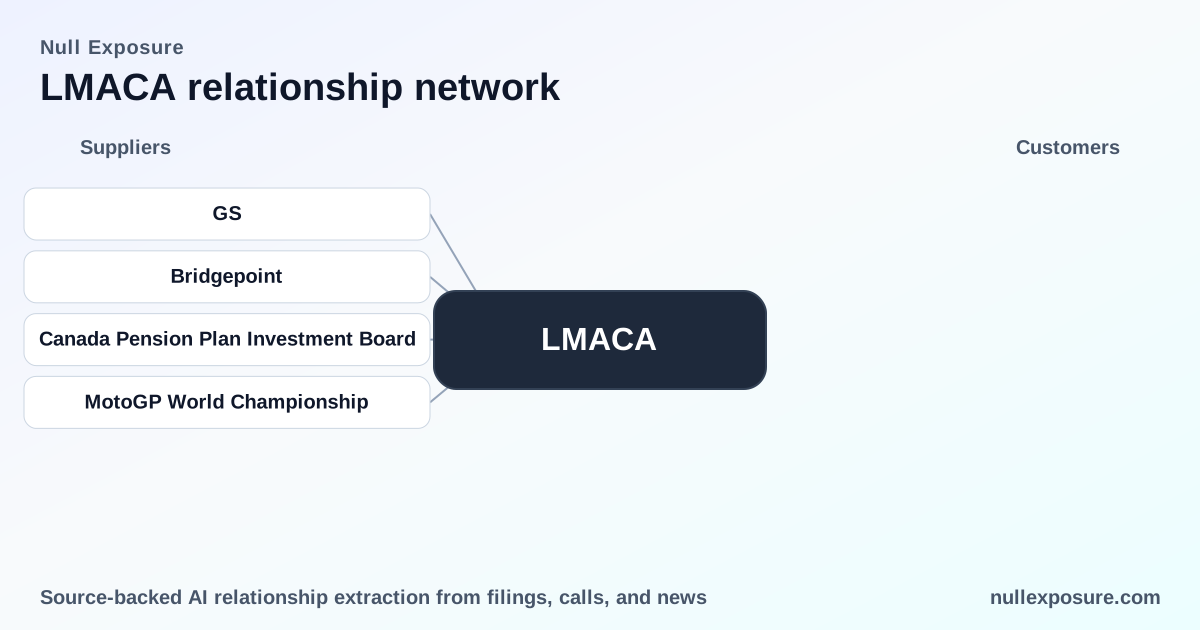
LMACA operates as a supplier that participates in large corporate and sporting finance transactions, monetizing through transaction-linked fees and recurring service agreements with institutional clients and financial intermediaries. The company’s commercial model is driven by a small set of high-value engagements where fee density and counterparty quality determine near-term revenue visibility and margin profile. For investors, the key questions are counterparty concentration, contract formality, and exposure to event-driven M&A cycles.
Explore broader supplier coverage and supplier-risk signals at https://nullexposure.com/.
Why these relationships matter for valuation and risk
LMACA’s disclosed relationships in public reporting and press coverage point to a business that is deeply embedded in high-ticket corporate financings and strategic disposals, rather than a high-volume retail supplier. That positioning implies:
- Contracting posture: engagements are structured around bespoke, fee-based arrangements with formal lead banks and sponsors, not standard off-the-shelf procurement contracts.
- Concentration: revenue is likely concentrated among a handful of large counterparties; each discrete transaction can meaningfully influence short-term top-line performance.
- Criticality: relationships with banks, private equity sellers, and pension investors indicate LMACA provides services that are important to transaction execution and financing certainty.
- Maturity: counterparties listed are established financial institutions and sponsors, suggesting a mature commercial profile rather than early-stage counterparty risk.
These company-level signals point to idiosyncratic event risk (timing of M&A and refinancing), counterparty credit sensitivity, and reputational exposure tied to headline transactions. For more supplier-risk context and comparative coverage, visit https://nullexposure.com/.
Who LMACA works with — direct relationship notes
Below are plain-English summaries of every relationship returned in the supplier results, each with a concise source reference.
-
Goldman Sachs Group Inc. (GS) — Goldman Sachs is identified as the lead bank in a $2.55 billion refinancing package tied to Liberty Media’s acquisition activity, placing Goldman in a lenders’ role for the transaction where LMACA is recorded as a supplier relationship. A Financial Post article covering the financing referenced Goldman Sachs’ lead role (March 10, 2026): https://financialpost.com/pmn/business-pmn/formula-1-wraps-up-2-55-billion-ma-refinancing-loan-package.
-
Bridgepoint — Bridgepoint is cited as a seller in the MotoGP transaction that Liberty Media agreed to acquire; LMACA’s connection to Bridgepoint signals involvement with secondary-market sellers and private-equity-backed disposals. The Financial Post report noted Bridgepoint as a seller to Liberty Media (March 10, 2026): https://financialpost.com/pmn/business-pmn/formula-1-wraps-up-2-55-billion-ma-refinancing-loan-package.
-
Canada Pension Plan Investment Board (CPPIB) — CPPIB appears alongside Bridgepoint as a co-seller of MotoGP, indicating LMACA’s exposure to large institutional asset managers and pension-backed investments that participate in high-profile sports and media asset sales. The transaction and CPPIB’s role are described in the same Financial Post coverage (March 10, 2026): https://financialpost.com/pmn/business-pmn/formula-1-wraps-up-2-55-billion-ma-refinancing-loan-package.
-
MotoGP World Championship — The MotoGP World Championship is the operating asset at the center of the acquisition financing; LMACA’s supplier relationship touching this asset suggests direct involvement in the commercial or financing chain around sports-rights transactions. Financial Post described the refinancing arranged to finance Liberty Media’s acquisition of MotoGP (March 10, 2026): https://financialpost.com/pmn/business-pmn/formula-1-wraps-up-2-55-billion-ma-refinancing-loan-package.
What the relationship map implies for operational dynamics
The composition of counterparties — a global investment bank, private equity seller, a large pension investor, and a marquee sports property — creates a profile where each engagement is event-driven and concentrated. Investors should treat LMACA’s near-term revenue cadence as tied to:
- The timing and size of M&A and refinancing mandates.
- The balance between one-off transaction fees versus recurring services for operating assets.
- Counterparty credit and reputational linkages: a lead bank or major seller’s decision can accelerate or delay recognition of contract revenue.
Collectively, these dynamics support a thesis where LMACA’s upside is asymmetric during cycles of consolidation and rights monetization in sports/media, while downside is concentrated when transaction flow slows.
(If you want a broader cross-supplier comparison or tailored counterparty risk maps, see https://nullexposure.com/.)
Investment implications and risk checklist
Investors evaluating LMACA should weigh the following, each tied back to the relationships above:
- Revenue concentration risk: reliance on large, discrete transactions means quarterly results will swing with deal cadence.
- Counterparty exposure: relationships with major banks and institutional sellers reduce counterparty risk but increase reputational linkage to headline deals.
- Event timing sensitivity: M&A and refinancing markets drive topline visibility; macro tightening or sponsor holdbacks compress near-term opportunities.
- Contract formalization: the mix between formal underwriting/engagement letters and ad hoc commercial agreements will determine collections and margin durability.
From an operator perspective, these characteristics argue for maintaining diversified sponsor coverage, formalizing recurring service contracts, and hedging timing risk through retainer or milestone fee structures.
Final takeaway and recommended actions
LMACA’s supplier footprint centers on high-value, high-visibility transactions with premier financial and institutional counterparties; its value to investors is concentrated and event-driven. Priorities for active investors or operators are clear: validate contract terms, track counterparties’ deal pipelines, and stress-test revenue under conservative transaction cadence assumptions.
- Review counterparties’ announced pipelines and financing calendars to model revenue timing.
- Insist on contract-level transparency for any material counterparties that could represent a large share of near-term revenue.
- Monitor reputational exposure tied to marquee transactions and ensure contingency plans for delayed closings.
For a structured view across suppliers and to build counterparty risk models for LMACA, visit the Nillexposure hub at https://nullexposure.com/.