LMAT supplier relationships: financing, counsel, and supply concentration that shape execution risk
LeMaitre Vascular (LMAT) manufactures and markets vascular surgical devices and biologic grafts/patches and monetizes by selling proprietary implants and related consumables through hospitals and surgical centers. The company sources a mix of third‑party manufacturing and sole‑source biologic materials, finances strategic acquisitions with bank credit facilities, and carries purchaser commitments that translate directly into working‑capital and supply‑chain exposure. For investors evaluating counterparty and operational risk, the interplay between bank financing, legal advisers, and concentrated supplier relationships is the primary driver of near‑term execution and M&A capacity.
Explore more vendor and counterparty intelligence at the Null Exposure homepage: https://nullexposure.com/
A concise read on the most important counterparties observed
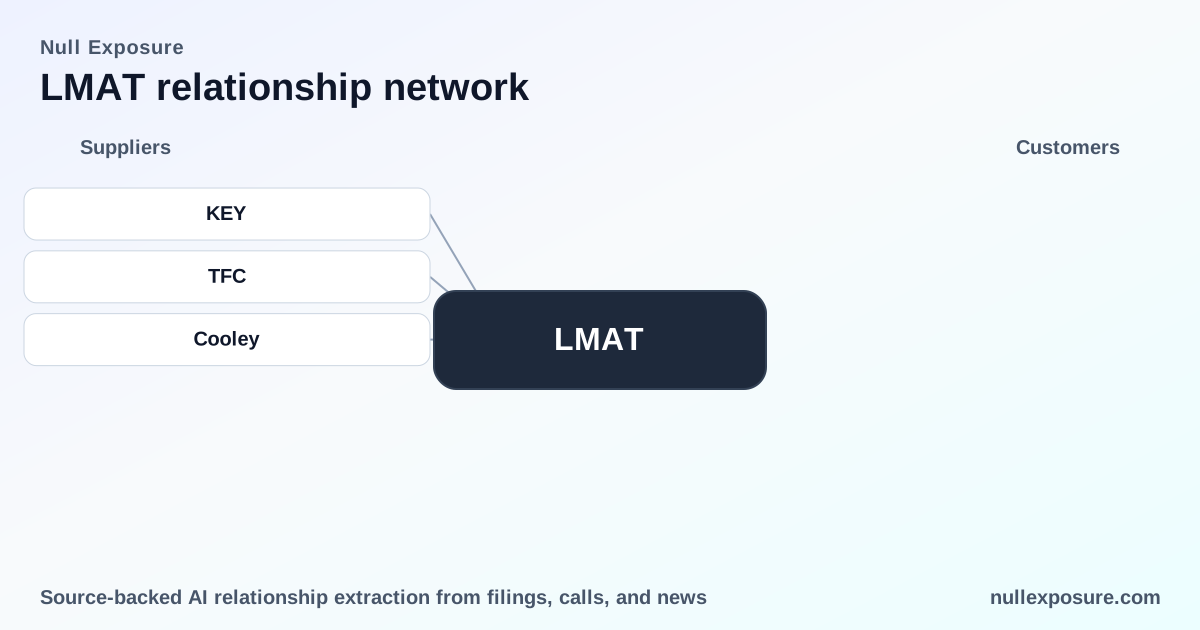
The public record captured three named counterparties tied to LMAT activity around an acquisition announced in March 2026. Each relationship conveys a discrete role in execution: financing, legal counsel, and operational support.
-
KeyBank National Association and Truist Bank — A March 2026 MassDevice report notes that KeyBank and Truist provided a credit facility used to support the acquisition of Artegraft, signaling that LMAT uses syndicated bank financing to fund inorganic growth and working capital needs (MassDevice, March 2026: https://www.massdevice.com/lemaitre-vascular-acquires-artegraft/).
This relationship underscores access to commercial bank capital for M&A and balance‑sheet flexibility. -
Cooley — Legal counsel to LeMaitre in the same transaction (MassDevice, March 2026: https://www.massdevice.com/lemaitre-vascular-acquires-artegraft/).
The use of a top‑tier law firm for deal execution indicates standardized M&A governance and documentation cadence, reducing legal execution risk on the transaction side.
Each named counterparty had a clear transactional role in the Artegraft acquisition; these are not supplier links for product inputs but are material to LMAT’s financing and deal‑making capacity.
Why these relationships matter to investors and operators
Bank financing and external counsel are not just administrative details; they materially affect LMAT’s strategic runway and operational resiliency.
-
Financing ergonomics. The presence of a credit facility with KeyBank and Truist shows LMAT can deploy leverage to accelerate shareable revenue streams through acquisitions. That expands addressable market quickly but increases interest‑rate and refinancing exposure. Investors should model debt servicing under stressed revenue scenarios post‑acquisition.
-
Transactional governance. Retaining Cooley for legal work signals that LMAT executes acquisitions within institutional standards, mitigating deal documentation risk and accelerating integration timelines.
For more supplier and counterparty profiles that impact investment decisions, visit Null Exposure: https://nullexposure.com/
Supply‑side constraints and what they reveal about LMAT’s operating model
Company disclosures establish several clear operating model characteristics that affect supplier risk and procurement behavior. These are company‑level signals and not tied to any single named counterparty.
-
Contracting posture: primarily spot purchases. Management states: "We do not have contractual arrangements with many suppliers and manufacturers, and we order supplies and products as‑needed." That language indicates low long‑term contractual coverage, exposing LMAT to price volatility and availability shocks for inputs procured on the spot market.
-
Concentration and criticality: a heavy dependence on sole or limited sources. Management explicitly identifies reliance on sole‑ and limited‑source suppliers for key products, including XenoSure, VascuCel, CardioCel, Artegraft, Omniflow, and RestoreFlow, noting there are "relatively few, or in some cases no, alternative, validated sources of supply." This is a high‑impact concentration risk: disruption at one supplier would directly constrain revenue for related product lines and complicate customer fulfillment.
-
Role complexity: buyer and outsourced manufacturer. The company both purchases components and outsources manufacturing: "We purchase certain components from, and have certain product lines manufactured by, third parties." This mixed model creates operational dependencies on contract manufacturers’ quality systems and validation processes, requiring active supplier qualification and inventory buffers.
-
Near‑term purchase commitments. Management reports commitments to purchase approximately $17.5 million of inventory through 2025, a concrete working‑capital obligation that firms up near‑term cash outflows and supplier exposure.
Collectively, these attributes define an operating model that is growth‑oriented but supply‑constrained and partially spot‑market dependent, increasing the relevance of both financial counterparty capacity (to fund inventory and acquisitions) and legal/advisory partners (to manage supplier contracts and integration).
Practical implications for valuation and operations
Investors and operators should convert these relationship signals into actionable checks:
-
Stress‑test debt capacity and covenant headroom under scenarios where a sole‑source supplier is disrupted for 3–6 months; model the incremental cost of validated alternate sourcing and lost sales conversion rates.
-
Monitor purchase commitments and days‑payable inventories; the reported $17.5M commitment through 2025 is a measurable working capital pivot that will absorb free cash flow.
-
Track announcements from KeyBank and Truist regarding covenant amendments or facility utilization after acquisitions; utilization levels will determine refinancing risk and ability to fund future inorganic moves.
-
Insist on visibility into third‑party manufacturer quality metrics and supplier dual‑sourcing plans; operational resilience will require converting spot purchases into at least partial contractual coverage for critical biologic inputs.
What to watch next—catalysts that change the risk/reward calculus
- Any disclosure of alternative validated suppliers for the named biologic products will materially reduce concentration risk and support multiple‑turn valuation expansion.
- Changes in bank facility terms, usage, or amendments will alter leverage ratios and cost of capital. Monitor quarterly filings and press releases closely.
- Integration progress and any manufacturing transitions post‑Artegraft acquisition will reveal whether the company can absorb acquisition‑related supply complexity without margin erosion.
Bottom line: concentrated inputs, structured financing, and active governance
LeMaitre’s public record around the Artegraft acquisition shows institutional financing (KeyBank, Truist) and top‑tier legal counsel (Cooley) supporting inorganic growth, while company disclosures reveal material supply concentration and a spot purchasing posture for many critical biologic products. For investors, the immediate focus is on how balance‑sheet flexibility and supplier qualification plans mitigate the high operational leverage embedded in sole‑source components.
Learn more about how supplier relationships affect investor outcomes at the Null Exposure homepage: https://nullexposure.com/