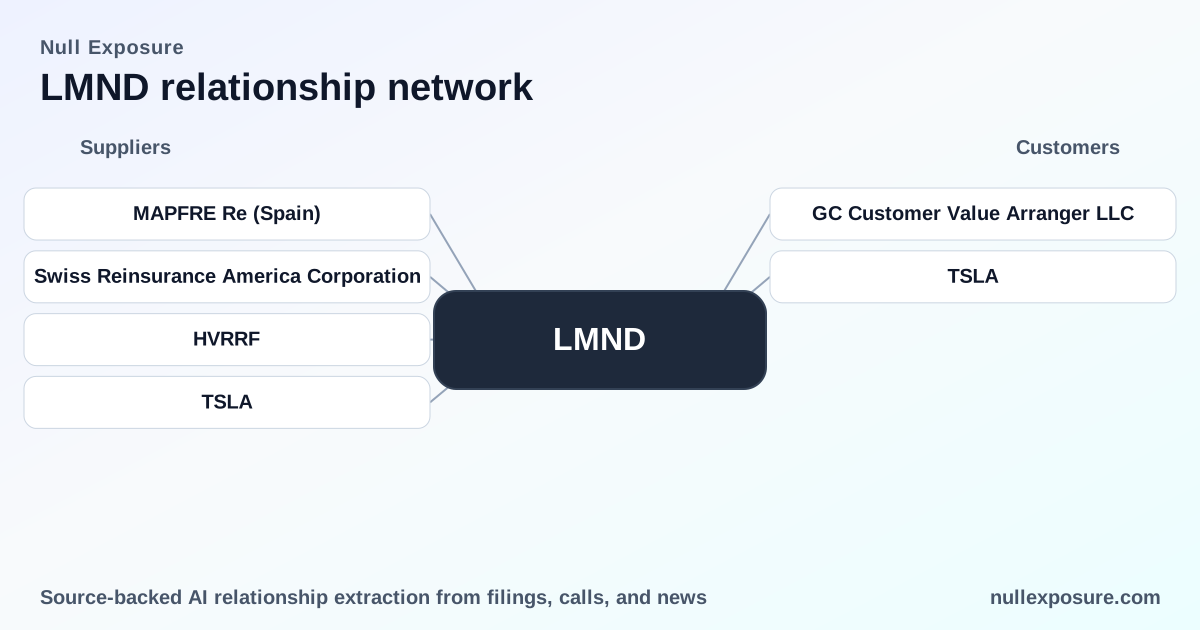
Lemonade (LMND): Reinsurance backbone, cloud dependence, and a new Tesla distribution vector
Lemonade operates as a digitally native property & casualty insurer that monetizes by underwriting retail premiums, ceding portions via quota-share reinsurance, and scaling distribution through online channels and partnerships. The company combines third-party cloud and licensed technology with ceded capital from global reinsurers to control volatility in claims, while pursuing growth through heavy customer acquisition spend and product extensions such as vehicle-specific insurance. Investors evaluating Lemonade should treat supplier relationships as central to both risk management (reinsurance) and future revenue expansion (technology and data partnerships).
Explore Lemonade’s supplier footprint on the Null Exposure platform: https://nullexposure.com/
How the supplier map shapes Lemonade’s operating model
Lemonade’s supplier signals paint a coherent operating posture: short-term, renewable reinsurance; dependence on licensed technologies and cloud providers; and meaningful marketing-driven spend to scale top line. Taken together these signals define a company that outsources insurance tail risk to global reinsurers, relies on external software and infrastructure to deliver customer-facing products, and accepts high near-term cost to capture market share.
Key operational characteristics implied by the constraints:
- Contracting posture / maturity: Reinsurance arrangements are described as short-term and renewable on an annual basis, signaling active program management rather than long-dated stability.
- Concentration and criticality: Use of major reinsurers and a single large cloud provider indicates concentrated dependencies that are critical to underwriting capacity and platform uptime.
- Commercial posture: The company functions both as a licensee and licensor of security and encryption technology, and as a consumer of service providers — a hybrid technology-insurer operating model.
- Cost structure and growth model: Documented marketing and customer acquisition spend places Lemonade in a high-growth, spending-intensive stage of business development.
These traits affect capital planning, counterparty diligence, and operational resilience assessments for investors and partners. For a deeper supplier due-diligence view, visit https://nullexposure.com/.
Supplier roll call and what each relationship means for investors
Here are the relationships disclosed in the reviewed records, with concise takeaways and source citations.
MAPFRE Re (Spain)
Lemonade has a whole quota share reinsurance contract with MAPFRE Re (Spain) effective July 1, 2024 that cedes a defined portion of premiums and losses to the reinsurer. According to Lemonade’s 2024 Form 10‑K, the contract is part of the company’s renewed Reinsurance Program for the July 2024–June 2025 period (FY2024 filing).
Swiss Reinsurance America Corporation
Swiss Reinsurance America Corporation is a subscribing reinsurer under Lemonade’s whole quota share program, also effective July 1, 2024, providing ceded capacity that reduces underwriting volatility. This relationship is disclosed in Lemonade’s 2024 Form 10‑K (FY2024 filing).
Hannover Ruck SE (HVRRF)
Hannover Rück SE is listed as a subscribing reinsurer to the same quota-share reinsurance contracts effective July 1, 2024, reinforcing that Lemonade’s reinsurance program uses multiple global counterparties to backstop retail policies. The arrangement is documented in the company’s 2024 Form 10‑K (FY2024 filing).
Tesla (TSLA)
Lemonade launched a Tesla-specific vehicle insurance offering that accesses live Tesla telemetry via a direct vehicle data feed; the program is described as foundational for future autonomous-car insurance products and for differentiated pricing. Industry reporting covering February–March 2026 notes Lemonade’s collaboration with Tesla to pull live telemetry through the Fleet API and to roll out “Lemonade Autonomous Car” insurance (Insurance Journal and contemporaneous news coverage, FY2026).
What investors should infer about risk and upside
The supplier set reveals both defensive and offensive levers for Lemonade’s business model.
- Defensive: Quota-share reinsurance with named global reinsurers transfers a material slice of underwriting risk off Lemonade’s balance sheet, stabilizing capital outcomes in near-term loss events. However, the reinsurance program’s short-term, renewable nature creates counterparty and pricing exposure on an annual cycle; renewals can shift economics quickly.
- Operational dependence: Cloud infrastructure and licensed security technologies are core operational suppliers. Loss of service or licensing disputes would materially disrupt policy issuance and claims handling.
- Growth vector: The Tesla partnership is an explicit product expansion that can improve loss ratios through telemetry-driven pricing and claims avoidance, and offers differentiated distribution into a high-value vehicle segment.
- Cost dynamics: Public filings show elevated marketing spend, consistent with acquisition-driven growth; this increases operating leverage risk if policy economics do not improve.
Investors should weigh the stabilizing effect of reinsurance against renewal exposure, and treat tech/data partnerships as asymmetric upside that also introduces new counterparty and regulatory touchpoints.
For a full supplier risk profile and comparative peer analysis, see our supplier intelligence hub at https://nullexposure.com/.
Practical diligence checklist for investors and operators
When evaluating LMND supplier relationships, prioritize:
- Reinsurance renewal terms and pricing rhythm (annual renewal windows and limits per occurrence).
- Counterparty credit and concentration among reinsurers and cloud providers.
- Contracts and controls around vehicle data feeds (data access, privacy, liability allocation).
- Trajectory of customer acquisition cost vs. lifetime value given current marketing spend.
These items are where supplier contracts convert into P&L and capital outcomes.
Conclusion: tradeoffs define the investment thesis
Lemonade’s supplier relationships show a deliberate tradeoff: transfer underwriting risk to established reinsurers while leaning heavily on third-party tech and strategic partners to scale products. This model accelerates growth potential—illustrated by the Tesla product launch—while exposing the company to annual reinsurance renewal cycles, platform dependencies, and elevated acquisition costs. Investors should prioritize counterparty diligence on the reinsurers and contractual terms governing new data partnerships as the next decisive variables for LMND’s path to profitability.
To begin a targeted supplier risk review for Lemonade, start at https://nullexposure.com/.