Lumexa Imaging (LMRI): Underwriting partners, technology vendors, and what they tell investors
Lumexa Imaging operates and monetizes a network of diagnostic imaging centers across the United States, generating revenue from patient imaging services and downstream radiology interpretations while pursuing scale through site expansion and service standardization. The company’s recent market activity — a well-placed IPO syndicate and targeted vendor relationships — reveals a dual strategy: secure capital markets access to fund growth and embed patient-facing technology to differentiate margins and retention. For investors and operators evaluating supplier relationships, the mix of top-tier underwriters and specialized technology partners is a concrete signal of both financing readiness and an operational focus on patient experience. Learn more at https://nullexposure.com/.
Market context and the obvious read: Lumexa launched an institutional-grade underwriting syndicate for its IPO and layered in specialized partners for IR and patient engagement. That combination defines the company’s near-term risk profile — execution on growth funded by public markets and reliance on third-party tech to sustain a differentiated clinical experience.
Syndicate breadth: a deep bench of investment banks worked the deal
Lumexa’s IPO involved a broad group of investment banks, with multiple firms named as joint bookrunners and co-managers across filings and press releases. The distribution of roles signals diversified access to institutional buyers and lower single-counterparty concentration for capital raising.
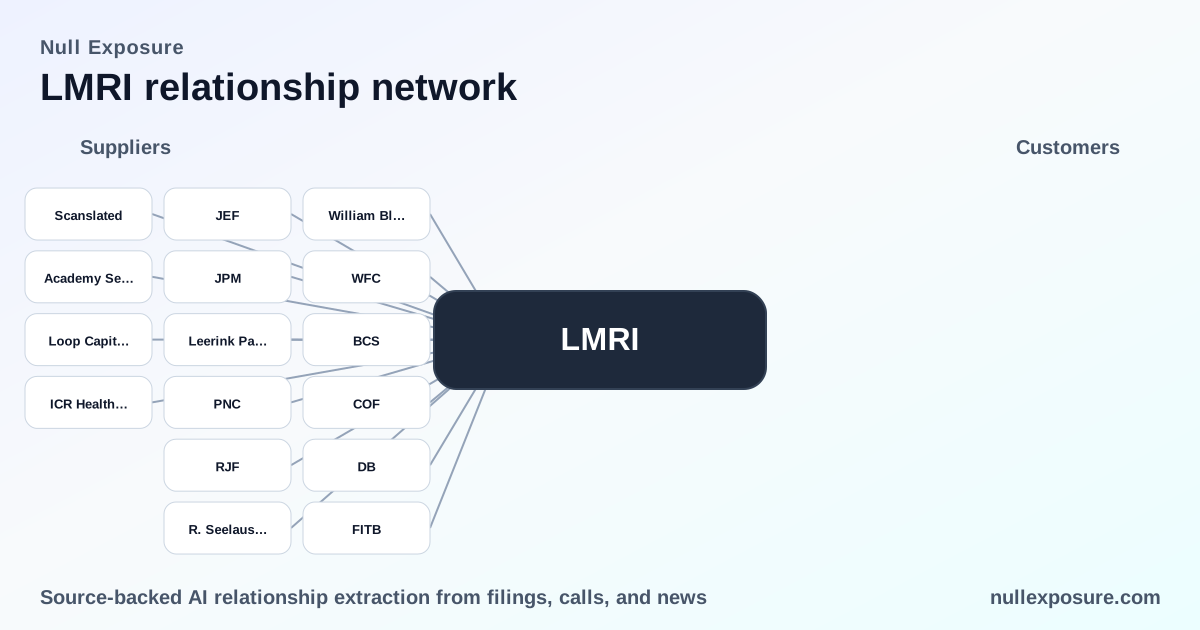
- Barclays — Identified as a joint lead book-running manager for Lumexa’s IPO, Barclays led alongside J.P. Morgan and Jefferies in the firm’s IPO syndicate (PR Newswire; Renaissance Capital, FY2025).
- J.P. Morgan — Named as a joint lead book-running manager, providing market-making and distribution capabilities to the offering (PR Newswire; Renaissance Capital, FY2025).
- Jefferies — Served as a joint lead book-running manager, rounding out the top tier of syndicate leadership (PR Newswire; Renaissance Capital, FY2025).
- Deutsche Bank / Deutsche Bank Securities — Listed among book-running managers on the IPO, contributing institutional distribution (PR Newswire; Renaissance Capital, FY2025).
- Wells Fargo Securities — Served as a book-running manager, supporting order flow and syndicate execution (PR Newswire; Renaissance Capital, FY2025).
- William Blair — Included as a bookrunner on the transaction, adding healthcare investment banking expertise to the syndicate (Renaissance Capital; PR Newswire, FY2025).
- Leerink Partners — Cited repeatedly as a bookrunner, reflecting specialized healthcare investment banking engagement (Renaissance Capital; PR Newswire, FY2025).
- Capital One Securities — Participated as a bookrunner, broadening the syndicate’s retail and institutional reach (Renaissance Capital; PR Newswire, FY2025).
- Fifth Third Securities — Named among the bookrunners, contributing regional distribution capacity (Renaissance Capital; PR Newswire, FY2025).
- Raymond James — Acted as a bookrunner on the deal and was also referenced in the IPO pricing announcement (Renaissance Capital; PR Newswire, FY2025).
- PNC Capital Markets / PNC Capital Markets LLC — Identified as a co-manager and co-participant, supporting syndicate execution (PR Newswire; Renaissance Capital, FY2025).
- Loop Capital Markets — Listed as a co-manager on the offering, adding diversity to retail and municipal channels (PR Newswire, FY2025).
- R. Seelaus & Co., LLC — Included as a co-manager, extending the co-manager layer of the syndicate and niche placement channels (PR Newswire, FY2025).
- Academy Securities — Named as a co-manager, further broadening distribution and compliance coverage for the transaction (PR Newswire, FY2025).
Each of these bank relationships is documented in Lumexa’s IPO communications and third‑party coverage; collectively they reflect a deliberate choice to spread underwriting across multiple experienced firms rather than relying on a single lead (Renaissance Capital and PR Newswire coverage, FY2025).
Technology and investor relations partners: targeted, mission-aligned suppliers
Lumexa’s non-bank supplier relationships complement the financing strategy with operational enablers.
- Scanslated — Lumexa uses Scanslated’s AI-driven software to translate radiology reports into patient-friendly language, supporting the company’s patient engagement and quality initiatives (SahmCapital / press release, Jan 2026).
- ICR Healthcare — ICR Healthcare is cited as Lumexa’s investor relations contact for investor conferences and communications, indicating a retained IR partner to manage public-market messaging and institutional outreach (PR Newswire; Futunn; Barchart, FY2026).
What these relationships imply about Lumexa’s operating model
With no explicit constraints filed, the relationship set itself functions as the signal set. From these supplier and syndicate choices, investors should infer the following company-level characteristics:
- Contracting posture: diversified and market-oriented. The use of a large syndicate plus multiple co-managers demonstrates an open, market-facing approach to capital raising rather than an exclusive bank dependency.
- Concentration: intentionally low on capital markets counterparties. The spread of bookrunners and co-managers reduces single-party counterparty risk for financing execution.
- Criticality: high for underwriting and IR; moderate-to-high for patient-tech vendors. Banks and IR advisors are critical to Lumexa’s immediate capital access and public-market liquidity, while specialized vendors like Scanslated are important to patient experience and retention.
- Maturity: transaction-level sophistication consistent with a company preparing for public ownership. The mix of national banks, specialty healthcare bankers, and retained IR firms signals organizational readiness for the governance and investor-relations demands of a public company.
Risks and investor considerations
- Execution risk on growth financing is concentrated around successful secondary market performance and continued access to institutional buyers despite a competitive healthcare IPO environment.
- Operational reliance on third-party patient-engagement tech elevates vendor management and integration execution as near-term priorities; failures here would impact patient satisfaction and referral economics.
- Reputational and compliance exposure increases when working with multiple co-managers and IR firms; consistent messaging and governance controls are essential.
Key takeaways for operators and investors:
- Underwriting depth reduces capital raising concentration risk.
- Patient-facing tech partnerships are strategic, not ancillary.
- Investor relations is outsourced to experienced firms, reflecting preparation for sustained public-market activity.
If you are building supplier diligence or preparing for a financing round, review Lumexa’s syndicate engagements and vendor contracts to benchmark your own counterparty diversification and operational dependencies. For deeper supplier-mapping and scenario planning, visit https://nullexposure.com/.
Conclusion and next steps
Lumexa’s supplier footprint is a purposeful blend of major investment banks and targeted service providers: a risk-managed capital strategy married to operational investments in patient experience. For investors, the most material monitorables are syndicate performance in aftermarket trading and vendor integration metrics that affect patient throughput and margins.
Explore a curated view of market relationships and prepare your own diligence framework at https://nullexposure.com/ to compare counterparties, contract structures, and supplier criticality across similar health-care service providers.