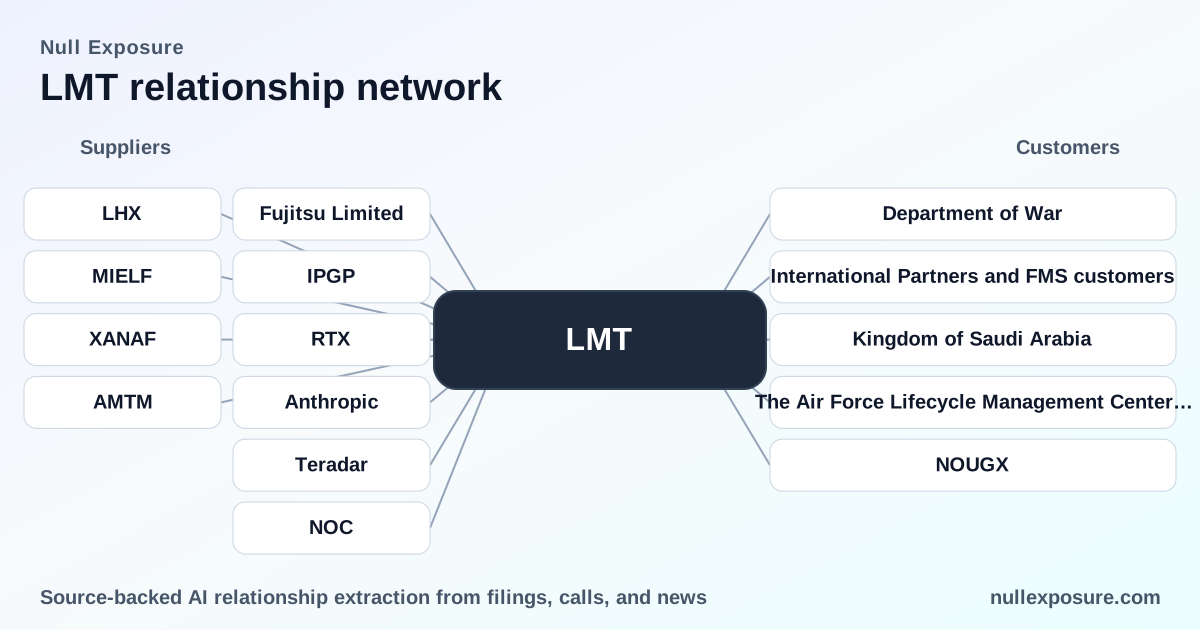
Lockheed Martin Supplier Map: Strategic Partners and Operational Constraints
Lockheed Martin is a prime defense contractor that designs, integrates and sustains large-scale weapons and aerospace systems and monetizes through long-term government contracts, follow‑on sustainment services, and targeted acquisitions that fold specialist capabilities into its platform business. The company’s revenue profile is driven by defense procurement cycles, fixed‑price and cost‑plus programs, and recurring aftermarket support that creates high visibility but also sensitivity to supplier continuity and component lead times. For a structured view of Lockheed’s supplier relationships and what they imply for operators and investors, visit https://nullexposure.com/.
The quick investor thesis: supply relationships are revenue enablers and risk levers
Lockheed operates as a systems integrator that depends on a tiered supplier base for critical components, sub‑systems and specialist services. Long-term contracting posture and program continuity reduce top-line volatility, but Lockheed’s FY2025 disclosures highlight material supplier constraints — shortages, extended lead times and pricing pressures — that have already affected program performance and will continue to influence margins and delivery timing in 2026. These supply dynamics are a company‑level signal: Lockheed is mature as a prime, highly integrated operationally, and concentrated in the defense market where a handful of suppliers supply mission‑critical sub‑systems.
Who Lockheed is working with now — relationship roll call and sources
Below I cover every supplier relationship surfaced in recent reporting and filings. Each entry is a concise, plain‑English summary with the cited source.
Fujitsu Limited
Lockheed formalized Fujitsu as a supplier to provide a key component for the SPY‑7 radar antenna fitted on Japan’s Aegis vessels, integrating Japanese IT/manufacturing into an allied naval radar program. Source: The Defense Post (Mar 2026).
Mitsubishi Electric
Lockheed and Mitsubishi Electric are partnering to supply anti‑jamming capability for Japan’s next‑generation geostationary defense communications satellite, reflecting cross‑border systems work on sensitive space programs. Source: The Defense Post (Mar 2026).
IPG Photonics Corporation (IPGP)
IPG Photonics received an order from Lockheed for the CROSSBOW™ high‑energy laser counter‑UAS systems, indicating Lockheed is sourcing directed‑energy subsystems from specialist laser manufacturers for counter‑drone roles. Source: IPG / Finviz reporting and Optics.org (Feb–Mar 2026).
RTX Corporation (RTX)
RTX operates as a dominant sub‑system supplier—engines and mission systems—even on platforms Lockheed does not build, which makes RTX a strategic sub‑tier supplier across multiple programs Lockheed primes or integrates. Source: FinancialContent/Markets commentary (Mar 2026).
Northrop Grumman Corporation (NOC)
Analyst commentary lists Northrop Grumman among suppliers that benefit from missile and payload demand, positioning it as a peer supplier in high‑end subsystems that feed into Lockheed programs. Source: Proactive Investors citing Jefferies (Mar 2026).
L3Harris Technologies Inc (LHX)
L3Harris is cited alongside Northrop as a supplier beneficiary in the current missile and defense spending environment, providing mission systems and electronics used across Lockheed platforms. Source: Proactive Investors citing Jefferies (Mar 2026).
IPG Photonics (duplicate mention)
Industry trade outlets confirm IPG’s deliveries of counter‑drone laser weapons to Lockheed, reinforcing the operational relationship for directed‑energy systems beyond the initial order announcement. Source: Optics.org (Mar 2026).
Anthropic
Lockheed announced plans to remove Anthropic’s Claude AI from certain operations following a Pentagon/administration policy ban, an operational change that aligns Lockheed with government policy but introduces short‑term vendor swap friction. Source: MarketBeat instant alert summarizing filings/news (Mar 2026).
Teradar
Lockheed has new partnerships involving terahertz sensing research that strengthen advanced sensor and analytics capabilities—an indicator of Lockheed’s investment in sensor differentiation through external research collaborations. Source: MarketBeat reporting (Mar 2026).
Xanadu
Xanadu is cited as a partner in quantum machine‑learning research with Lockheed, pointing to exploratory collaborations intended to seed long‑term differentiation in analytics and sensing. Source: MarketBeat reporting (Mar 2026).
Amentum (AMTM)
Lockheed paid $360 million in cash in Q2 2025 to acquire Amentum’s Rapid Solutions business, bringing previously outsourced rapid‑response capabilities in‑house and reflecting active M&A to internalize strategic services. Source: Lockheed Martin FY2025 Form 10‑K (filed 2026).
What the relationships collectively imply
These relationships show a deliberate strategy: buy or partner for specialized tech (lasers, sensors, quantum research), co‑develop with allied industrials for foreign programs, and acquire to internalize mission‑critical services. The mix of suppliers ranges from global primes (RTX, Northrop, L3Harris) to targeted specialists (IPG, Teradar, Xanadu) and allied OEMs (Fujitsu, Mitsubishi Electric). This combination supports Lockheed’s platform breadth while exposing the company to supplier lead‑time, geopolitical and policy risks.
Visit https://nullexposure.com/ for a deeper supplier exposure view and to track supplier shifts over time.
Operational constraints that drive investor decisions
Lockheed’s public disclosures frame several company‑level constraints that shape how suppliers and contracts affect performance:
- Materiality and program impact: Lockheed states supplier disruptions have led to parts shortages, longer lead times and higher prices that have already increased costs and delayed programs and are expected to continue into 2026 (company filing FY2025). This elevates supplier risk from tactical to strategic for earnings and delivery schedules.
- Reliance on external manufacturing and services: The company explicitly relies on other firms to provide materials, components and services across most contracts, indicating structural dependence on a diverse vendor base rather than vertical self‑sufficiency.
- Role complexity: Suppliers function as both manufacturers and service providers, meaning Lockheed’s supply relationships are multidimensional—component supply, system sub‑integration, and lifecycle sustainment—all of which carry different contractual and operational risk profiles.
Investment implications and a short checklist
Lockheed’s supply posture supports stable backlog and aftermarket revenue but makes margins and delivery timing sensitive to supplier execution. For investors and operators, prioritize monitoring:
- Supplier concentration on program‑critical items and single‑source risks.
- Policy and export dependencies when partnering with foreign OEMs on allied programs.
- Progress in internalizing capabilities via acquisitions (Amentum) versus continued external procurement.
Key items to watch:
- Backlog and margin sensitivity to supplier lead‑time commentary in next quarterly filings.
- Program‑level delivery schedules for Aegis/space and directed‑energy programs.
- Any further vendor displacements due to government AI/security policies.
Bottom line and next step
Lockheed leverages a hybrid strategy of partnership, purchase and acquisition to secure mission‑critical subsystems while accepting supply risk that is material to program performance. Investors should treat supplier developments as first‑order inputs to program timing and margin forecasts. For more supplier‑level intelligence and to see how these relationships evolve, go to https://nullexposure.com/.
If you want a supplier risk brief tailored to a specific Lockheed program or country program, check the homepage and request a focused analysis at https://nullexposure.com/.