Lunai Bioworks (LNAI) supplier map: what SRI and defense advisors reveal about risk and optionality
Lunai Bioworks operates as a clinical-stage biotechnology company that acquires and licenses early-stage intellectual property, funds targeted R&D, and augments its pipeline through strategic acquisitions; the commercial thesis is execution on licensed therapeutics and platform capabilities, with monetization coming from eventual product commercialization, sublicensing, and value created through M&A. Investors should value Lunai as a licensing-and-acquisition-led operator that relies on third-party research partners and advisory firms to convert IP into investable assets. For a consolidated supplier and counterparty view, visit https://nullexposure.com/.
What the disclosed relationships are and why they matter
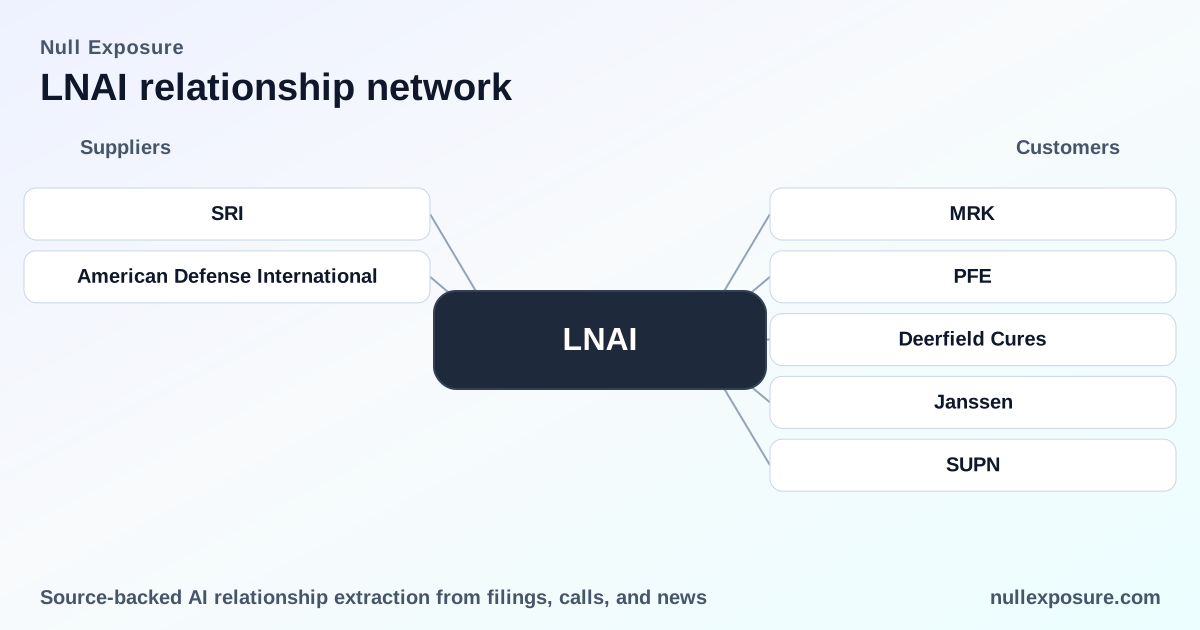
Lunai’s public filings and news coverage identify two distinct supplier/partner relationships in scope: an academic/non-profit licensor and a defense-focused advisory firm. Each relationship plays a different role for strategy execution — one in core R&D licensing and the other in government interfacing and program development.
- SRI — A $600,000 initial payment and ongoing research funding. According to Lunai’s FY2025 Form 10‑K (filed June 30, 2025), the company paid SRI $600,000 upfront and agreed to fund future HIV research conducted by the Licensors, establishing a funded research and licensing relationship that supports pipeline development. (FY2025 10‑K)
- American Defense International — Defense and government advisory services. A March 2026 industry article reported Lunai retained American Defense International, a Washington, D.C. advisory firm, as a consultant for defense initiatives and government partnerships, reflecting an explicit push to engage government channels and defense-related stakeholders. (TechS2, March 10, 2026)
How these relationships map to Lunai’s operating and business model
The public excerpts and constraints drawn from filings present a consistent operating profile: license-centric, third-party reliant, geographically diversified, and IP-critical. These characteristics drive risk, concentration dynamics, and contracting posture.
- Licensing is central. The company has executed perpetual, sublicensable, exclusive licenses (for example, the HBV License underlying an HBV treatment), which positions Lunai as a licensee that depends on licensed IP to underpin product strategies. These long-term license terms embed durable rights but also create single-source dependencies for key programs. (Company licensing disclosures, HBV License Agreement)
- Third parties perform core functions. Lunai regularly engages university labs, non-profits, CROs and CDMOs for R&D, clinical programs and manufacturing, signaling a contracting posture that outsources technical execution and relies on external providers for clinical advancement. This structure accelerates go-to-clinic timelines but concentrates operational execution off‑balance‑sheet. (FY2025 10‑K third‑party relationships)
- Geographic spread and acquisition-led growth. Filings document acquisitions and international supplier footprints — including targets in the United Kingdom and other non‑U.S. jurisdictions — indicating a geographically diversified supply base and inorganic growth strategy that brings integration risk alongside access to niche capabilities. (Stock Purchase Agreement with GEDi Cube Intl Ltd.; acquisition disclosures)
- IP is critical. Lunai explicitly identifies licensed intellectual property as critical to its business; loss or disruption of license agreements would materially impact the company’s rights and program viability. This elevates counterparty and contractual risk for any licensing counterpart. (Intellectual property risk disclosures)
- Spend scale is moderate. Reported changes in collaborating partner expenses (for example, a $1.35M decrease tied to CDMO/CRO work) place partner spend in the low‑single‑digit millions range, which is material enough to affect period P&L but not yet at the scale of large-cap biopharma outsourcing. (FY2025 R&D expense breakdown)
If you are mapping supplier risk across Lunai’s ecosystem for due diligence or credit purposes, review the public contract excerpts and counterparty names in detail at https://nullexposure.com/.
Relationship-by-relationship detail (concise investor view)
SRI — Lunai as licensee and funded research partner: The FY2025 10‑K records an initial payment of $600,000 to Seraph Research Institute (SRI) and a commitment to fund future HIV research conducted by the group of Licensors, making SRI both a licensor and an active research collaborator in Lunai’s pipeline development. (FY2025 Form 10‑K, June 30, 2025)
American Defense International — Government advisory retained: TechS2 reported that Lunai formed a Scientific Advisory Board and retained American Defense International to assist in navigating government partnerships and defense initiatives, signaling strategic intent to engage defense/government channels beyond commercial biotech routes. (TechS2, March 10, 2026)
Operational implications for investors and operators
Understanding these relationships yields four actionable implications for investors and operators:
- Counterparty concentration risk centers on IP licensors. Exclusive, perpetual licenses create single‑point dependencies; investors should evaluate termination provisions, milestone obligations, and sublicensing rights in underlying agreements.
- Execution risk is outsourced. Reliance on universities, non‑profits, CROs and CDMOs accelerates program timelines but transfers operational control; monitor partner performance, contractual SLAs, and contingency arrangements for critical experiments or GMP supply.
- Regulatory/government strategy is explicit and expanding. Retaining a D.C. advisory firm indicates Lunai is actively pursuing government partnerships or defense-sponsored R&D pathways, which can open non-dilutive funding but requires compliance infrastructure and program management.
- Spend and scale profile suggests stage sensitivity. Partner spend in the $1M–$10M band is meaningful to cash flow and R&D cadence; investors should model true‑up spend for clinical transitions and potential cost volatility from contract changes.
Key investor checklist: review license language for termination and indemnity, validate CRO/CDMO performance history, and assess the commercial runway given current partner spend and acquisition liabilities.
Final assessment and next steps
Lunai’s supplier relationships reveal a classic small‑cap biotech structure: strategic licensing for proprietary IP, pragmatic outsourcing for execution, and external advisors to access government channels. The critical exposure is contractual: licensed IP and third‑party execution are the levers that determine whether the company can convert R&D investments into value creation. For a deeper supplier and counterparty risk map, visit https://nullexposure.com/ and review consolidated supplier signals.
If you are performing commercial or credit diligence, focus on license terms, counterparty performance metrics, and any cross‑border integration risks introduced by recent acquisitions. For an investor-ready supplier risk report and ongoing monitoring, see the firm overview at https://nullexposure.com/.