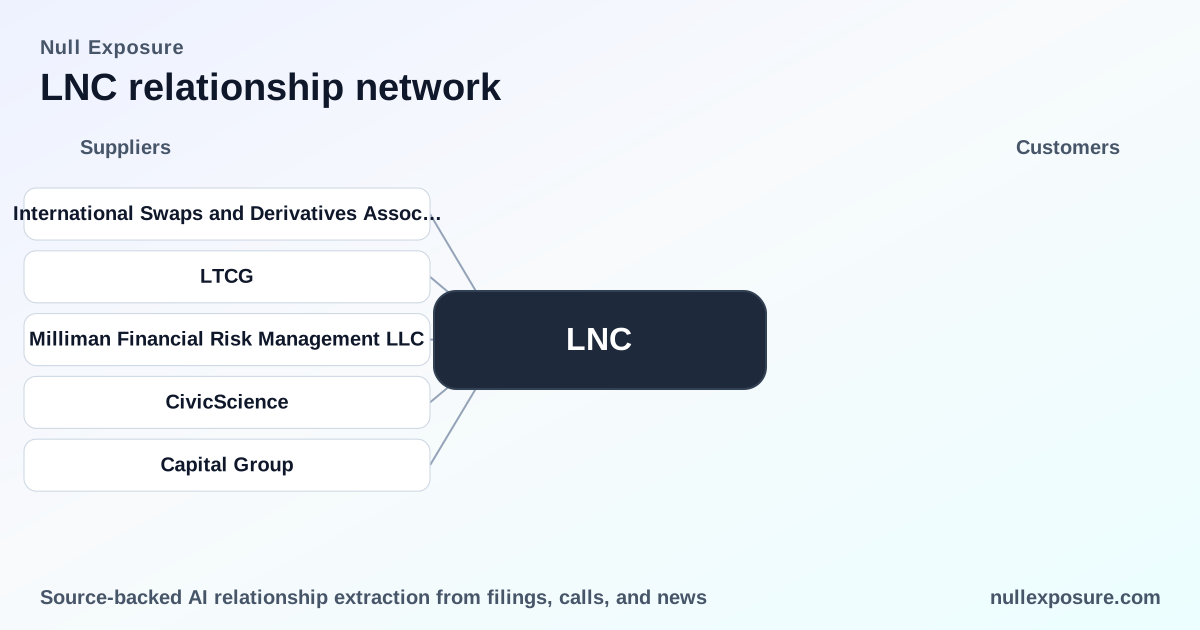
Lincoln National (LNC): the supplier relationships that shape capital, risk transfer and distribution
Lincoln National Corporation runs a diversified life insurance and retirement services franchise and monetizes through three core channels: insurance underwriting and annuity spread, fee-based investment management, and risk transfer via reinsurance and derivatives. Supplier relationships fall into two strategic buckets for investors: those that expand product distribution and investment capability, and those that manage balance‑sheet risk and liquidity. Understanding both sets is central to evaluating LNC’s margin sustainability and capital efficiency.
Explore more supplier intelligence at https://nullexposure.com/.
How Lincoln uses partners to push and protect earnings
Lincoln sells life and annuity products through its distribution and retirement channels while running an asset‑intensive investment program to back guarantees. That dual role creates two supplier imperatives: (1) partners that enhance product offer economics (sub‑advisors, index providers, research firms), and (2) counterparties that reduce capital volatility (reinsurers, derivative frameworks, bank lenders). Lincoln monetizes by collecting premiums and fees and capturing investment spread; suppliers either lift yield/volume or reduce required capital against guarantees. These relationships therefore directly affect both the numerator (earnings) and denominator (regulatory capital) of shareholder returns.
Who Lincoln contracts with — the relationships you need to track
Below I list every supplier relationship disclosed in our coverage set, with a concise plain‑English description and the documentary source.
International Swaps and Derivatives Association (ISDA)
Lincoln requires that its derivative contracts be governed by an ISDA Master Agreement, a standard legal framework used to manage counterparty credit and netting for interest rate and hedging transactions. According to Lincoln’s FY2024 10‑K filing, this is company policy for derivatives documentation. (Source: LNC 2024 Form 10‑K)
LTCG (long‑term care group)
LTCG designed and implemented Lincoln’s What Care Costs survey, a research and long‑term‑care administration collaboration that supports product positioning and market intelligence for LTC solutions. The engagement was referenced in a Lincoln press release reported via ADVFN in March 2026. (Source: company release reported on ADVFN, Mar 2026)
Milliman Financial Risk Management LLC
Milliman is the sub‑advisor for Lincoln Defined Outcome Funds, providing defined‑outcome solutions expertise used in Lincoln’s structured/defined outcome investment products. Milliman’s actuarial and risk modeling capabilities underpin the portfolio design and hedging rules for these funds, according to Lincoln’s product announcement referenced in March 2026 coverage. (Source: Lincoln product announcement reported on ADVFN, Mar 2026)
CivicScience
Lincoln partnered with CivicScience to build the Consumer Retirement Index, a sentiment and consumer behavior tool used to inform retirement product marketing and distribution strategy. The partnership and launch were flagged by Lincoln in April 2025 coverage. (Source: Lincoln press coverage, Apr 2025)
Capital Group
Capital Group provides index exposure used in new Capital Group ETF indexed accounts sold through Lincoln’s fixed indexed annuity wrapper, pairing upside equity exposure with principal protection mechanics. This product collaboration was discussed in industry commentary and valuation notes in 2025. (Source: industry coverage via Simply Wall St, 2025)
What the supplier picture reveals about Lincoln’s operating model
Taken together, these relationships illuminate Lincoln’s contracting posture and strategic priorities.
- Framework contracting for financial risk: The explicit ISDA requirement signals disciplined documentation for derivatives and hedging — a mature, risk‑averse contracting stance for managing market exposures. (Company signal from FY2024 10‑K)
- Large‑enterprise reinsurance counterparties and concentration: Lincoln relies on sizable reinsurers (evidence elsewhere in filings) and enforces high ratings for new reinsurers, indicating high criticality and deliberate counterparty selection to protect capital metrics.
- North American operational footprint: Office ownership and leases concentrated in U.S. states (PA, IN, NC, NE, NH) indicate a domestically focused operations base with likely supplier networks built around North American service providers and vendors.
- Long‑term funding posture: Lincoln’s unsecured five‑year credit agreement allowing up to $2.0 billion of commitments through December 21, 2028, demonstrates multi‑year liquidity planning and the use of committed bank facilities as backstop liquidity rather than short‑term repo reliance. (Company-level signal from credit agreement disclosure)
- Buyer and service‑provider roles: Lincoln operates both as a buyer of third‑party services (for administration, analytics, sub‑advisory) and as a counterparty that purchases reinsurance and hedging — a dual role that increases the complexity of supplier governance and third‑party security requirements.
- Active lifecycle management: Supplier security assessments and periodic reassessments are formalized, indicating active vendor risk management rather than passive contracting. This is consistent with a regulated insurer that must control third‑party cyber and operational risk.
These are company‑level operational signals unless a constraint specifically names a relationship; the ISDA framework is one such explicit mapping to a named relationship.
If you want a structured supplier risk profile for Lincoln or comparable insurers, see authoritative supplier intelligence at https://nullexposure.com/.
Investment implications and a concise risk checklist
Lincoln’s supplier ecosystem supports product innovation (Capital Group, Milliman) and consumer insight (CivicScience, LTCG) while preserving capital through formal hedging and reinsurance arrangements. That combination explains why Lincoln trades with a low price‑to‑book and compressed P/E metrics relative to growth peers — the stock is a capital‑intensive, spread‑driven business with visible downside protection through counterparties.
Key takeaways for investors:
- Upside driver: Sub‑advisory and index relationships enable product diversification (defined outcome and indexed annuities) that can expand fee pools and premium flows.
- Downside mitigant: ISDA governance, conservative reinsurance underwriting criteria, and a multiyear credit facility reduce balance‑sheet volatility and protect statutory capital.
- Operational risk: Concentrated U.S. footprint and high dependency on large enterprise reinsurers create counterparty concentration risk that warrants monitoring.
Checklist:
- Confirm counterparty ratings and collateral terms for major reinsurers.
- Track hedging counterparties and ISDA netting sets in the 10‑K and quarterly filings.
- Monitor product rollouts that use sub‑advisors to assess fee capture and margin resilience.
For a deeper supplier risk profile and to benchmark LNC against peer relationships, check Lincoln supplier coverage at https://nullexposure.com/.
Next steps for operators and sourcing teams
Operators evaluating LNC as a counterparty should prioritize proof of robust ISDA master agreements, clarity on reinsurance attachment points (retention limits and collateralization), and documented vendor security assessment processes. Suppliers pursuing business with Lincoln should expect formal security reviews, long‑term contracting horizons for critical services, and a preference for large‑enterprise counterparties with strong ratings.
If you want tailored supplier due diligence or comparative supplier intelligence for financial services relationships, visit https://nullexposure.com/ for licensing and engagement options.
Bold relationships, disciplined contracting and active risk governance are the themes that will determine whether Lincoln converts supplier partnerships into durable, capital‑efficient growth.