LNKS: What the IPO-era supplier map reveals about capital access and execution risk
Linkers Industries Limited (LNKS) monetizes through its underlying operating business while relying on capital markets to fund growth and liquidity; the supplier relationships tied to its FY2024 offering show a transactional, capital-markets-first supplier posture where legal counsel and underwriters are the critical external vendors enabling public listing and access to institutional capital. For investors, the supplier set signals execution competence on capital raises but limited evidence of broad, long-term vendor dependency—an important distinction when modeling operating leverage and counterparty risk. Visit the Nillexposure homepage for deeper supplier intelligence: https://nullexposure.com/
A compact supplier map driven by the IPO
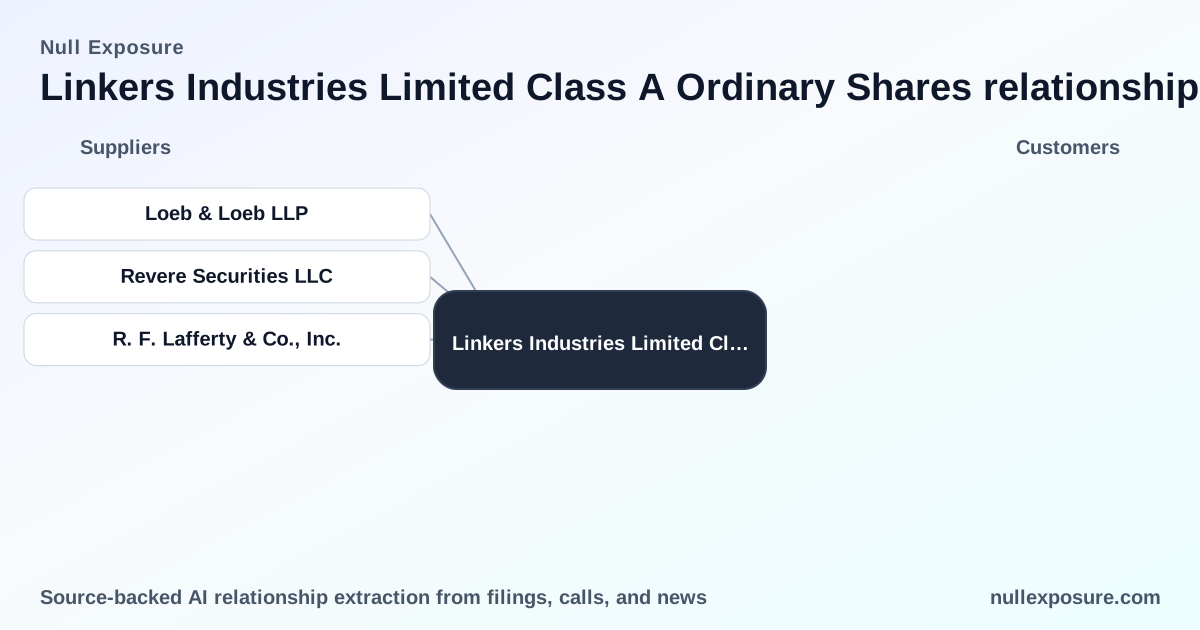
The public record for LNKS in FY2024 centers on the closing of an initial public offering. The relationships disclosed are exclusively capital-markets services: U.S. legal counsel and underwriters. That concentration around a single transaction points to a transactional supplier architecture during the IPO window rather than a diversified, operational vendor ecosystem disclosed in filings.
- Capital markets services are critical and time-sensitive. Underwriters and legal counsel directly affect pricing, timing, and regulatory compliance for the listing.
- Supplier concentration is high for the specific function of capital raising, but not necessarily indicative of wider operational concentration. There is no public evidence here of long-term operational suppliers such as manufacturing, logistics, or IT vendors.
If you want structured supplier risk summaries for comparable situations or historical tracking, Nillexposure maintains relevant profiles and alerts: https://nullexposure.com/
What the relationships are — plain-English snapshots
Loeb & Loeb LLP
Loeb & Loeb LLP acted as U.S. legal counsel to Linkers Industries Limited for the offering, providing the transactional and regulatory legal services required to complete a U.S.-facing IPO process. According to a FinancialContent report covering the company’s FY2024 offering, Loeb & Loeb served as the company’s U.S. counsel in the transaction (news article dated December 6, 2024).
R. F. Lafferty & Co., Inc.
R. F. Lafferty & Co., Inc. served as the representative of the underwriters for the offering, taking the lead role in coordinating bookbuilding and allocation in the underwriting syndicate. A FinancialContent article on the closing of the IPO lists R. F. Lafferty as the underwriters’ representative for the FY2024 offering (publication December 6, 2024).
Revere Securities LLC
Revere Securities LLC participated as a co‑underwriter in the syndicate that managed LNKS’s offering, supporting distribution to institutional and retail channels alongside the representative underwriter. The same FinancialContent notice on the IPO’s closing names Revere Securities as a co‑underwriter in FY2024 (reported December 6, 2024).
What these supplier facts imply about LNKS’s operating model and risk posture
Absent constraints explicitly named in the record, the supplier evidence generates a set of company-level signals relevant for valuation, diligence, and operational forecasting:
- Contracting posture — transactional and event-driven. The vendor relationships disclosed are classic, short-duration capital-markets engagements rather than long-term operational partnerships; the company contracted specialized firms to complete an IPO transaction.
- Concentration — high for capital markets activities, low apparent for broad operations. The record shows reliance on a small set of specialized providers to access public capital, creating concentration risk in the fundraising channel until the company establishes a broader supplier footprint or recurring service agreements.
- Criticality — underwriters and counsel are mission-critical for liquidity events. For any near-term financing or secondary offerings, these categories of suppliers materially affect timing, regulatory exposure, and cost of capital.
- Maturity — transitioning toward public-company governance. The engagement of U.S. legal counsel and a syndicate of underwriters is consistent with a firm moving from private to public status, signaling evolving vendor demands (investor relations, compliance, auditing) and higher fixed costs in governance.
- Predictability — event-driven costs, uncertain recurring commitments. The transactional nature of these relationships suggests an operating model where professional services costs spike around financings rather than producing predictable ongoing liabilities.
These signals should be reflected in cash flow modeling (lumpy corporate finance expense), governance risk premiums, and scenarios for follow-on capital raises.
Risk implications for investors and operators
- Execution risk is concentrated around future capital raises. If LNKS needs additional capital before operations generate sustainable free cash flow, it will depend again on a narrow supplier class (underwriters, legal counsel), which can influence cost and timing.
- Regulatory and disclosure risk increases with public status. The involvement of U.S. counsel implies cross‑jurisdictional compliance requirements and potential increases in legal and compliance spend.
- Limited transparency on operational suppliers. The current public trail does not reveal recurring vendors for production, distribution, or technology; investors should treat operating-supplier exposure as an open diligence item.
For a tailored supplier risk assessment or to track how these relationships evolve, access Nillexposure’s supplier intelligence tools: https://nullexposure.com/
Investment takeaway and next steps
Linkers Industries’ FY2024 supplier footprint tells a focused story: the company secured the professional services necessary to complete a U.S.-facing IPO, with legal counsel and a small underwriting syndicate carrying the transaction. That structure is normal for a company at this stage, but it implies that near-term valuation sensitivity centers on successful execution of public-company transitions and any subsequent capital raises.
Actionable steps for investors:
- Confirm whether LNKS has established longer-term vendor contracts beyond the IPO engagements, particularly for operations and technology.
- Monitor follow-on financing activity and underwriter selection; changes in syndicate composition or pricing will signal market appetite.
- Incorporate event-driven professional services spend and potential governance cost increases into forward cash flow scenarios.
For ongoing monitoring and to receive alerts when LNKS adds or changes critical suppliers, visit Nillexposure: https://nullexposure.com/
Bold, precise supplier intelligence shortens the pathway from data to investment decision. Use the supplier map above to refine your thesis and prioritize due diligence on financing execution and operational supplier disclosure.