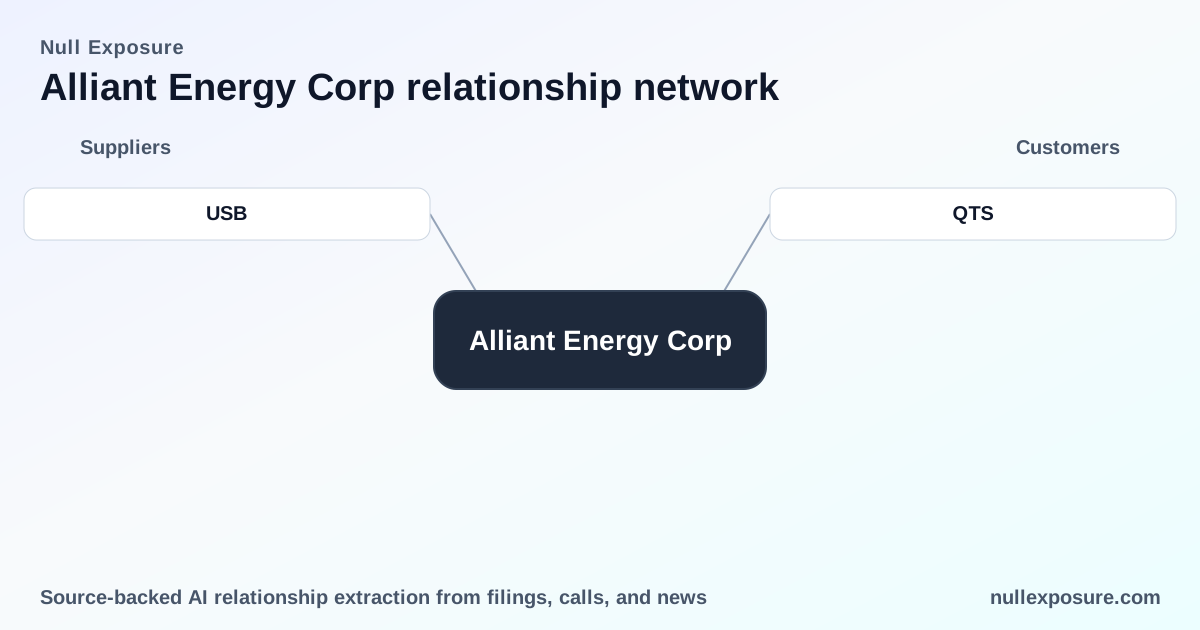
Alliant Energy (LNT) — supplier relationships and what they mean for investors
Alliant Energy is a regulated utility that delivers electricity and gas across Wisconsin and Iowa and monetizes through rate-regulated energy delivery, capital spending on generation and networks, and finance arrangements that support working capital and project investment. For investors and operators evaluating Alliant’s supplier posture, the crucial considerations are the company’s reliance on bank-lending facilities for liquidity, and a geographically diversified fuel procurement strategy that underpins generation. Understanding the bank counterparty footprint and the structure of fuel purchase agreements is central to assessing short‑term liquidity and long‑term operational resilience.
Explore Alliant’s supplier footprint at https://nullexposure.com/ for a full map of counterparties and documented contracts.
The headline lending relationship you need to know
A market report in March 2026 recorded that U.S. Bank is acting as Administrative Agent on a $400 million term loan to Alliant, with a $100 million incremental option, alongside other lenders (TradingView, 2026). This is a bank-administered syndicated facility rather than bilateral debt, which bolsters short-term liquidity and provides optional capacity to fund capital requirements or working capital.
Why the U.S. Bank facility matters for credit and operations
- The presence of an administrative agent and a syndicate structure signals standardized bank documentation and shared lender exposure, which lowers single‑lender concentration risk and improves access to committed funding.
- A term loan plus an incremental option gives Alliant flexible balance-sheet capacity: the incremental tranche is typical for utilities managing construction or fuel-supply cash flow timing without immediately increasing permanent leverage.
A full report from TradingView is available here: https://www.tradingview.com/news/tradingview:70a8c454d7cdc:0-alliant-energy-secures-400-million-term-loan-adds-100-million-incremental-option-with-u-s-bank/ (TradingView, 2026).
Relationship inventory — every supplier relationship in the current results
This compilation covers the supplier relationships surfaced in the supplied results; below is a plain-English summary of each record and its source.
- U.S. Bank — U.S. Bank is listed as Administrative Agent on a $400 million term loan to Alliant Energy with a $100 million incremental option and participation by other lenders, evidencing a syndicated bank facility supporting Alliant’s liquidity (TradingView report, March 2026: https://www.tradingview.com/news/tradingview:70a8c454d7cdc:0-alliant-energy-secures-400-million-term-loan-adds-100-million-incremental-option-with-u-s-bank/).
Company-level supplier constraints and what they signal for operations
The documented constraint in the supplier feed notes that “IPL and WPL maintain purchase agreements with numerous suppliers of natural gas from various gas producing regions of the U.S. and Canada.” This is a company-level signal that carries several operational implications:
- Geographic diversification of fuel supply is explicit: procurement spans U.S. and Canadian producing regions, which reduces single-region sourcing risk but increases logistical complexity and counterparty management overhead.
- Contracting posture: the language implies long-form purchase agreements rather than spot-only exposure, which suggests reliance on contractual commitments to secure fuel for generation and reduces volatility in fuel availability.
- Concentration and criticality: while supply is diversified geographically, generation units (IPL/WPL) are dependent on continuous gas deliveries; thus suppliers are operationally critical even if individually dispersed.
- Maturity and predictability: purchase agreements imply multi-year commitments that support modeling of fuel costs and dispatch planning, improving predictability for rate cases and capital planning.
These constraints are company-level signals and are not assigned to any single listed bank or lender.
Explore supplier signals and constraint analytics in more depth at https://nullexposure.com/ — the supplier map and constraint overlays give immediate context for counterparties and commodity sourcing.
How this fits into Alliant’s financial profile
Alliant’s regulated revenue base and investment profile shape the way supplier relationships affect value:
- Stable cash flow under regulation (Revenue TTM ≈ $4.36B, Profit Margin ≈ 18.6%) supports bank access and term facilities, enabling capital projects without forcing high-cost capital raises.
- Leverage and liquidity management: syndicated bank lending provides a flexible, lower-cost complement to capital markets, and the administrative‑agent structure observed with U.S. Bank aligns with standard utility finance practice.
- Operational sensitivity to fuel contracts: fuel purchase agreements indexed to diverse producing regions smooth procurement risk but keep the company exposed to regional pipeline constraints and cross-border logistics.
Investor takeaways and risks to monitor
- Key positive: The U.S. Bank‑led syndicated term loan increases committed liquidity and demonstrates continued access to bank markets — a credit-positive in the near term.
- Key operational signal: The company’s procurement of natural gas from multiple U.S. and Canadian regions indicates supply diversification, which reduces single-market shocks but requires disciplined contract and pipeline management.
- Key risk: Counterparty disruption in gas supply chains or deterioration in bank market appetite for utility credit could compress liquidity if not offset by rate recovery mechanisms.
For active investors and operators, track these items quarterly: lender group composition and facility covenants, changes to purchase agreement counterparties or geography, and regulatory outcomes that change rate recovery mechanics.
If you are benchmarking supplier exposure or building counterparty scorecards, see the full supplier mapping at https://nullexposure.com/ for source-linked documentation and constraint overlays.
Final assessment
Alliant’s supplier picture in this dataset is straightforward: bank-administered liquidity paired with geographically diversified fuel purchase agreements. For investors, that combination supports operational continuity and moderated credit risk, provided Alliant maintains access to banking markets and its fuel contracts remain intact and well-managed. Monitor bank facility rollovers and any shifts in the geographic mix of fuel suppliers as leading indicators of liquidity or operational stress.
For a deeper read and a supplier-level view tailored to underwriting or risk analysis, consult the full portal at https://nullexposure.com/ — the supplier maps and constraint analytics are built for exactly this type of diligence.