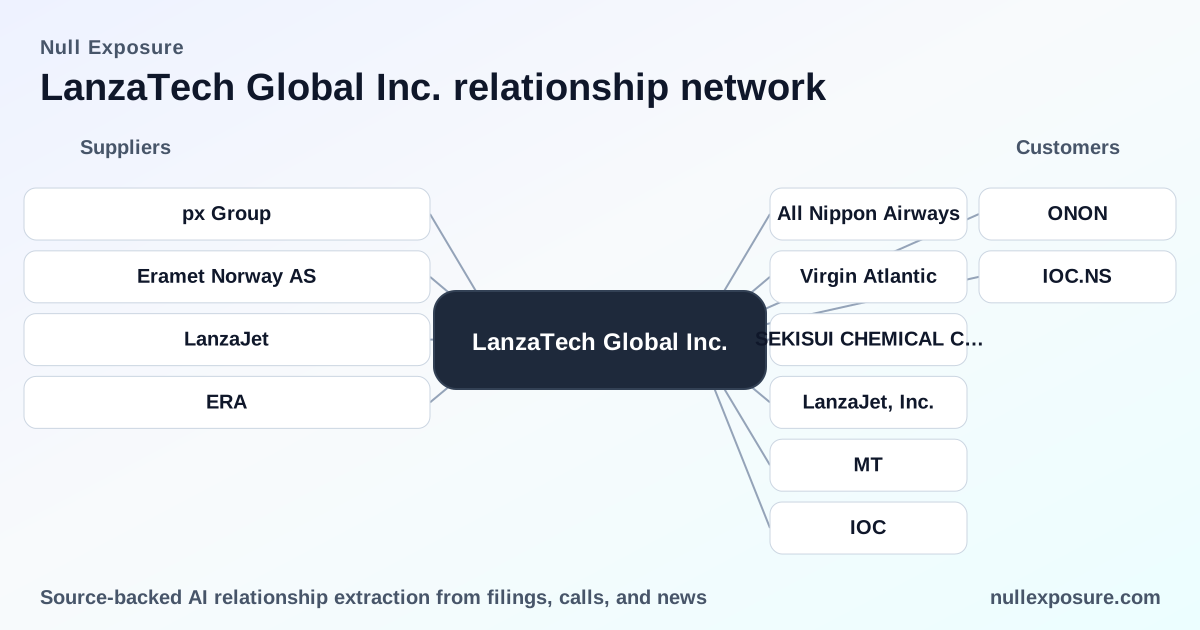
LanzaTech (LNZA) supplier relationships: where the company sources scale and how partners shape execution
LanzaTech operates by converting industrial off-gases into commercial ethanol and downstream sustainable aviation fuel (SAF) feedstocks. The company monetizes through a mix of product sales of CarbonSmart ethanol and derivatives, project development and site partnerships that embed its second‑generation bioreactors into industrial complexes, and licensing/technology partnerships that accelerate deployment. Investor focus should be on partner selection and site infrastructure, because these determine feedstock access, scale economics, and route-to-market for higher-margin SAF conversions. For a focused view of supplier and partner exposure, visit https://nullexposure.com/.
Why partners matter for LNZA’s margins and growth
LanzaTech’s business model is project-centric: each commercial step requires a host site with suitable waste gas streams or integration into a chemicals park for SAF production. That creates concentrated counterparty risk and a contracting posture that favors long-term site agreements and joint development. The firm also purchases ethanol from adopters of its technology and packages it as CarbonSmart product—this buyer role introduces an additional commercial loop where LanzaTech both empowers and transacts with the same commercial ecosystem. This behavior is a company-level signal: the firm is simultaneously technology supplier, offtaker, and marketer rather than just a licensor.
- Concentration: Growth depends on a handful of industrial-scale sites and strategic park relationships.
- Criticality: Host-site infrastructure (pipelines, storage, hydrogen access) is critical to economics and timeline.
- Maturity: LanzaTech is moving into early commercial deployments of second‑generation bioreactors, so projects carry execution and scale-up risk.
Explore partner-level intelligence and supplier mapping at https://nullexposure.com/.
Project and partner roll call — what the public record shows
Below are the relationships captured in recent coverage, with concise, plain-English summaries and source context.
px Group / Saltend Chemicals Park — strategic host for DRAGON II (Humberside)
LanzaTech selected px Saltend Chemicals Park as the home for the DRAGON II sustainable aviation fuel project because the park provides the necessary infrastructure for SAF production and future hydrogen and CO2 pipeline connections, and px’s operational skills are a strong fit with LanzaTech’s deployment needs. This site selection is central to the company’s UK SAF ambitions and signals reliance on integrated chemical-park partners for scale. Coverage included press releases reported in FY2026 by outlets including The Manila Times and Yahoo Finance and was summarized in QuiverQuant’s project announcement in March 2026.
LanzaJet — technology integration partner for SAF production
LanzaTech will pair its carbon‑recycling technology with LanzaJet’s SAF conversion process to deliver finished aviation fuel at Saltend, combining upstream ethanol production with downstream fuel synthesis capabilities. This partnership shows a deliberate vertical integration strategy—linking feedstock production to SAF conversion with a named industry partner—reported in FY2026 press coverage by QuiverQuant and The Manila Times.
Eramet Norway AS — first commercial deployment of second‑generation bioreactor and CCUS integration
LanzaTech’s Norway project will consume furnace greenhouse gases from the Porsgrunn Manganese Smelter operated by Eramet Norway AS to produce ethanol using the company’s second‑generation bioreactor; the project also secured an EU Innovation Fund grant. This engagement represents a commercialization step for the new bioreactor design and leverages a large industrial emitter as the feedstock source, as described in company filings and press reports around FY2025 in The Globe and Mail and FinancialContent.
How these relationships translate into operational constraints and risk
These public relationships point to several concrete operating characteristics that matter for investors:
- Contracting posture: LanzaTech structures relationships around site selection and integrated projects rather than pure licensing. That increases deal complexity and execution risk but preserves upside if throughput targets and SAF synthesis are achieved.
- Concentration and counterparty dependency: A small number of large industrial parks and corporate partners will materially determine throughput and revenue ramping; delays or operational issues at any named site can have outsized financial impact.
- Critical infrastructure dependency: Successful SAF economics require access to hydrogen, CO2 handling, storage and pipeline connectivity—features emphasized in the Saltend selection—and these are not controllable by LanzaTech alone.
- Commercial maturity: The Norway engagement represents a first commercial deployment of a second‑generation reactor, so the firm is transitioning from demonstration to early commercial scale with attendant operational risk and learning curves.
These are company-level signals drawn from public disclosures and press accounts; they do not assign constraint excerpts to a single counterparty unless the excerpt names them.
Investment implications and upside/downside paths
- Upside: If Saltend and Norway projects reach design throughput, LanzaTech converts technology leadership into recurring product sales and SAF feedstock economics, improving margin profile and validating repeatable project templates. The combination with LanzaJet is a positive sign of integrated value capture for SAF.
- Downside: Execution risk is front and center—project delays, infrastructure gaps, or underperformance in first commercial reactors will throttle revenue and heighten capital needs. Concentration of supply partners raises downside volatility relative to broad-based licensors.
- Catalysts to watch: construction milestones at Saltend, first ethanol output from the Eramet site, regulatory approvals for SAF production, and any further long‑term offtake agreements for CarbonSmart ethanol.
For deeper counterparty analysis and to track supplier concentration in real time, visit https://nullexposure.com/.
Practical takeaway for operators and investors
- Partners are not ancillary — they are the business. LanzaTech’s economics hinge on host-site infrastructure and named partners that provide feedstock, storage and downstream conversion capability.
- Treat early commercial projects as execution bets with high information value; success de-risks rollouts and improves valuation multiples, while setbacks amplify capital consumption risk.
- Monitor policy and grant flows that can materially shift project economics, as demonstrated by the EU Innovation Fund support for the Norway project.
Concluding: LanzaTech has structured its model to capture value from both technology deployment and product sales, but the path to durable margins depends on successful, timely execution of a few major partner projects and the maturation of second‑generation bioreactors. For continuing coverage and supplier-level exposure insights, see https://nullexposure.com/.