Manhattan Bridge Capital (LOAN): Banking relationships that underwrite growth and risk
Manhattan Bridge Capital (LOAN) operates as a mortgage-finance and specialty lending platform that funds originations and portfolio carry through committed bank credit lines and note issuances; it monetizes by capturing net interest spreads on held loans and by managing capital structure via secured notes and revolving facilities. The company's operating model is tightly integrated with a small group of commercial banks whose credit lines supply working capital and collateralized leverage for mortgage assets, making those banking relationships central to liquidity and execution.
If you want ongoing, structured coverage of counterparty exposures and supplier relationships, visit the Null Exposure homepage: https://nullexposure.com/
Why these bank ties matter for investors
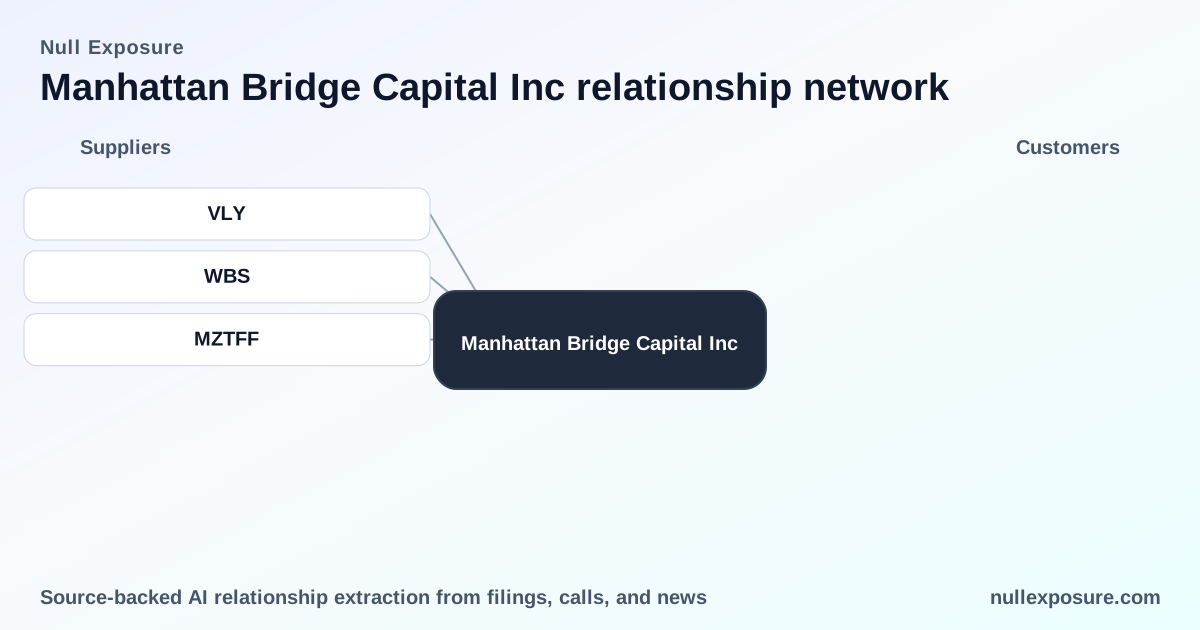
Manhattan Bridge runs a concentrated funding model where a handful of lenders provide revolving, collateralized credit that supports loan originations and balance-sheet flexibility. The public disclosures and news reporting show three relevant bank relationships and a clear credit-line architecture: a $32.5 million aggregated credit facility originally provided by Webster Business Credit Corporation, Flushing Bank and Mizrahi Tefahot Bank, supplemented by other bilateral lines such as a $10 million facility under a related MBC subsidiary.
- Contracting posture and maturity: The credit arrangements are structured as multi-bank revolving facilities with explicit expiration dates (the Webster facility is documented through February 28, 2026), which creates a defined refinancing horizon and requires active management of lender relationships.
- Concentration and spend band: Facility capacity and outstanding balances place the company clearly in the $10m–$100m funding band; at year-end 2024, $16,427,874 was outstanding under the Webster credit line, against a $32.5 million aggregate commitment. This is a material, not trivial, dependence on bank-provided liquidity (company filing, Dec 31, 2024).
- Criticality and role: The banks function as service providers—they supply secured, asset-backed credit and collateral enforcement mechanics that are core to the business model rather than peripheral vendor services.
- Global counterparty footprint: The lender group includes a foreign institution (Mizrahi Tefahot Bank Ltd.), establishing an international element to the counterparty mix and operational oversight requirements.
If you want to cross-check these lender exposures quickly, go to https://nullexposure.com/ for consolidated sourcing and relationship maps.
The relationships you need on your watchlist
Webster Bank — the anchor revolver and active lender
Webster Bank is the primary administrative lender under an Amended and Restated Credit and Security Agreement that supports the Webster Credit Line; the company increased the principal on a Second Amended and Restated Revolving Credit Note to $22.5 million from $15.0 million, reflecting an upsizing of Webster’s paper in early 2026 coverage. A TradingView report covering company filings in FY2026 documents this upsizing and extension activity. (TradingView, FY2026)
Mizrahi Tefahot Bank — international lender that reallocated commitments
Mizrahi Tefahot Bank is named in company disclosures as a participant in the $32.5 million syndicated credit line; news reporting notes Mizrahi’s departure from the lender group, with commitments reallocated among the remaining lenders as the revolving facility was extended through March 31, 2026, a structural change that affects lender concentration and allocation. (TradingView, FY2026)
Valley National Bank — a subsidiary-level bilateral line
MBC Funding II, a Manhattan Bridge Capital subsidiary, secured a $10 million line of credit from Valley National Bank on December 12, 2025, providing a discrete source of secured working capital for that funding vehicle. This was disclosed in a press release reported by The Globe and Mail. (The Globe and Mail press release, Dec 12, 2025)
What these relationships imply for liquidity and risk
The mix of a mid-sized syndicated facility plus subsidiary bilateral lines creates a hybrid funding posture: committed but finite bank liquidity that requires rollover or replacement before contractual expiration. The Webster group’s facility—documented as a $32.5 million aggregate line secured by assignments of mortgages and other collateral—functions as the core revolver for balance-sheet activity (company filing language). The presence of an outstanding balance of roughly $16.4 million at year-end 2024 under the Webster facility is an explicit indicator of utilization and funding dependence (company filing, Dec 31, 2024).
Because one lender (Mizrahi) exited the group and the facility was reallocated, investors should treat borrower-lender dynamics as an active vector for funding volatility: reallocations change concentration and operational covenants, and upsizing/downsizing actions by Webster demonstrate the lenders’ material influence on available liquidity (TradingView, FY2026).
Short, actionable investor checklist
- Monitor the covenant schedule and the Feb 28, 2026 / Mar 31, 2026 maturity windows for the syndicated revolver; these dates set the next refinancing milestones and are central to near-term liquidity risk management. (company filing / TradingView coverage)
- Track outstanding utilization against the $32.5 million aggregate commitment; the $16.4 million outstanding figure reported at Dec 31, 2024 illustrates meaningful but not full utilization, leaving capacity that can be drawn or returned depending on operations. (company filing, Dec 31, 2024)
- Watch lender composition changes: Mizrahi’s departure and Webster’s upsizing shift counterparty concentration and require reassessment of operational and jurisdictional exposures. (TradingView, FY2026)
For a consolidated view of LOAN’s supplier and counterparty exposure, visit the Null Exposure homepage: https://nullexposure.com/
Final takeaways for investors and operators
- Bank credit lines are central to LOAN’s funding model; they are secured, active, and sized in the mid-double-digit millions. This makes proactive lender management a core operational competency for the company.
- Maturity clustering around early 2026 creates a clear refinancing timeline; successful portfolio execution depends on predictable access to these credited facilities or credible alternatives.
- Changes in lender composition are material—the reallocation after Mizrahi’s exit and Webster’s note upsizing materially alter counterparty concentration and should be priced into risk assessments.
If you want a structured counterparty map and ongoing alerts for these relationships, go to https://nullexposure.com/ for direct access and analyst-ready summaries.