Loar Holdings (LOAR): What the lender relationships reveal about financing strategy and operational leverage
Loar Holdings operates as a diversified investment and holding company that monetizes through asset acquisition, operational management, and portfolio-level cash flow optimization across technology and real estate. The company funds growth and liquidity primarily with structured credit facilities and term loans while generating operating cash from its industrial and aerospace & defense exposures; investors should value Loar as a leveraged asset manager where financing relationships drive both runway and risk-adjusted returns. For a concise view of supplier and counterparty relationships that matter to underwriting and operations, see https://nullexposure.com/.
A credit amendment that matters: one deal, two counterparties
On March 10, 2026 Loar signed a credit agreement amendment that directly involves First Eagle Alternative Credit and Citibank as agents alongside participating lenders, consolidating customary representations, covenants, and events of default. This is not a routine press release — it is a structural event that clarifies the company’s current creditor architecture and covenant set with institutional lenders. According to TradingView’s coverage, the amendment formalized agent roles and preserved standard credit protections (TradingView, March 10, 2026).
Relationship-by-relationship: who Loar is working with now
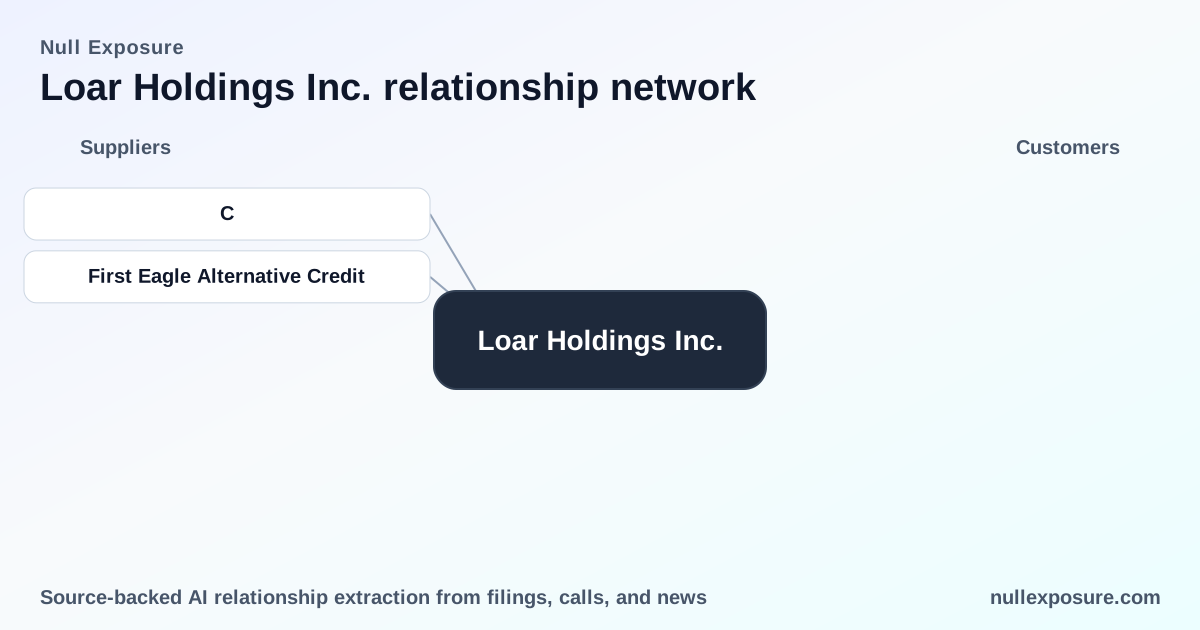
- Citibank — Citibank is one of the agents on Loar’s amended credit agreement, positioned to administrate the facility and coordinate payments and covenant enforcement across the lender group. This placement signals institutional-grade administrative control on the credit line (TradingView, March 10, 2026).
- First Eagle Alternative Credit — First Eagle functions as an agent alongside Citibank and is named in the amendment as a principal lender participant in the amended credit agreement, putting it squarely in the company’s capital stack for term debt provisioning (TradingView, March 10, 2026).
What the contractual evidence says about Loar’s financing posture
Company-level disclosures for the period ending December 31, 2024 show a clear long-term contracting posture: the outstanding debt balance due to a lender was approximately $281.4 million with no amount due within the next twelve months, and the firm accepted substantial term loans ($360.0 million in 2024 and $53.0 million in 2023). The disclosure also records payments made through the credit administrative agent totaling approximately $669.7 million and $68.8 million for those respective years. These items together indicate heavy reliance on multi-year term financing and active debt servicing through an administrative agent (company filings for period ending Dec 31, 2024).
- Contract maturity and stability: The fact that significant balances are not due within 12 months points to a multi-year maturity profile rather than a short-term liquidity squeeze.
- Concentration and criticality: Large term loans and the presence of an administrative agent imply concentrated lender relationships that are critical to Loar’s liquidity and capital allocation choices.
- Maturity profile and operational implications: The company’s use of term loans rather than revolving only facilities indicates a capital structure oriented toward long-term projects and asset holding, which favors stability but increases sensitivity to covenant terms.
Financial context that amplifies the relationships
Loar’s market metrics and profitability underline why creditor relationships are consequential. The company carries a market capitalization of $6.206B on trailing revenue of roughly $496.3M and EBITDA of $174.0M, producing a high EV/EBITDA multiple (~43.5x) and a Price-to-Sales around 12.5x. These multiples show the market prices future growth into the equity and lock creditors and equity holders into expectations for operational scaling and refinancing discipline. Loar’s operating margin of 24.6% and profit margin of 14.5% provide operating cover for interest but also mean credit covenants and lender confidence will be central to execution.
For a broader map of counterparties and how they influence supplier risk, visit https://nullexposure.com/.
What investors and operators should focus on next
- Covenant architecture: Given the use of an administrative agent and long-term term loans, covenant thresholds and waiver flexibility are primary value drivers; they determine whether growth capex or portfolio rebalancing can proceed without renegotiation.
- Counterparty concentration risk: A small set of agents (Citibank, First Eagle) controlling facilitation and enforcement increases single-point-of-failure risk in adverse cycles. For operators, diversifying liquidity channels or pre-negotiating amendment buffers reduces dependence on any one agent’s commercial appetite.
- Refinancing and market timing: With large term loan draws in recent years, Loar’s ability to refinance at favorable spreads will directly affect returns to equity; the current market valuation implies tight execution is required to meet investor expectations.
If you want to track how these lender dynamics evolve and see an integrated view of Loar’s supplier counterparty map, go to https://nullexposure.com/ and explore the supplier coverage.
Risk factors distilled for portfolio managers
- Leverage sensitivity: The firm’s substantial term loan draws and large cumulative payments indicate leverage that is serviceable today but sensitive to rates and EBITDA shocks.
- Counterparty control: Agent banks have the power to accelerate remedies under events of default; this concentrates downside governance.
- Repricing exposure: High valuation multiples require execution upside; any material deterioration in operating performance compresses equity prospects rapidly.
Closing assessment and action points
Loar’s amended credit agreement with institutional agents and the disclosed long-term debt profile make credit relationships a core strategic asset and primary risk vector. For investors, the thesis is straightforward: equity upside depends on portfolio execution plus disciplined credit management; for operators, maintaining covenant headroom and diversified liquidity channels is essential.
To review the supplier relationship map and monitor future amendments and filings, visit https://nullexposure.com/. For a concise dashboard that ties Loar’s counterparty exposures to covenant and cash-flow signals, return to https://nullexposure.com/ and subscribe for updates.