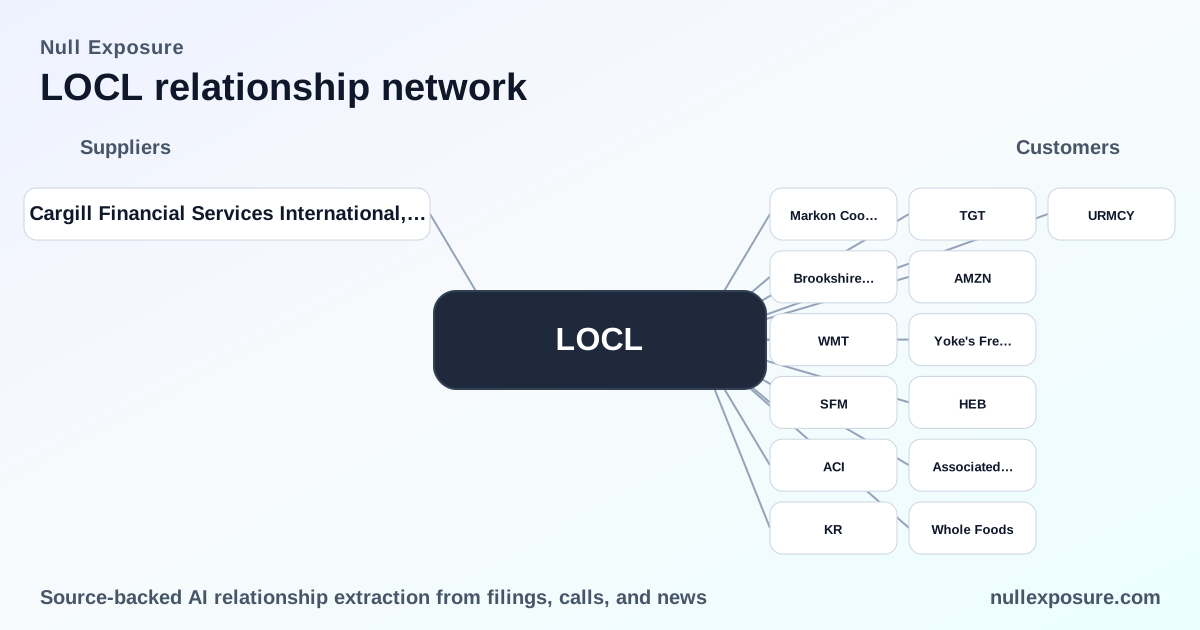
Local Bounti (LOCL) — supplier relationships and what they mean for investors
Local Bounti operates and monetizes by growing and selling controlled-environment leafy greens to retailers and foodservice buyers, while using third-party financing to fund capital-intensive indoor farming assets and working capital. The company’s supplier relationships include not just seed, inputs and logistics, but also financial counterparties whose covenants and restrictions materially shape operational flexibility and strategic options. For investors evaluating LOCL’s supplier posture, analysis must consider the financing counterparties alongside physical suppliers because credit terms drive runway and investment cadence. For a concise supplier-risk view and supplier mapping, visit Null Exposure.
Quick investor thesis: why the financing supplier matters as much as growers and distributors
Local Bounti’s model requires continuous capital to scale farms, stabilize yield curves and absorb seasonality in produce pricing. Financial suppliers who extend debt and impose covenants effectively act as operational counterparties: they can restrict capital deployment, require deleveraging, or trigger defaults that affect supply continuity. That dynamic elevates the importance of tracking debt-provider relationships and covenant language when sizing equity or credit exposure.
Known supplier relationship in the record
Cargill Financial Services International, Inc. — Local Bounti has an active debt facility relationship with Cargill Financial Services that includes covenants and restrictions. According to a Barchart news report dated March 10, 2026, Local Bounti’s filings reference “restrictions and covenants contained in Local Bounti's debt facility agreements with Cargill Financial Services International, Inc. and Local Bounti's ability to comply therewith.” This confirms Cargill’s role as a formal financing counterparty in FY2026 (Barchart, March 10, 2026).
What this single relationship means in plain English
- Cargill as creditor creates a dual supplier role: beyond commodity or input flows, this is a capital supplier whose terms can limit management choices. The March 2026 filing reference shows covenant language is in force and being disclosed to markets (Barchart, 3/10/2026).
- Covenant disclosure signals monitoring and potential pressure points: the specific mention of “ability to comply” is a standard investor alert that covenant tests are relevant to near-term liquidity planning.
How to read the operating constraints as company-level signals
Although the available record does not list a broad matrix of supplier constraints, the company-level evidence provides a clear operating signal set that investors should use to calibrate exposure:
- Contracting posture — creditor-driven: The public covenant disclosure signals that Local Bounti accepts external control terms in exchange for capital. That contracting posture gives lenders formal oversight tools and reduces unilateral flexibility to restructure operations or capital allocation without lender consent.
- Counterparty concentration — potentially elevated: When substantial capital originates from a named large agribusiness financier, counterparty concentration risk increases relative to a diversified lender base. That concentration amplifies single-counterparty influence over covenants and restructurings.
- Criticality — financing is mission-critical: For a capital-intensive grower, access to credit is critical to sustaining operations and ramping farms. Covenants that constrain cash distribution or require specific deleveraging actions are effectively operational constraints.
- Maturity and monitoring — active covenant profile: The explicit FY2026 covenant disclosure indicates an active monitoring regime and an inflection point where compliance is material to going-concern and market-listing narratives.
These operating-model characteristics are company-level signals and should be used to size exposure and diligence cadence; they are not tied to any single supplier unless a constraint excerpt explicitly names them.
Investment implications and risk framework
- Upstream impact on growth: Covenant restrictions can delay capital investments, slowing capacity growth and deferring revenue. Investors should treat borrowings as implicit supply-side partners rather than passive lenders.
- Refinancing and repricing risk: If covenant compliance tightens, Local Bounti could need to refinance at higher cost or accept restrictive amendments, which would press margins and shareholder returns.
- Event risk for markets: Covenant breaches or continued listing notices often drive rapid revaluation events. The presence of covenant language in FY2026 filings is a monitoring trigger for potential near-term volatility (Barchart, March 2026).
- Negotiation leverage: Large financial counterparties can extract concessions that shape long-term capital structure and counterparty behavior; this is a structural governance and control consideration for investors.
Practical signals to watch on a forward-looking basis
- Covenant test outcomes and any amendments filed with regulators.
- New or expanded lending relationships that diversify counterparty concentration.
- Any operational covenants that tie capital infusions to performance milestones or asset sales.
- Public market notices related to listing standards, which often accompany covenant scrutiny (see March 2026 reporting).
For a full supplier-risks dashboard and timeline view, see Null Exposure — our service tracks creditor covenants alongside physical supplier concentration.
How to act on this read
- Hedge near-term execution risk: Prioritize shorter-duration positions or protective options if covenant disclosures accelerate.
- Demand clarity in engagements: When conducting diligence calls, request explicit covenant schedules and recent covenant test results.
- Monitor filings weekly: Covenant-triggered events evolve quickly; add LOCL filing dates to surveillance streams.
For institutional clients who need deeper counterparty maps and covenant-language analytics, visit Null Exposure to request a tailored supplier-risk brief.
Conclusion: focus on financing counterparties as functional suppliers
Local Bounti’s relationship with Cargill Financial Services is not a peripheral note — it is an operational lever. Investors should treat major creditors like suppliers because their contractual rights constrain strategy and execution. The FY2026 covenant disclosure is a concrete signal to prioritize covenant monitoring, counterparty concentration analysis, and proactive liquidity planning when sizing LOCL exposure (Barchart, March 10, 2026). For customized supplier intelligence and covenant tracking, explore Null Exposure.