LOCO (El Pollo Loco) — Supplier Relationships That Drive Cost and Consistency
El Pollo Loco operates and monetizes as a fast-casual restaurant franchisor and operator: it sells chicken-centric food and beverages through company-owned and franchised restaurants, collects franchise royalties and fees, and depends on centralized purchasing and distribution to preserve margins and brand consistency. Supplier arrangements — from primary distributors to beverage contracts and ingredient purchase commitments — are a direct lever on cost of goods sold, operating leverage and franchise economics. For investors, the supplier picture is as important as menu mix when modeling margins and downside risk.
Explore full supplier profiles on NullExposure
Why suppliers matter to LOCO’s P&L and execution
El Pollo Loco’s operating model concentrates exposure in a few predictable lines: poultry procurement, beverage supply, and distribution logistics. Company disclosures show that poultry is the largest product cost and represented a meaningful share of food and paper costs in fiscal 2024, while distribution through a primary foodservice partner covers the bulk of restaurant supplies. These characteristics create both leverage and vulnerability:
- Concentration: The company relies on large-enterprise counterparties for distribution and on a narrow range of core ingredients, which amplifies supplier bargaining dynamics and operational impact of disruptions.
- Criticality: Poultry is a critical input — the largest product cost line — which means any price inflation or availability issue flows directly to margins and menu pricing.
- Maturity and tenor: The company operates with a mix of contract tenors — long-term beverage agreements that extend through 2025 alongside one-to-two year supplier contracts in other categories — giving it a balance between committed pricing and short-run flexibility.
- Committed spend: Public disclosures identify a non-trivial contracted purchase commitment for chicken (roughly $25.6 million as of December 25, 2024), which establishes baseline cash flow obligations and informs working-capital sensitivity.
These signals together imply a supplier posture that is partly hedged via contract commitments but still exposed to commodity and distribution risk because of concentration in poultry and centralized distribution.
The distribution partner is a structural counterparty
Company filings for fiscal 2024 name McLane Company as the “primary distributor” for substantially all food and supplies, including the poultry delivered to restaurants. That single-distributor arrangement is a structural dependency: it reduces procurement complexity and supports uniform execution, but it also creates single-point operational and negotiation risk with a large-enterprise counterparty. (Company filing, fiscal 2024)
Relationship inventory: who’s in the supplier roster
Below is the full set of supplier-related relationships identified in the available results. Each entry is summarized in plain English with a source reference.
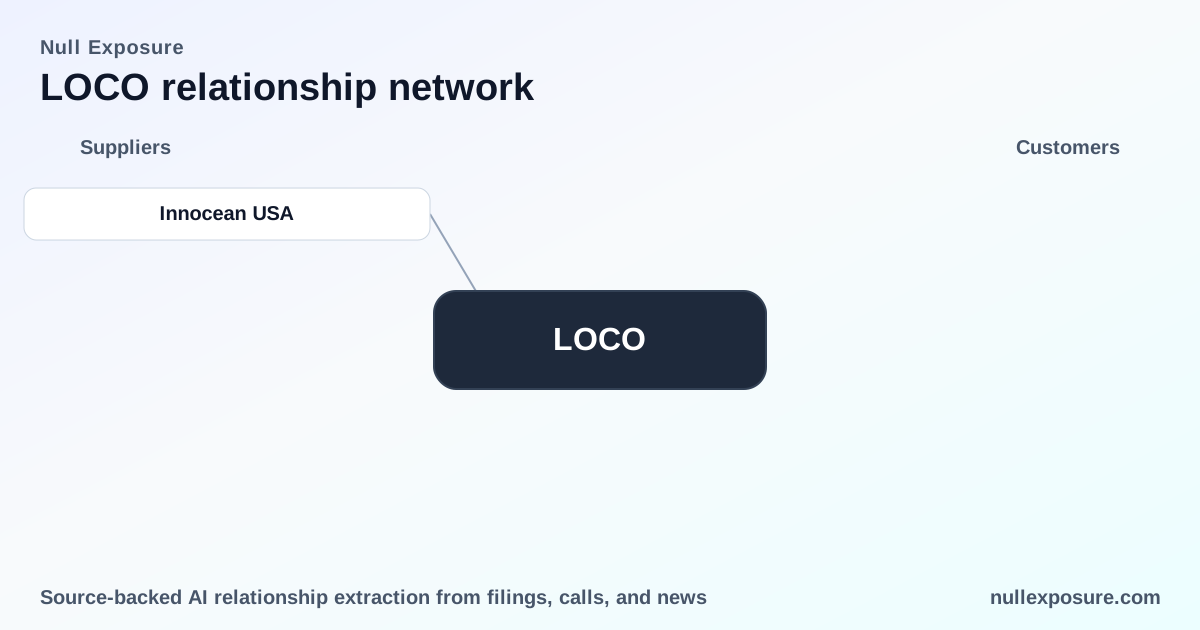
- Innocean USA — El Pollo Loco engaged Innocean USA as its new creative agency to lead a brand refresh tied to the company’s 50th anniversary, intended to attract new customers while re-engaging existing ones; this is a marketing/creative supplier relationship rather than an operational input. According to a GlobeNewswire press release dated May 2, 2025, the brand introduced Innocean USA as part of its 50th-anniversary initiative (GlobeNewswire, May 2, 2025: https://www.globenewswire.com/news-release/2025/05/02/3073301/31831/en/El-Pollo-Loco-Continues-50th-Anniversary-Celebration-With-Innovative-and-Bold-Brand-Refresh.html).
This result set did not list other individual suppliers by name besides relationships described in company disclosures, so the single documented vendor engagement in the dataset is the creative agency above.
What the constraints tell investors about LOCO’s supplier risk profile
The disclosed constraints and excerpts create clear company-level signals about procurement posture and potential exposure:
- Contract tenor mix (company-level): The firm holds long-term beverage supply agreements extending through the end of 2025, while other procurement contracts are commonly one-to-two year arrangements. That combination gives LOCO some price certainty on beverage lines while retaining flexibility on many food categories.
- Large-enterprise counterparties (relationship-level where named): The company explicitly contracts with McLane Company as its primary distributor for substantially all food and supplies in fiscal 2024; this is a named counterparty and should be treated as a high-impact supplier relationship.
- Materiality and concentration (company-level): Poultry is the single largest product cost, representing approximately 37% of total food and paper costs for 2024, which translates into outsized sensitivity of gross margin to chicken prices.
- Committed spend (company-level): The company reported an estimated purchase-commitment for chicken of approximately $25.6 million as of December 25, 2024, establishing a baseline contractual exposure for the primary commodity.
Taken together, these constraints indicate high operational importance of a narrow set of suppliers and commodities, with partial contractual insulation in beverages but concentrated exposure to poultry and distribution.
See how suppliers feed into risk models at NullExposure
Investment implications: what to watch in the coming quarters
For investors and operators modeling LOCO, focus attention on three vectors:
- Commodity cost trajectory for poultry — given poultry’s 37% share of food & paper cost, price inflation or supply shocks will have immediate margin impact. Monitor wholesale chicken market indicators and any amendments to purchase commitments.
- Distributor dependence — the McLane arrangement is operationally efficient but creates counterparty concentration risk; track contract renewals, service-level disclosures, and any moves to diversify distribution.
- Contract maturity and re-pricing windows — long-term beverage contracts provide short-term stability through 2025, but the prevalence of 1–2 year contracts elsewhere means the company can re-price inputs more frequently, creating both downside protection if prices fall and downside risk if prices rise at contract renewal points.
Key takeaway: LOCO’s supplier profile is a classic fast-casual sensitivity mix — meaningful committed spend and concentration on a critical commodity, paired with enough contractual flexibility to reprice within a 1–2 year horizon. That combination favors active monitoring of input markets and distributor negotiations when assessing near-term margin risk.
Next steps for diligence and risk mitigation
- Read the named distributor disclosure and purchase-commitment language in the company’s filings to quantify renewal windows and penalty provisions.
- Track commodity price indices for chicken and beverage supply contract expirations through 2025 to forecast margin path.
- Consider scenario analysis that stresses poultry costs and distribution dislocation to evaluate downside to franchisee economics and company-store profitability.
Review full supplier signals and download supplier reports at NullExposure
Bottom line: El Pollo Loco’s supplier landscape is concentrated but contractually managed — poultry and a single primary distributor drive both the company’s cost structure and operational vulnerability, while shorter contract tenors elsewhere preserve the ability to reprice inputs. Investors should prioritize monitoring poultry market moves and distribution arrangements when forecasting margins and downside scenarios.