Launch One Acquisition Corp. (LPAA) — supplier relationships and what they tell investors
Launch One Acquisition Corp. is a technology-focused SPAC that currently generates no operating revenue and intends to create shareholder value by completing an initial business combination; in the interim it runs lean operations funded by trust assets and governed by sponsor arrangements. The company covers recurring administrative needs through paid services (notably office and secretarial support) and outsources investor relations functions to third parties, creating a profile of low absolute spend, concentrated related-party services, and dependence on sponsor-provided infrastructure for day-to-day administration. For a direct view into how LPAA structures these relationships and the implications for investors, see Null Exposure’s research portal: https://nullexposure.com/.
The quick operating thesis for investors
LPAA monetizes by completing a business combination that converts public-SPAC capital into operating equity of a target; until that event it has no material revenue, relies on sponsor-funded services, and incurs modest external fees for audit and communications. Market signals show a $307.9m market capitalization but effectively no operating cash flow — this places emphasis on governance, counterparty terms and the timing of the deal execution as the main drivers of investor returns.
Key financial context: LPAA reports a market cap of $307,913,000, shares outstanding of 23,000,000 and no revenue to date; filings show modest professional and administrative spending through December 31, 2024. For a concise vendor-risk briefing, visit https://nullexposure.com/.
What the supplier constraints reveal about LPAA’s operating model
LPAA’s supplier profile is shaped by the SPAC lifecycle: minimal internal operating scale, reliance on sponsor affiliates for infrastructure, and selective external vendors for investor communications and audit. The constraint evidence gives a clear, unified signal:
- Contracting posture — subscription-style, recurring administrative fee. The company pays a monthly $12,500 fee to a Sponsor affiliate for office space and secretarial/administrative services under an Administrative Services Agreement; payments stop on completion of the business combination or liquidation. This is a classic SPAC structure where internal operating needs are externally provisioned through a standing contract.
- Relationship role — service provider. Multiple excerpts designate suppliers as service providers delivering office, secretarial, audit, and IR functions rather than product vendors or strategic technology partners.
- Spend scale and maturity — low absolute spend and nascent procurement maturity. Documented cash outflow for administrative services and professional fees is small in absolute terms: $70,565 paid under the Administrative Services Agreement as of Dec 31, 2024, and approximately $87,360 to auditors (Withum) for work from inception through that date. These figures indicate low vendor spend and a straightforward procurement footprint typical of newly formed SPACs.
- Concentration and criticality — concentrated but replaceable. The use of a Sponsor affiliate for core administrative needs creates concentration and potential governance issues, but those services are operationally replaceable; the relationship is critical for current operations but not a long-term strategic dependency post-merger.
Investor takeaway: LPAA’s supplier risk is procedural and governance-oriented rather than executional or vendor-capacity driven; investors should focus diligence on related-party terms, the duration and change-of-control mechanics for these contracts, and whether audit/IR vendors have any lingering dependencies after a combination.
Supplier relationships on the record — what public mentions show
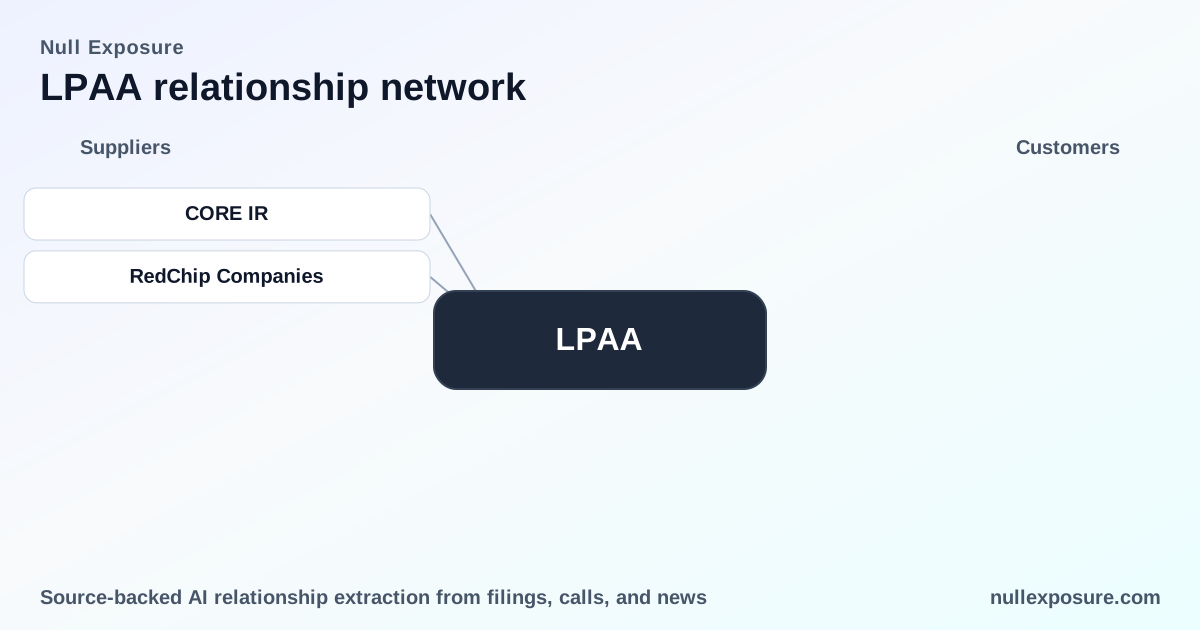
LPAA’s external supplier mentions in public releases are limited and focused on investor relations and communications. The results returned for supplier relationships include two named parties.
CORE IR
LPAA lists contact details for CORE IR, with Jules Abraham named as Managing Director, Communications, providing a direct investor-relations contact line. According to a Globe and Mail/GlobeNewswire release dated March 10, 2026, CORE IR is presented as an investor-relations contact for LPAA, indicating the company uses external IR support for market communications and enquiries.
RedChip Companies
RedChip Companies is listed with Dave Gentry (CEO) and an LPAA-specific contact email, suggesting LPAA engages RedChip for investor outreach or public relations support. The same Globe and Mail/GlobeNewswire release (March 10, 2026) includes the RedChip contact, confirming its role as an external communications/IR resource for LPAA.
Both mentions are single-line investor-relations contacts in a broader press distribution; they do not, on the public record provided, include contracting terms, fees, or duration.
What these supplier relationships mean for investors and operators
- Communications outsourcing is standard: LPAA uses named IR firms to handle investor engagement and press distribution, which reduces internal staffing needs and centralizes external messaging control. That is consistent with a SPAC in the pre-combination phase.
- Financial impact is small but governance-relevant: Documented external spending (audit and administrative fees) totals well under six figures through Dec 31, 2024, limiting near-term cash impact but elevating the importance of contractual disclosure, related-party transparency, and fee alignment with shareholder interests.
- Operational vulnerability is time-bound: The Administrative Services Agreement and IR contracts are important for ongoing compliance and market access today, but their strategic importance diminishes after a successful business combination — the window of risk is therefore concentrated in the SPAC lifecycle.
Practical due diligence checklist for analysts and operators
- Confirm the precise terms, termination rights, and change-of-control provisions of the Administrative Services Agreement and any Sponsor-affiliate arrangements.
- Verify the scope and compensation of IR engagements (CORE IR, RedChip) to understand whether they are retained‑fee, project-based, or performance-linked.
- Reconcile the amounts disclosed in filings ($70,565 administrative payments; ~$87,360 professional fees through Dec 31, 2024) with cash flows and trust protections.
- Evaluate governance controls around related-party agreements and board oversight ahead of a business combination.
- Monitor timelines: redemption behavior, deal announcements, and lock-up structures that materially affect post-combination liquidity.
If you want a structured supplier-risk scorecard or a vendor contract audit for LPAA, Null Exposure can help — start here: https://nullexposure.com/.
Final assessment and action points
LPAA’s supplier footprint is small, concentrated on administrative and investor-relations services, and dominated by sponsor-affiliate arrangements with low current spend but high governance sensitivity. For investors, the critical questions are not vendor capacity but the terms and oversight of related-party services and the timetable to a business combination. For operators, the priority is ensuring transparent contracts and a clean transition plan for vendor relationships post-combination.
For deeper supplier-by-supplier documentation or a tailored diligence memo on LPAA, visit Null Exposure to commission research or download our template playbook: https://nullexposure.com/.