LPBBU supplier relationships: what investors should know today
Launch Two Acquisition Corp. (LPBBU) is a SPAC that generates value by identifying and executing an initial business combination with a target company in technology, consumer, or healthcare, leveraging sponsor networks and capital committed through its NASDAQ listing and trust structure. The company’s current vendor footprint is lean and operationally focused: routine professional services (audit, administrative support and office services) underpin the SPAC lifecycle rather than core operating revenue. If you evaluate LPBBU as a counterparty or portfolio holding, the supplier profile signals a low-complexity, high-control operating model where sponsor-affiliated services and a single professional auditor dominate vendor exposure. For more detailed supplier intelligence on LPBBU, visit https://nullexposure.com/.
What the filings disclose — the full list of suppliers in scope
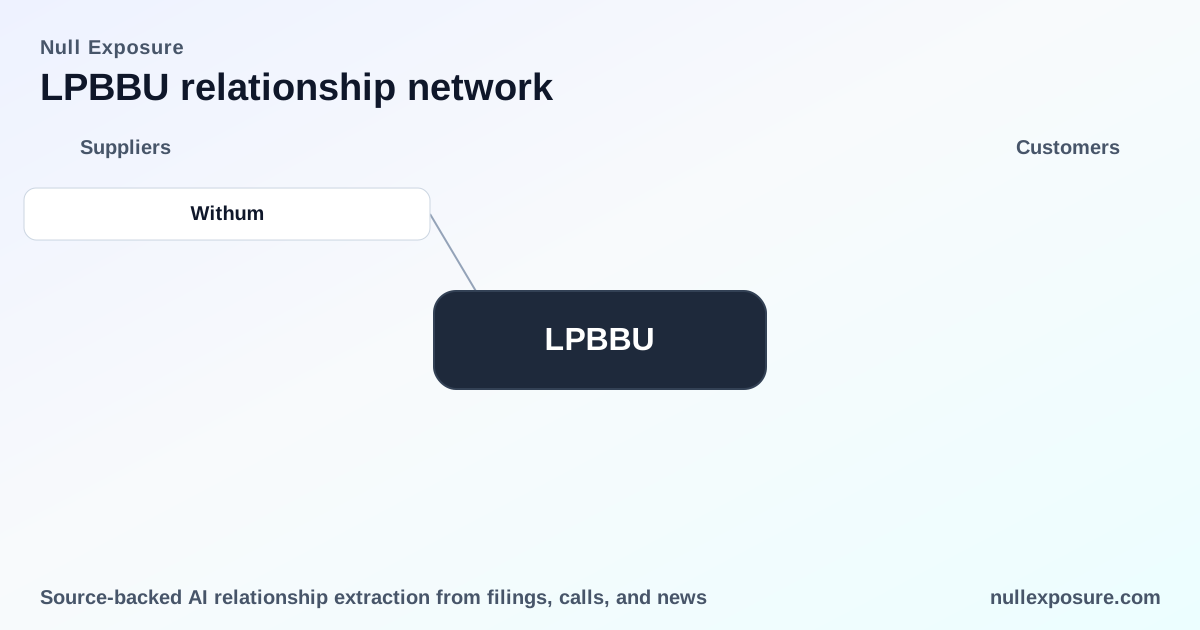
In the company’s FY2024 filings the only named external professional supplier disclosed in the supplier search results is Withum, the accounting firm that performed audit services. According to the FY2024 Form 10‑K, Withum was paid audit fees for the year-end financial statement audit and related services provided in connection with regulatory filings (FY2024 10‑K). This is the sole named relationship returned in the supplier-scope results for LPBBU.
- Withum — The FY2024 Form 10‑K states audit fees were charged by Withum for the year‑end audit and services normally provided in connection with regulatory filings. (Source: FY2024 Form 10‑K filing).
How that single disclosed supplier fits the SPAC operating model
The vendor list is intentionally short and consistent with SPACs at this stage of their lifecycle: primary external spend is concentrated in compliance and administrative services rather than product vendors or R&D partners. The disclosures show two distinct supplier categories in LPBBU’s operating posture:
- Professional auditor (external third party): Withum handles statutory audit and regulatory filing support — a compliance-critical, arms‑length relationship that is standard and non-strategic from a revenue perspective.
- Sponsor-affiliated administrative services (internal/affiliate supplier): The company reimburses a sponsor affiliate $12,500 per month for office space, utilities and secretarial and administrative support under an Administrative Services Agreement; payments of $34,274 were recorded as of December 31, 2024. These payments are contractual and ongoing until completion of the initial business combination or liquidation, and they reflect a subscription-style, recurring cost structure disclosed in the 10‑K.
(Disclosure context: the administrative services language and monthly reimbursement are described in the FY2024 10‑K administrative services section.)
Contracting posture and business model constraints — what that means for investors
LPBBU’s supplier signals indicate a controlled and low-risk procurement posture appropriate to a SPAC in pre-deal status:
- Contract type: The Administrative Services Agreement is structured as a recurring subscription-style reimbursement ($12,500/month) for office and administrative services, which creates predictable fixed operating cash outflows until a business combination or liquidation occurs. This is a company-level characteristic disclosed in the 10‑K.
- Concentration: Supplier concentration is high but benign — a single professional auditor and a sponsor-affiliate providing office/administrative support dominate vendor relationships, limiting counterparty complexity and dependency on external operating suppliers.
- Criticality: Audit services are compliance-critical and legally necessary; sponsor-affiliate administrative services are operationally critical for day-to-day functioning but not for generating revenue. Both are essential to maintaining SPAC readiness for a transaction.
- Maturity: The supplier relationships are early-stage and transactional by design: the audit engagement is annual/periodic, and the administrative services contract runs until deal completion or wind-up, indicating short-to-medium maturity aligned with the SPAC timeline.
- Geography: Operational activities and the administrative services are centered in Oakland, California (180 Grand Avenue, Suite 1530), placing LPBBU’s core vendor footprint in the U.S. West Coast market.
These are company-level signals drawn from the 10‑K and the supplier classification in the results.
Visit https://nullexposure.com/ for comparative supplier risk profiles and to see how LPBBU stacks up against peers for audit and affiliate-service exposure.
Relationship-by-relationship detail (complete)
Withum — The FY2024 Form 10‑K discloses audit fees paid to Withum for the audit of the year‑end financial statements and related regulatory filing services; this is presented as the company’s primary external professional services relationship in the filing (FY2024 10‑K).
(That is the complete set of supplier relationships returned in the supplier-scope search results for LPBBU.)
What these supplier relationships imply for deal risk and governance
- Governance focus: With an auditor relationship and sponsor-affiliate administrative payments the governance lens tightens on independence and related-party disclosure practices. Investors should monitor audit firm rotation, audit scope, and the transparency of affiliate reimbursements in subsequent filings.
- Cash-flow predictability vs. downside: The $12,500/month reimbursement creates a fixed cash drag until deal close; while modest in absolute terms, the subscription-style outflow is material relative to a SPAC’s administrative budget and trust-preservation obligations. The company reported $34,274 paid under that agreement through 12/31/2024 in the 10‑K.
- Concentration risk low but present: Supplier concentration increases execution control but reduces diversification; this is acceptable for a pre-combination SPAC but becomes a risk consideration post-combination when operating scale and supplier complexity typically expand.
Risk checklist for investors evaluating LPBBU
- Confirm auditor independence, audit tenure and engagement fees in the next periodic filing.
- Track affiliate administrative payments and any shifts from affiliate to arm’s-length providers after a business combination.
- Assess cash held versus recurring administrative cash burn to ensure the trust and working capital are sufficient through deal close.
Practical takeaways and next steps
LPBBU’s disclosed supplier footprint is narrow, dominated by audit services and sponsor-affiliate administrative support — a low-complexity profile that reduces third-party execution risk but raises governance questions around related-party transactions. Investors focused on counterparty risk should prioritize follow-up on audit scope, related-party disclosure clarity, and the SPAC’s runway relative to recurring affiliate fees.
For investor-grade supplier analytics and to map these relationships against peer SPACs, go to https://nullexposure.com/. If you want a tailored supplier-risk report for LPBBU or comparative benchmarking across SPAC issuers, start your review at https://nullexposure.com/ and request the LPBBU supplier briefing.