Lipocine Inc (LPCN) — supplier relationships and what they mean for investors
Lipocine is a clinical-stage biopharmaceutical developer that creates and licenses oral formulations for endocrine and metabolic indications, monetizing through product licensing, milestone and royalty streams, and potential direct commercialization where regulatory approvals exist. The company’s economics today are concentrated on a small number of partnered assets and on intellectual property that underpins oral steroid formulations; its revenue base is small relative to market capitalization and the supply chain for active pharmaceutical ingredients is a strategic constraint.
If you want a consolidated view of counterparty exposure and supplier risk for LPCN, visit Null Exposure for detailed supplier intelligence and monitoring: https://nullexposure.com/
Company snapshot for context: Lipocine reports trailing twelve‑month revenue of roughly $1.98 million against a market capitalization near $40.5 million, negative EBITDA and persistent operating losses, reflective of a clinical-stage company relying on partner commercialization and licensing to scale revenue.
How Lipocine generates value and cash flows Lipocine advances clinical assets through development programs, then monetizes via out‑licensing, co‑development or direct commercialization when feasible. The company has historically relied on partner relationships to commercialize lead assets (for example, the oral testosterone product TLANDO) and on third‑party manufacturers and service providers for development, clinical operations, and API supply. Revenue today is driven by licensing and limited product-related receipts; meaningful scaling is contingent on commercial launches or larger partnerships.
Key supplier and outsourcing characteristics investors must internalize
- Outsourced development and manufacturing posture. Lipocine outsources clinical work to CROs and manufacturing to CMOs and collaborators; regulatory, QA and clinical data functions are handled by external specialists. This is how the company controls fixed costs but increases dependency on third parties for timelines and quality.
- High supplier concentration for critical APIs. Company disclosures flag reliance on a single third‑party supplier for testosterone esters used in TLANDO and several pipeline assets, and a limited set of suppliers for NAS (the API for other programs). This concentration is labeled critical in company filings because the number of global suppliers is small and replacement is nontrivial.
- Operational criticality and pricing power risk. With few global suppliers for key active ingredients, Lipocine faces meaningful pricing and availability risk that can directly delay development milestones and compress commercial margins if it cannot secure supply on favorable terms.
- Clinical-stage maturity influences leverage. As a developer without broad commercial scale, Lipocine’s bargaining position with suppliers is constrained by volume—this increases the economic impact of supplier price moves and the operational impact of supplier disruptions.
Supplier relationships and public mentions — the complete list Below I cover every named relationship surfaced in the supplier search results.
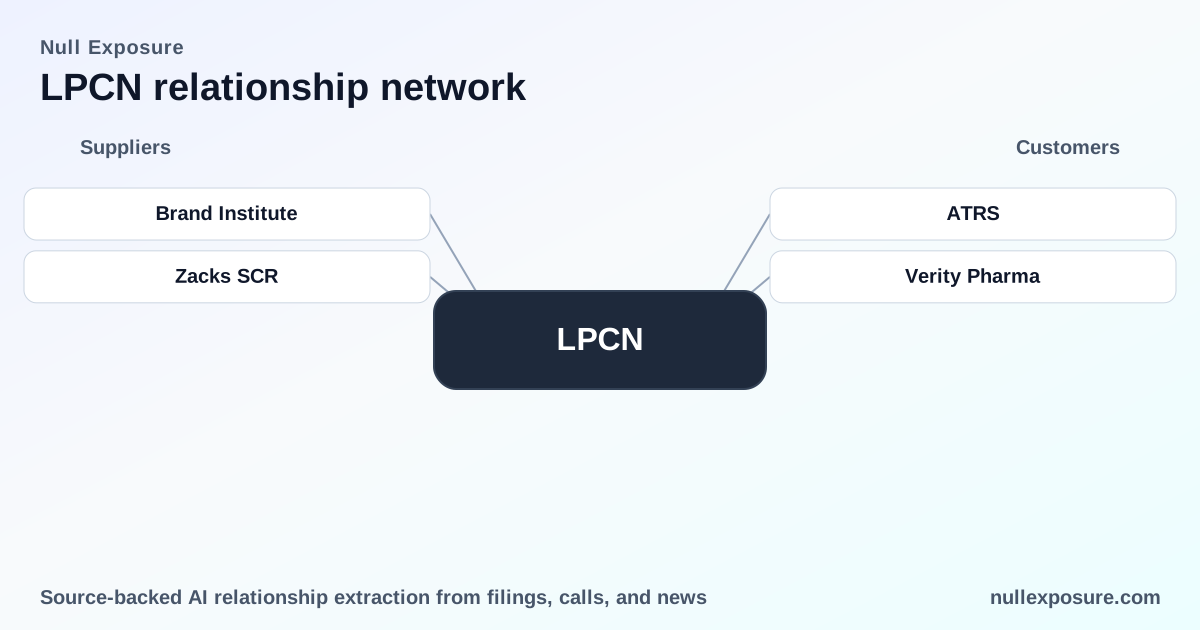
Brand Institute — brand and commercialization support Brand Institute announced it worked with Lipocine on the TLANDO® brand name, a branded oral testosterone therapy that Lipocine developed and which is commercially associated with Antares Pharma following FDA approval. This relationship is marketing and brand support rather than a manufacturing tie, but it confirms Lipocine’s reliance on specialist external providers for commercialization assets (Brand Institute announcement reported by BioSpace, March 2026: https://www.biospace.com/fda-approves-tlando-testosterone-undecanoate-an-oral-treatment-for-testosterone-replacement-therapy-by-antares-pharma-inc-developed-by-lipocine-inc).
Zacks SCR — investor relations / sponsored coverage Zacks SCR disclosed it received compensation from Lipocine or an investor relations firm to provide research coverage for at least a year, indicating a commercial relationship for investor communications and coverage services rather than a scientific or manufacturing partnership (Zacks SCR disclosure, FY2018: https://scr.zacks.com/news/news-details/2018/LPCN-Androgen-Therapy-in-NASH-A-Comprehensive-Approach-/default.aspx).
What these relationships signal about the operating model
- Brand Institute’s involvement underscores a strategic approach where Lipocine outsources specialist commercialization tasks such as naming, branding and launch support — Lipocine leverages external marketing and commercialization expertise rather than building scale internally.
- Zacks SCR’s compensated coverage is a reminder that Lipocine uses paid investor‑relations and research channels to maintain market visibility, which is routine for small-cap biotechs seeking to amplify milestones to the investment community.
Supply-chain constraints and investment implications Company disclosure language explicitly flags single‑supplier dependence for key APIs (testosterone esters) and limited supplier pools for NAS, labeling these arrangements as critical for product development and potential commercialization. These constraints have multiple investor implications:
- Timeline risk: Loss or delay of a supplier can materially postpone development or launch dates.
- Cost risk: Limited supplier competition increases the probability of price escalation that would compress gross margins on any approved product.
- Partner negotiation leverage: As a relatively small buyer, Lipocine is structurally disadvantaged in negotiating supply contracts versus larger pharmaceutical buyers; this elevates the importance of securing long‑term supply agreements or qualifying secondary suppliers as a de‑risking priority.
- Regulatory and quality dependence: Outsourced manufacture creates a dependency chain where third‑party quality issues flow to Lipocine’s regulatory standing and product release cadence.
Practical takeaways for investors and operators
- Prioritize supplier diversification and long‑term supply contracts: Given the explicit disclosure of single-supplier exposure for testosterone esters and limited NAS sources, any durable valuation should assume execution risk unless management secures diversified supply or robust contractual protections.
- Examine partner economics and royalty structures: Because Lipocine monetizes through partners for commercialization, investors should focus on the structure of licensing deals and milestone/royalty buffers that absorb supplier‑driven cost swings.
- Monitor operational KPIs beyond clinical readouts: Track supply contracts, CMO qualification status, and any regulatory inspection outcomes; these operational signals will have first‑order effects on timing and the cost base for commercialization.
If you want deeper supplier maps, counterparty risk scores, and ongoing monitoring for Lipocine and its critical suppliers, see Null Exposure’s platform: https://nullexposure.com/
Conclusion and next actions Lipocine’s model is a classic clinical‑stage biotech profile: value built through clinical advancement and licensing, operationalized via outsourced service providers and critically dependent on a narrow set of API suppliers. For investors, the single‑supplier exposure for testosterone esters and limited NAS supply are the standout supply‑side risks that can alter timelines and economics more directly than clinical outcomes alone. Operators and partners should press for multi‑sourced supply and long‑dated agreements to stabilize margins and protect go‑to‑market timing.
For continuous supplier intelligence and an actionable view of LPCN counterparty exposure, visit Null Exposure: https://nullexposure.com/