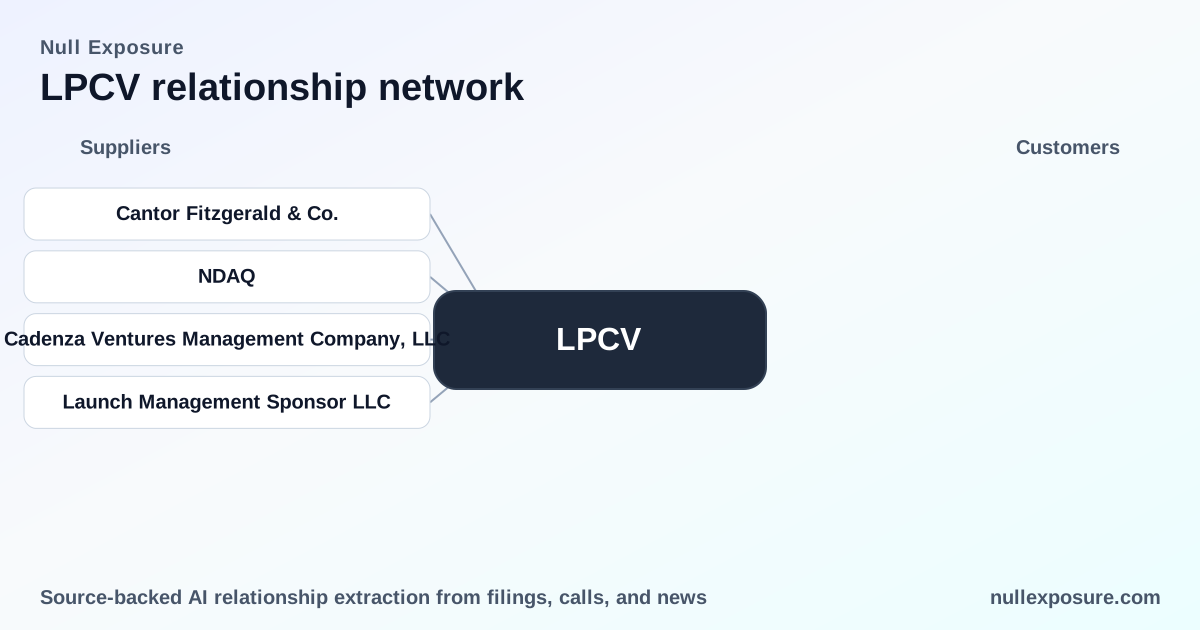
Launchpad Cadenza (LPCV): a concise supplier map and what it means for investors
Launchpad Cadenza Acquisition Corp I (LPCV) is a SPAC that raises capital via a Nasdaq listing and seeks to combine with a technology or digital-sector target; it monetizes by delivering post-combination equity value to public shareholders and through sponsor and transaction-related economics common to blank‑check vehicles. LPCV currently has no operating revenue and a public market capitalization of $285,488,000; its near-term supplier relationships are concentrated on underwriting, listing infrastructure, and sponsor-provided administrative services. For investors evaluating counterparty risk and contracting posture, the supplier list reveals a classical SPAC footprint: a single book‑runner, a public-exchange listing, and sponsor arrangements that supply office and administrative support. Learn more about supplier analytics at https://nullexposure.com/.
Why supplier relationships matter for a SPAC like LPCV
SPACs derive value not from internal cashflow today but from the credibility of management, the market access provided by underwriters and exchanges, and the operational backbone supplied by sponsors. Supplier relationships are therefore not peripheral — they are a proxy for deal execution capability and timing risk. A concentrated supplier base shortens the execution chain but raises single-counterparty risk: if a sole underwriter or sponsor relationship changes, the timeline and cost of completing a business combination can shift materially.
Underwriting and listing: the two external rails that enable a SPAC
-
Cantor Fitzgerald & Co. is the sole book‑running manager for LPCV’s initial public offering. A single underwriter model centralizes distribution and pricing control, increasing execution dependence on Cantor Fitzgerald’s capital markets franchise. According to a Quiver Quant news release covering the IPO pricing (first reported March 10, 2026), Cantor acted as sole book‑runner. Source: Quiver Quant news release (IPO pricing announcement, March 10, 2026).
-
The units were structured to list on The Nasdaq Global Stock Market and began trading under the ticker LPCVU. Nasdaq’s listing delivers market liquidity and governance standards but also subjects the vehicle to exchange rules that govern shareholder redemptions and disclosure timing. The same Quiver Quant notice notes the Nasdaq listing and the December 18, 2025 trading commencement under LPCVU. Source: Quiver Quant news release (IPO pricing and listing details, March 10, 2026).
Sponsor services and early-stage operating support
-
Cadenza Ventures Management Company, LLC (sponsor affiliate) is contracted to provide office space and administrative support at a fixed monthly fee of $25,000, commencing December 17, 2025. This recurring, short‑term contract reflects the typical SPAC operating model: sponsors supply the administrative runway until a transaction closes. The 10‑Q filed details the arrangement and the monthly fee. Source: SEC 10‑Q referenced in TradingView coverage (FY2026 filing).
-
Launch Management Sponsor LLC shares the same administrative and office services arrangement, also compensated $25,000 per month beginning December 17, 2025. Dual sponsor entities collecting fixed monthly payments concentrate operational control with sponsor management while shifting cash‑burn predictability to the sponsor relationship. This is documented in the company’s 10‑Q disclosure summarized in TradingView’s article. Source: SEC 10‑Q referenced in TradingView coverage (FY2026 filing).
Complete relationship inventory (compact)
-
Cantor Fitzgerald & Co.: Acting as sole book‑running manager for LPCV’s IPO, centralizing underwriting and distribution responsibilities for the offering. Source: Quiver Quant news release (IPO pricing announcement, March 10, 2026).
-
The Nasdaq Global Stock Market LLC (Nasdaq): The units were listed and began trading on December 18, 2025 under the ticker LPCVU, providing primary market listing and exchange oversight. Source: Quiver Quant news release (IPO pricing and listing details, March 10, 2026).
-
Cadenza Ventures Management Company, LLC: Contracted to provide office space and administrative support for a fee of $25,000 per month, effective December 17, 2025. Source: SEC 10‑Q as summarized in TradingView (FY2026 filing).
-
Launch Management Sponsor LLC: Same monthly arrangement for office and administrative services at $25,000 per month beginning December 17, 2025. Source: SEC 10‑Q as summarized in TradingView (FY2026 filing).
Operating-model signals and contracting posture
There are no supplier constraint excerpts reported in the available relationship data; this is a company‑level signal. From the disclosed relationships we can draw the following operational characteristics with clarity:
- Contracting posture: transactional and short horizon. Fixed monthly fees for sponsor services indicate a stop‑gap operating model designed to minimize SPAC overhead while a combination is sought.
- Concentration: high. The underwriting and administrative footprint is narrow — a single book‑runner and a small set of sponsor entities — which shortens execution pathways but increases counterparty concentration risk.
- Criticality: sponsor and underwriter relationships are mission‑critical. Deal sourcing, public distribution, and compliance hinge on these counterparties.
- Maturity: early-stage. The presence of monthly sponsor payments and the absence of operating revenue are consistent with a pre‑combination SPAC that is still building toward a de‑SPAC transaction.
If you are tracking counterparties across a portfolio, these signals are precisely the ones that shift vote outcomes, redemption behavior, and timeline risk.
Explore supplier risk scoring and benchmarking at https://nullexposure.com/ to integrate these supplier signals into your portfolio monitoring.
Investment implications — risks and what to watch next
- Execution dependency on Cantor Fitzgerald elevates a single-point-of-failure risk in distribution and pricing; any change in underwriting support could delay or alter transaction economics.
- Sponsor control of day-to-day operations via paid administrative services concentrates operational continuity in entities that are compensated regardless of transaction success; sponsors can accelerate or decelerate spending based on strategic incentives.
- No operating revenue and limited public operating history mean valuation ultimately depends on the quality of the merger partner and post-combination performance, not on current fundamentals.
- Exchange oversight from Nasdaq mitigates some governance risk but also enforces timelines that can compress decision-making around redemptions and vote mechanics.
For actionable monitoring, track subsequent SEC filings for amendments to sponsor agreements, underwriting changes, or updated listing arrangements — those filings materially affect deal timing and counterparty risk.
Bottom line and next steps
LPCV’s supplier landscape is textbook SPAC: concentrated, sponsor-led, and transaction-focused. That structure enables fast execution if management and underwriter incentives align, but it also concentrates single‑counterparty risk that investors should price into expected deal timelines and outcomes.
If you want ongoing supplier-level monitoring and alerts tied to filings and news triggers, see how we map counterparties and constraints at https://nullexposure.com/. For portfolio managers assessing SPAC counterparties, adding supplier concentration and contract-tenor signals is a high‑value next step — start with the public filings and underwriter announcements tied to trading commencement and sponsor engagement.