LPCVW: What investors and operators need to know about supplier ties and execution risk
Launchpad Cadenza Acquisition Corp I Warrant (LPCVW) is a SPAC warrant issued alongside a special purpose acquisition company that completed a public offering in late 2025; the sponsor monetizes through the SPAC model — raising capital via underwritten units and then seeking a business combination with a target in consumer technology, while warrant holders retain optional upside post-combination. For investors and operators, the commercial reality is straightforward: value is driven by sponsor deal execution, the underwriting and listing partners who enable liquidity, and the timeline for a qualifying merger. Learn more or track counterparties at the NullExposure homepage: https://nullexposure.com/
How LPCVW works in plain language
LPCVW is not an operating company — it is a financial instrument tied to a blank‑check vehicle whose sole business is to source and close an acquisition. The company raised capital via an initial public offering of units that included common shares and warrants; that capital sits in trust until a qualifying merger is completed or returned to investors. Monetization for warrant holders depends entirely on a successful business combination and post‑transaction market performance, not on operating cash flow today.
Two counterparties underpin the offering — and why they matter
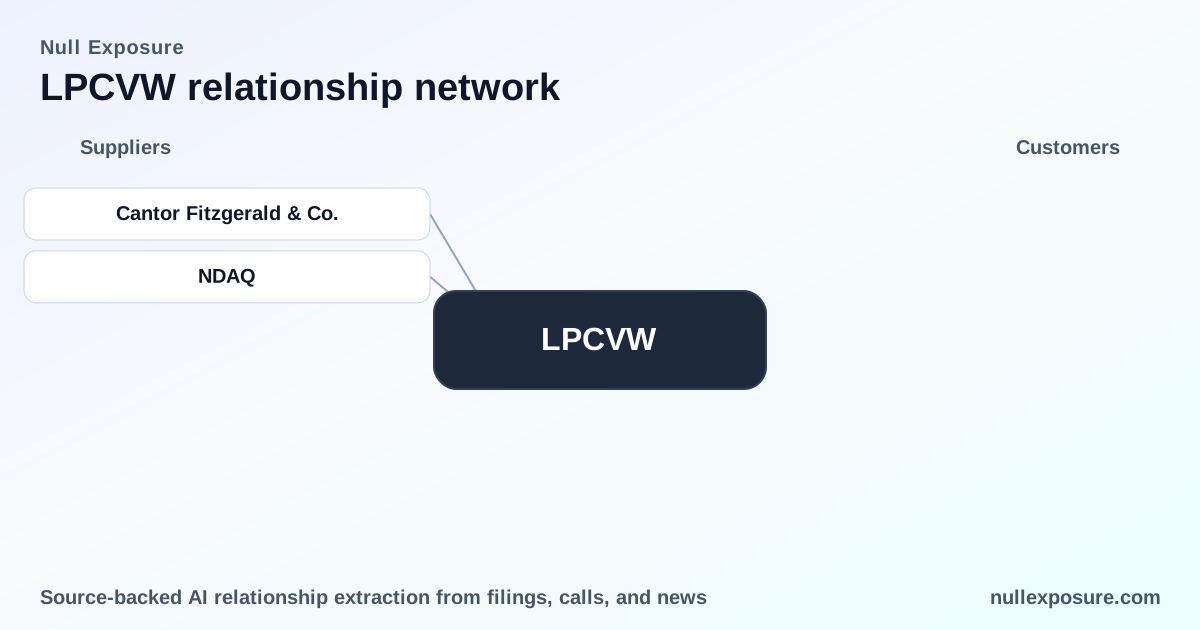
LPCVW’s public availability and initial capitalization were delivered through two critical supplier relationships: the underwriting manager and the listing exchange. Both roles are foundational to a SPAC’s lifecycle — they generate distribution reach, regulatory visibility, and post‑deal market access.
Cantor Fitzgerald & Co. — underwriting muscle behind the raise
Cantor Fitzgerald & Co. acted as the sole book‑running manager for the offering that launched Launchpad Cadenza’s units into the market. That placement gave the SPAC immediate institutional distribution and a recognized underwriter brand that supports aftermarket liquidity and investor confidence (Quiver Quant, March 10, 2026).
The Nasdaq Global Stock Market LLC — the exchange venue for market access
The SPAC’s units began trading on The Nasdaq Global Stock Market LLC under the ticker LPCVU on December 18, 2025, providing immediate market venue and the regulatory framework required for subsequent merger transactions and secondary trading (Quiver Quant, March 10, 2026).
What these relationships mean for investors and operators
Both counterparties are execution enablers: the underwriter provided distribution and credibility during the offering, while the exchange supplies the market and regulatory infrastructure needed for the SPAC lifecycle. For an operator evaluating supplier relationships, the implications are:
- Contracting posture: Standard capital markets engagements prevail — underwriting agreements and listing arrangements are governed by market practice and regulatory filings. These are commercial, arms‑length relationships rather than integrated operational partnerships.
- Concentration: The supplier footprint is narrow at launch — a single underwriter and a single listing exchange are sufficient to get a SPAC to market, which concentrates execution risk into a few counterparties.
- Criticality: Both supplier types are mission‑critical for the SPAC model: without underwriting the raise and exchange listing, the SPAC cannot access public capital or complete a merger that yields warrant value.
- Maturity: The SPAC is newly formed and lacks operating history; its supplier relationships are foundational rather than long‑standing strategic alliances.
These are company‑level signals: they describe how Launchpad Cadenza operates and where single points of failure could emerge, not bespoke contractual terms with a specific counterparty.
Relationship-by-relationship concise summaries
- Cantor Fitzgerald & Co. provided sole book‑running management for the SPAC’s IPO, giving the sponsor distribution and underwriter credibility for the $230 million offering that launched in late 2025, a necessary step for the SPAC’s capital formation (news release reported by Quiver Quant, March 10, 2026).
- The Nasdaq Global Stock Market LLC listed the units on December 18, 2025 under the ticker LPCVU, establishing public market access and the disclosure/regulatory framework required for the SPAC lifecycle (news release reported by Quiver Quant, March 10, 2026).
Risks and operational constraints to weigh
The public record for LPCVW is sparse on long‑form contracts and ongoing supplier obligations; the constraints dataset returned no explicit contractual constraints. Treat that absence as a signal: no additional supplier covenants or restrictive clauses are visible in the material returned, so operational risk centers on market and execution outcomes rather than complex vendor lock‑ins.
Key risk vectors for investors and operators:
- Execution risk dominates — the warrant’s future value is contingent on a completed business combination and the market’s reception of the combined company.
- Counterparty concentration creates single points of failure at origination; while Cantor Fitzgerald and Nasdaq are reputable, the relationship set is narrow.
- Time and governance constraints inherent to SPACs (deadline to consummate a merger, shareholder vote mechanics, trust account rules) drive liquidity timing and optionality for warrant holders.
Tactical takeaways for portfolio managers and operators
- Monitor deal timelines and proxy filings closely — value realization is binary around a completed merger and subsequent equity performance.
- Track underwriting and market‑making activity to assess post‑listing liquidity; Cantor Fitzgerald’s involvement provides an initial distribution pathway but does not guarantee sustained aftermarket support.
- Assess concentration risk in your exposure — a small supplier footprint means operational disruptions are unlikely but execution failures are more impactful.
For deeper relationship intelligence and continuous monitoring, visit NullExposure: https://nullexposure.com/
Final assessment and next steps
LPCVW is a classic SPAC warrant: its economics are simple, but its risk profile is concentrated and execution‑driven. The two supplier relationships publicly recorded — an established underwriter and a Nasdaq listing — give the vehicle the mechanics to operate, but they do not substitute for successful target selection and deal execution.
If you are evaluating exposure or operational partnerships tied to LPCVW, the priority actions are to watch filings that enumerate the merger timeline, review the sponsor team’s pipeline credibility, and observe market liquidity trends after any announcement. For a structured supplier‑level view and alerts on material changes, check NullExposure’s coverage and monitoring tools: https://nullexposure.com/
Bold and decisive monitoring of the sponsor’s next steps will determine whether LPCVW’s warrantholders and associated counterparties capture real value or simply hold a short‑lived financial instrument.