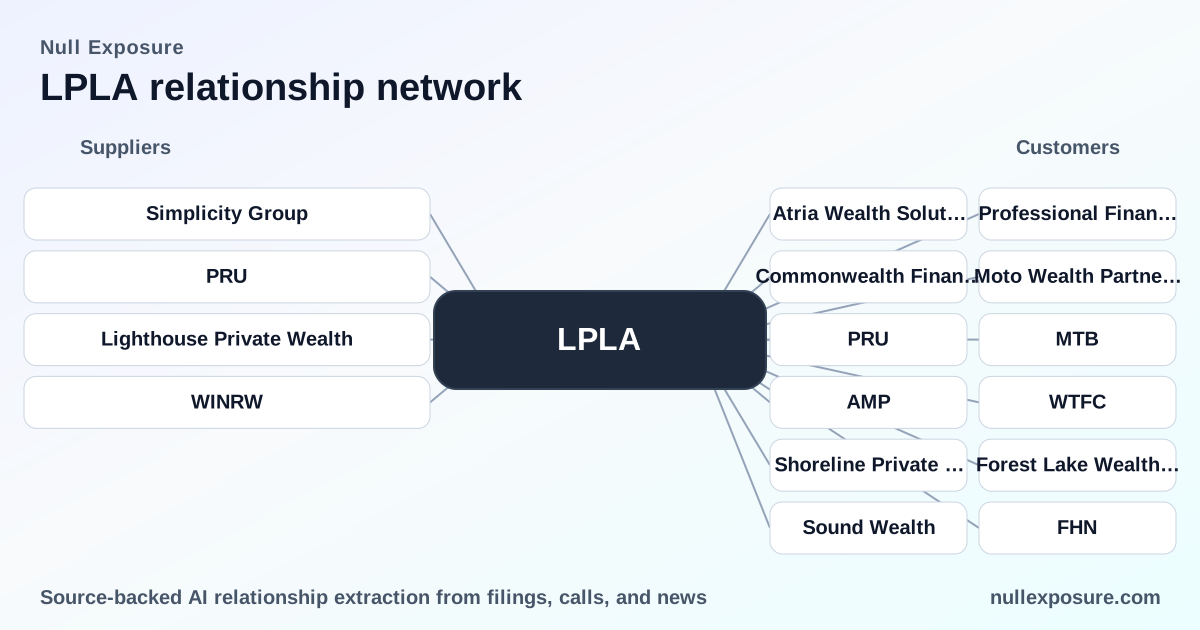
LPL Financial Holdings (LPLA): Supplier footprint and what it means for investors
LPL Financial runs an integrated brokerage and advisory platform that monetizes through transaction revenue, asset-based advisory fees, and recurring platform services to independent advisors and institutions. The firm leverages scale in custody, clearing, and advisor services to generate predictable fee income and cross-sell insurance and technology services to its advisor network; those supplier and vendor relationships directly affect operating leverage, cost structure and product distribution. For investors assessing supplier risk and strategic optionality, the supply-side moves announced in early 2026 shift both distribution capability and near-term expense dynamics. Explore supplier details and implications below — or visit the Nillexposure research hub for more coverage: https://nullexposure.com/.
Why supplier relationships matter to LPL's economics
LPL's business model is platform-first: it turns custody and clearing infrastructure into a recurring revenue engine while selling value-added services (technology, insurance placement, training) to affiliated advisors. Suppliers and service partners therefore influence three investment levers:
- Revenue capture and distribution: preferred partners that deepen advisor-facing product sets (for example, a Brokerage General Agency for insurance) increase wallet share per advisor and reduce leakage to competitors.
- Cost and margin profile: M&A (Commonwealth acquisition effects) and outsourcing decisions drive core G&A and operating margin volatility. LPL reported $16.6 billion revenue TTM and an operating margin near 10%, so incremental supplier-driven costs scale quickly.
- Operational resilience: reliance on third-party platform and offshore providers concentrates operational risk; a single major provider failure could be material to operations and reputation.
Key corporate signals from LPL’s filings reinforce this: the company carries long-term leases (1–12 years with extension options), segregates short-term government securities for regulatory purposes, and relies extensively on third-party service providers and consultants for technology and security. Those are company-level characteristics that shape contracting posture, concentration risk and criticality of supplier relationships.
Supplier roll-call: every relationship reported (concise summaries and sources)
Simplicity Group / Simplicity (FY2026)
Simplicity will become LPL’s preferred Brokerage General Agency (BGA) effective May 1, 2026, taking responsibility for insurance distribution, technology for advisors, and assuming LPL Insurance Associates — a move that centralizes insurance placement under a preferred external partner and strengthens LPL’s advisor-facing insurance capabilities. This was announced in a PR Newswire release (March 2026) and reported across market outlets including SimplyWallSt and TradingView in early March 2026.
Source: PR Newswire press release (March 10, 2026) and corroborating coverage on SimplyWallSt and TradingView (FY2026).
Prudential / Commonwealth expense impact (2025Q4)
Management reported in the 2025 Q4 earnings call that the full-year impact of expenses related to Commonwealth (a transaction or integration with Prudential-related activity) will add roughly $380–$390 million, leading to a 2026 core G&A expectation in the $2.155B–$2.210B range; this indicates supplier/integration costs are a material near-term driver of operating expenses. The comment was made on LPL’s Q4 2025 earnings call.
Source: LPL Financial Q4 2025 earnings call transcript (2025Q4).
Lighthouse Private Wealth (FY2026)
Lighthouse Private Wealth is referenced as an existing firm that supports LPL-affiliated advisors, highlighted in press around advisor moves and team transitions; the relationship is distribution-focused, emphasizing LPL’s reliance on independent wealth firms to sustain asset growth. This was noted in recent coverage of advisor hires and team alignments.
Source: News coverage on advisor moves reported via QuiverQuant (March 2026).
(Trading and market outlets sometimes list Simplicity under related tickers such as WINRW in public write-ups; press coverage is consistent that Simplicity will service insurance distribution for LPL. Sources: TradingView and other March 2026 articles.)
What the constraints tell investors about LPL’s operating posture
- Contracting posture — long-term commitments. LPL maintains long-term leases and contractual commitments (1–12 years with extension options), which implies fixed-cost leverage and limited short-term flexibility in real estate and equipment spend. Treat occupancy and related fixed costs as structural rather than transient.
- Counterparty mix — government exposure for regulation. The company segregates U.S. Treasury bills under federal regulations for cash equivalents, demonstrating conservative short-term liquidity placement and regulatory compliance practices.
- Operational concentration — material supplier risk exists. While LPL asserts no single cybersecurity incident has been material historically, its disclosure names third-party service-provider risk explicitly: BETAHost and other service providers are cited as potential sources of serious operational disruption if they fail. That language elevates supplier criticality from a theoretical to a measurable operational risk.
- Buyer and service-provider roles. LPL functions as a buyer in securities borrowing and as a buyer of outsourced technology and support, while also acting as a service provider to advisors; this dual role creates complex dependency chains where an upstream vendor failure can flow downstream into advisor-facing service interruptions.
Together, these signals indicate a mature platform with significant fixed-cost commitments and concentrated third-party dependencies — positive for scale economics when suppliers perform, but a vulnerability if key partners fail.
If you want a concise supplier-risk scorecard tailored to LPL’s vendor lineup and contractual terms, Nillexposure tracks these relationships in detail: https://nullexposure.com/.
Investment implications: read-throughs and red flags
- Positive read-throughs: The Simplicity BGA arrangement strengthens LPL’s insurance distribution and advisor value proposition, supporting advisory revenue penetration and cross-sell potential; advisory assets already account for a rising share of total assets under custody, which increases recurring fee potential.
- Near-term margin pressure: Integration and transaction-related expenses (Commonwealth/Prudential reference) create a clear near-term headwind to core G&A and operating margins; investors must bake in the $380–$390 million cost influence referenced by management for 2026.
- Operational risk to monitor: BETAHost and other named service-provider exposures are a tangible operational risk; any vendor outage or cybersecurity incident involving a third party would have outsized reputational and operational consequences given LPL’s role as platform operator. Active vendor oversight and contract terms will be material to long-term risk mitigation.
For a focused vendor due-diligence brief and contract-risk mapping against LPL’s public filings, Nillexposure provides structured reports for institutional investors: https://nullexposure.com/.
Bottom line for investors
LPL is a scaled, fee-driven platform that is using supplier relationships strategically to extend advisor services (insurance, technology) while absorbing material integration costs that compress near-term margins. The Simplicity partnership is a net strategic positive for distribution; Prudential/Commonwealth-related expenses intensify margin scrutiny; and named third-party dependencies like BETAHost elevate operational risk. Investors should weigh the revenue upside from improved insurance distribution against the real execution risk embedded in supplier concentration and integration costs.
For ongoing supplier intelligence and supplier-specific scorecards on LPL and peers, visit Nillexposure: https://nullexposure.com/.