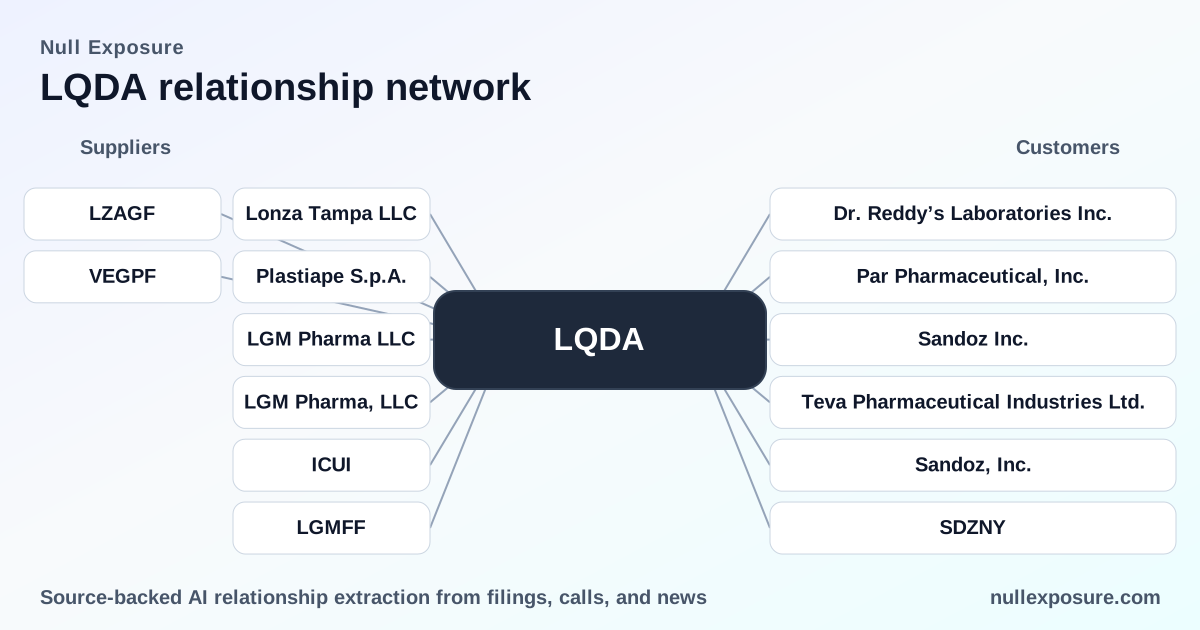
Liquidia Technologies (LQDA): Supplier map, concentrations, and what operators need to know
Liquidia is a clinical-stage and commercial biopharma that develops inhaled and subcutaneous treprostinil products using its PRINT® particle-engineering platform. The company monetizes through commercial sales of YUTREPIA (treprostinil powder), partnered and internal manufacturing and supply contracts, licensing of its inhaled program L606, and milestone/royalty obligations tied to external licenses. Revenue today is driven by YUTREPIA commercialization while future upside is concentrated in L606 and licensed devices; supplier relationships are therefore pivotal to both current cash flow and launch scale-up. For an operator-level supplier risk view and contract intelligence, visit https://nullexposure.com/ for supplier diligence and monitoring.
Why suppliers are central to Liquidia's economics
Liquidia outsources multiple critical steps of its value chain: active pharmaceutical ingredient (API) production, device supply, and final encapsulation and packaging. That outsourcing is not peripheral — it is the operating model. Single-source suppliers for the API, device, and encapsulation create concentrated operational risk: a disruption at any one vendor directly impacts product availability and revenue. Contracting posture is predominantly long-term and commitment-heavy: the company has non-cancelable supply commitments and binding forecast obligations that convert forecasts into firm orders with minimums. These commercial features translate into both downside operational risk and upside predictability for investors that value secured supply lanes.
- Contract maturity and term structure are long-dated. The amended Commercial Supply Agreement (CSA) with Lonza runs through December 31, 2028 with extension options, and corporate real estate leases extend into 2031 (with renewal options to 2036), reflecting a long-horizon operational posture.
- Concentration and criticality are high. The 10‑K discloses sole-supplier status for multiple components of YUTREPIA and single-source API and device arrangements for L606.
- Financial commitments range across bands. Company-level signals show non-cancelable commitments of
$12.8 million, rolling forecast obligations with annual minimums ($2.7 million to LGM), and larger milestone/sales potential tied to licensing (up to tens or hundreds of millions under the Pharmosa deal).
For a tailored view of how these supplier relationships map to exposure and compliance, see the supplier intelligence hub at https://nullexposure.com/.
Relationship-by-relationship: who does what (every reported supplier and mention)
Below are concise, sourced descriptions of every supplier entry disclosed in the results.
-
Lonza Tampa LLC — encapsulation and packaging partner (CSA). Liquidia executed an Amended and Restated Commercial Manufacturing Services and Supply Agreement with Lonza on July 14, 2023; Lonza is the sole supplier for encapsulation and packaging of YUTREPIA under that CSA. According to Liquidia’s 2024 Form 10‑K (filed December 31, 2024), the CSA governs delivery of bulk treprostinil powder to Lonza, which encapsulates and packages the product.
Source: Liquidia 2024 Form 10‑K (Dec 31, 2024). -
Plastiape S.p.A. — device supplier for RS00 Model 8 DPI. The company relies on Plastiape as the sole supplier of the RS00 Model 8 dry powder inhaler used to administer YUTREPIA, making Plastiape a mission‑critical device partner for ongoing commercial supply.
Source: Liquidia 2024 Form 10‑K (Dec 31, 2024). -
LGM Pharma (LGM) — API supplier and multi-year supply agreement. Liquidia identifies LGM as its sole supplier for treprostinil (the API for YUTREPIA) and has a multi‑year supply agreement that includes rolling forecasts and binding firm orders with an annual minimum purchase commitment of $2.7 million.
Source: Liquidia 2024 Form 10‑K (Dec 31, 2024). -
LGM (news mention) — binding forecasts and non-cancelable commitments. Market coverage of Liquidia’s filings highlights “established partnerships with Lonza and LGM with binding forecasts and $58.2 million in non‑cancelable supply commitments” to support launch scale-up and commercial supply.
Source: TradingView news summary of Liquidia disclosures (March 2026). -
LGM Pharma, LLC (separate 10‑K excerpt) — multi-year supply agreement (duplicate entry). The company also documents a multi‑year arrangement with LGM to supply active pharmaceutical ingredients for YUTREPIA, reinforcing the supplier’s centrality to commercial supply.
Source: Liquidia 2024 Form 10‑K (Dec 31, 2024). -
ICU Medical — pump legacy and servicing dependency. Liquidia’s filing notes that patients historically use the CADD‑MS 3 infusion pump manufactured by ICU Medical and that ICU Medical no longer manufactures or supports the CADD‑MS 3, creating a patient-device servicing and transition consideration for subcutaneous administration of treprostinil injection.
Source: Liquidia 2024 Form 10‑K (Dec 31, 2024). -
Lonza (news mention) — commercial supply commitments. TradingView coverage echoes the CSA relationship and reports binding forecasts and part of a $58.2 million set of non‑cancelable commitments tied to Lonza and LGM to underwrite launch scale-up.
Source: TradingView news summary of Liquidia disclosures (March 2026). -
Vectura (news mention) — device license and manufacturing/supply agreements. Public coverage of Liquidia’s commercial strategy notes that Liquidia secured a license for a Vectura device and established manufacturing and supply agreements to support commercialization of inhaled products.
Source: TradingView news summary of Liquidia disclosures (March 2026).
What these relationships imply for investors and operators
- Concentration risk is the central operational hazard. With sole suppliers for API, device and encapsulation, any supplier-quality, capacity, or regulatory interruption would directly constrain revenue. This is not theoretical; the 10‑K explicitly flags sole-supplier status for several components of YUTREPIA and L606.
- Contractual structure provides both predictability and fixed commitments. Long-term CSAs and binding forecast mechanics create predictable supply but also lock Liquidia into minimum purchase obligations and non‑cancelable spend — translating supply security into financial obligation. The CSA term (through December 31, 2028) and the LGM minimums are examples of that dynamic.
- Mitigation vectors: redundancy and scale-up spend. The company references efforts to establish redundant global supply chains (notably through the Pharmosa license for L606), and the Pharmosa deal embeds significant milestone/sales payment potential (development milestones and royalties), indicating a strategic trade-off between outsourcing and protected upside.
For a deeper, transaction-level view of these suppliers and to monitor changes in commitments or counterparty risks, use the supplier intelligence tools at https://nullexposure.com/.
Practical takeaways and investor actions
- Prioritize monitoring of Lonza, LGM, and Plastiape operational performance. These three vendors underpin YUTREPIA’s supply chain and therefore revenue continuity.
- Track non‑cancelable and minimum commitments in quarterly disclosure language. Changes in forecast structures, purchase minimums, or capital reimbursement clauses (e.g., Lonza equipment reimbursement caps) will move near-term cash flow and margin risk.
- Validate contingency plans for device and pump support. The obsolescence of the ICU Medical CADD‑MS 3 pump introduces a patient‑care transition risk; device licenses (e.g., Vectura) and pump development collaborations should be monitored for regulatory timelines and 510(k) progress.
If you manage supply‑chain exposure or run diligence for a portfolio, the supplier dossier and alerting available at https://nullexposure.com/ will materialize these relationships into operational signals and early warnings. Use that to convert disclosed contractual commitments into actionable risk weights ahead of quarter‑end filings.