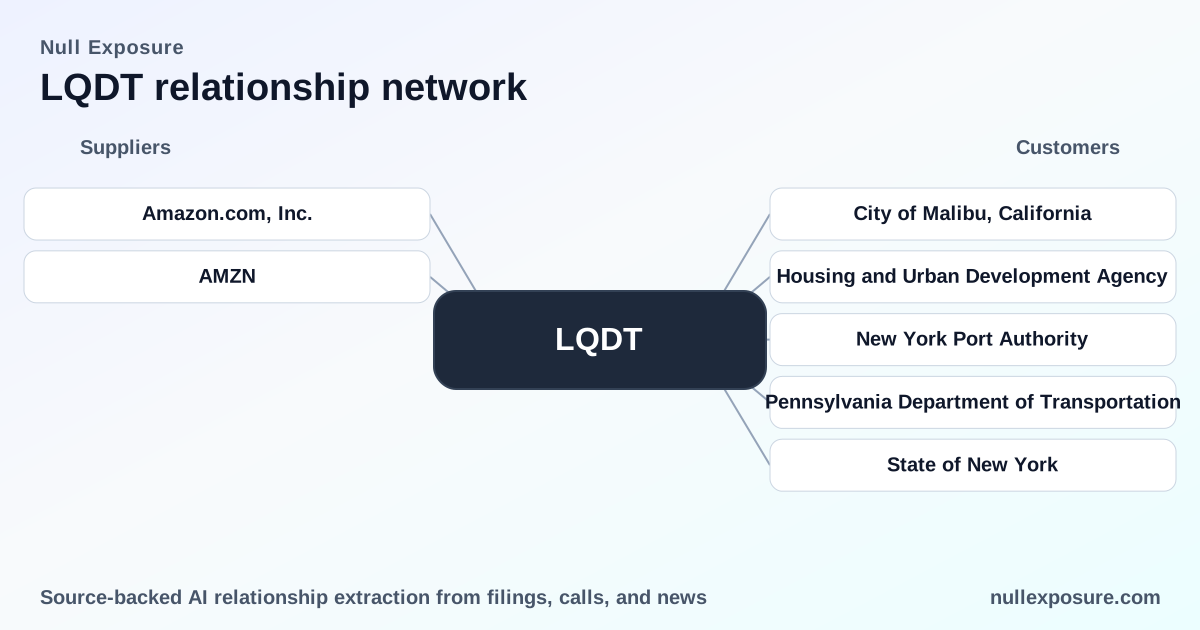
Liquidity Services (LQDT): supplier exposure and the Amazon dependency investors must price
Liquidity Services operates an e-commerce marketplace and a purchase‑and‑resale business that acquires commercial merchandise from sellers and resells it through automated channels. The company monetizes through resale margins on purchased inventory and marketplace/service revenues tied to disposition activity. For investors evaluating supplier counterparty risk, the dominant near‑term item is supply concentration: Liquidity Services sources a meaningful share of its purchased inventory from a small number of large vendors, which directly influences availability, cost of goods sold, and margin volatility. For further supplier-mapping intelligence, visit https://nullexposure.com/.
The quick read on how LQDT runs procurement and why suppliers matter
Liquidity Services combines marketplace facilitation with direct inventory purchasing under a purchase transaction model; the company explicitly recognizes purchase revenues from the resale of inventory it buys from sellers. That mix creates two operating levers and two distinct supplier relationships: marketplace sellers with transactional terms, and large vendor counterparties whose supply cadence sets the volume and cost base for the resale business. This dual role amplifies supplier economics: when large vendors change mix, cadence, or commercial terms, Liquidity Services’ procurement pipeline and margins move materially.
- Contracting posture: The company relies on multiple vendor contracts, but the 10‑K highlights limited near‑term alternatives if a major vendor alters terms. That gives suppliers leverage over supply quality and timing.
- Concentration: Management discloses that Amazon supplies a significant portion of purchased inventory; this creates a single‑counterparty concentration risk.
- Criticality: The company states that adverse changes from major vendors would materially affect its ability to procure inventory timely, which is critical for revenue continuity.
- Maturity: Vendor relationships are established and recurring, but their terms and the vendor’s inventory mix can change quickly and affect throughput.
If you want a compact supplier risk report tied to transaction-level evidence, start here: https://nullexposure.com/.
Supplier relationship evidence: what the filings and press releases show
Below are the specific relationship records surfaced across filings and press coverage. Each entry is presented with a concise, plain‑English summary and the source.
FY2025 Form 10‑K — Amazon.com, Inc.
Liquidity Services discloses multiple vendor contracts with Amazon under which it acquires and sells commercial merchandise, and warns that if Amazon stopped selling inventory on acceptable terms the company could not replace that inventory on acceptable terms or timelines. According to the FY2025 Form 10‑K (period ended September 30, 2025), this is a direct operational vulnerability to supplier commercial behavior.
GlobeNewswire press release (Nov 20, 2025) — Amazon.com, Inc.
In its FY2025 results release, management reiterated that disruptions in vendor contracts with Amazon would affect the substantial portion of purchased inventory the company sources through those agreements. The GlobeNewswire release dated November 20, 2025 records the same supply‑concentration risk highlighted in the 10‑K.
Yahoo Finance coverage (Mar 10, 2026) — Amazon.com, Inc.
Liquidity Services’ FY2026 first quarter commentary, summarized in a Yahoo Finance article on March 10, 2026, again references disruptions in vendor contracts with Amazon as a material sourcing exposure. The press coverage confirms that supply‑side dependency on Amazon continued into FY2026 commentary.
What the constraint data says about LQDT’s operating model
The company‑level constraint language shows that under its purchase transaction model Liquidity Services recognizes revenue from the resale of inventory purchased from sellers and considers those sellers to be its vendors. That is a structural operating signal: the firm is not purely a neutral marketplace operator; it is an active buyer-reseller. This distinction matters for investor diligence:
- It shifts credit and inventory risk onto the balance sheet and working capital cycle rather than leaving it wholly with third‑party sellers.
- It creates direct commercial negotiations with suppliers over price, quality, and lot mix, so supplier bargaining power translates into margin pressure.
- Because large vendors can materially affect supply mix and quantity, the company’s throughput and gross profit are sensitive to counterparty decisions rather than solely to end‑buyer demand.
These constraints are company‑level signals; they describe Liquidity Services’ operating posture rather than any single counterparty.
Investment implications: where to focus the underwriting
The supplier disclosures elevate several investment considerations that are both operational and valuation relevant:
- Concentration risk is quantifiable and material. The filings and releases identify Amazon as a significant supplier of purchased inventory; that must be modeled as a potential supply shock in downside scenarios.
- Margin sensitivity is direct. Liquidity Services’ gross profit (reported as $215.7M on trailing twelve‑month figures) and operating margin (7.73% TTM) depend on the cost and availability of purchased inventory.
- Valuation multiples assume stability. Market cap sits near $870.6M with EV/EBITDA ~14.95 and forward P/E around 20; those multiples price some continuation of current procurement economics and margin structure. A shock to vendor terms would compress margins and justify a re‑rating.
- Bargaining power is asymmetric. Large suppliers with scale—like Amazon—wield pricing and mix control that can change throughput materially, creating scenarios where Liquidity Services must accept lower margins or lower volumes.
Key financial context: Revenue TTM is $475.6M, profit margin 6.26%, and return on equity 14.7%, which together describe a mid‑margin retail disposition business leveraged to supply continuity.
Practical diligence checklist for investors and operators
When engaging with management or counterparties, prioritize questions that trace supply economics and contractual protections:
- What percentage of purchased inventory by dollar value and by units comes from each top 5 vendor, and how has that mix changed over the past 12 months?
- What are the commercial terms with major vendors (pricing mechanics, minimums, termination provisions, exclusivity or preferred channels)?
- How quickly can alternative inventories be sourced and at what incremental cost?
- What contractual or operational hedges exist (rebuy rights, return terms, consignment options)?
- How do marketplace fee revenues behave relative to purchase‑and‑resale margins in stress scenarios?
For a more structured supplier exposure map and to compare LQDT against peers, consult https://nullexposure.com/.
Bottom line: supplier exposure is a first‑order valuation lever
Liquidity Services runs a hybrid marketplace and purchase‑and‑resale franchise whose near‑term profitability is directly exposed to supplier behavior, and the company’s filings explicitly single out Amazon as a major vendor that supplies a significant portion of purchased inventory. That concentration is a clear valuation and operational risk: investors must model both the probability of vendor term shifts and the speed with which management can source acceptable alternative inventory. For targeted supplier intelligence and scenario analysis that integrates these filings and press disclosures, start your due diligence at https://nullexposure.com/.
Key takeaway: supplier concentration equals execution risk — price that into margin forecasts and downside scenarios before underwriting LQDT.