Larimar Therapeutics (LRMR): Underwriters, Advisors and the Supply-side Profile Investors Need to Know
Larimar Therapeutics develops treatments for rare diseases and monetizes by advancing clinical-stage biologics toward regulatory approval and eventual commercial sales or licensing; today the company funds that clinical progression primarily through equity raises and strategic licensing while relying heavily on third-party manufacturers and service providers to execute R&D and manufacturing. Recent underwritten offerings and a stable set of investor relations advisors reveal a financing-first model supported by outsourced production and academic licenses — a profile that drives both upside if clinical milestones succeed and execution risk if supply or partner relationships falter. For more context on supplier and capital-market counterparties visit https://nullexposure.com/.
Market-facing headline: Larimar has been actively accessing public capital in 2025–2026, engaging a syndicate of investment banks and investor-relations firms while continuing to outsource manufacturing under master service agreements and to rely on academic licenses for IP.
Why that matters to investors and operators
- Equity financings are Larimar’s near-term engine for runway; the composition of bookrunners and managers determines distribution, pricing power and execution certainty.
- Outsourced manufacturing and academic licensing create operational leverage (lower fixed cost) but also counterparty concentration and critical single-source risk that affects development timelines and commercial readiness.
- Institutional ownership is high (75.3% per public profile), amplifying the market impact of financing announcements and clinical-readout news.
If you evaluate supplier relationships or the quality of underwriting syndicates for LRMR, see full company-scope intelligence at https://nullexposure.com/.
Recent capital-markets counterparties and public relations
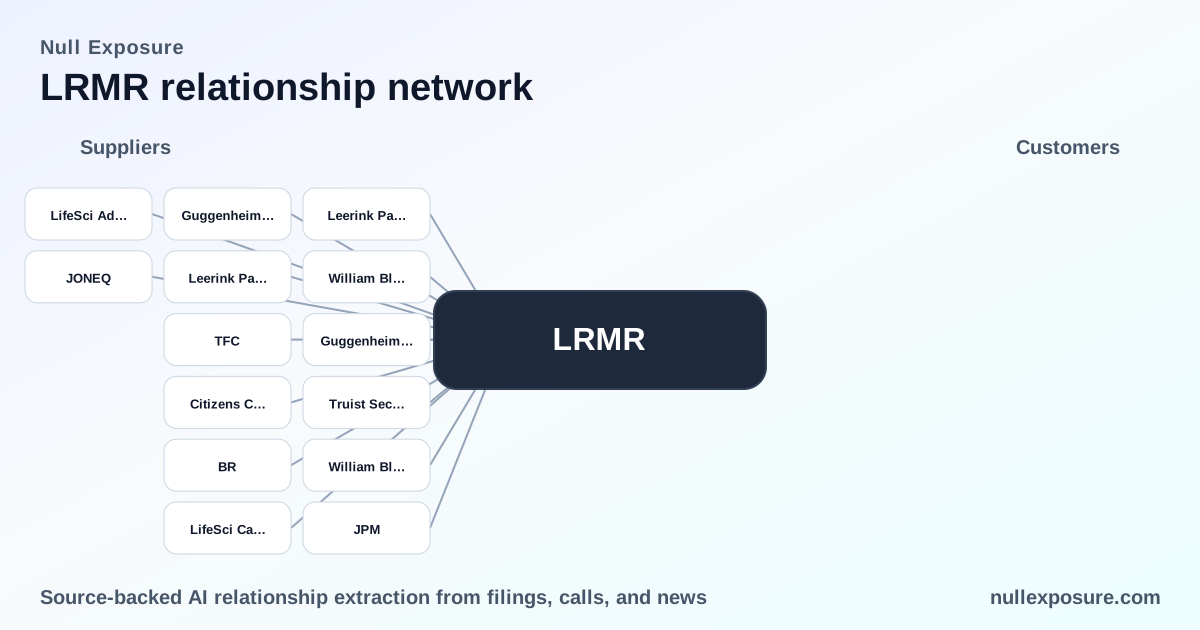
The list below captures every named counterparty that has appeared in recent press and syndication notices related to Larimar’s public offerings and investor relations activity. Each entry includes a plain-English description and the specific source context.
-
Leerink Partners LLC / Leerink Partners — Leerink served as one of the joint book-running managers on Larimar’s $69 million public offering disclosed in 2025 filings and press coverage. The Mintz press note on the offering lists Leerink among the underwriters (Mintz, 2026 press release covering FY2025 offering).
-
William Blair & Company, L.L.C. / William Blair — William Blair acted as a joint book-running manager on Larimar’s 2025–2026 underwritten offerings and is cited in multiple pricing announcements for the upsized public offering (Mintz and QuiverQuant press coverage, FY2025–FY2026).
-
Guggenheim Securities, LLC / Guggenheim Securities — Guggenheim has been named repeatedly as a joint bookrunning manager and as an underwriter representative on Larimar’s underwritten public offerings in late 2025 and early 2026 (GlobeNewswire and QuiverQuant press releases, FY2026 and FY2025).
-
Truist Securities / Truist Securities, Inc. — Truist is identified as one of the joint book-running managers on the $69 million offering disclosed in press reports, participating in the underwriting syndicate (Mintz press coverage, FY2025).
-
J.P. Morgan / J.P. Morgan Securities — J.P. Morgan and its securities arm are listed as joint bookrunning managers and representatives of the underwriters on Larimar’s 2026 upsized public offering and pricing announcements, including notices that the offering priced at $5.00 per share (GlobeNewswire, TradingView and SahmCapital news, FY2026).
-
Broadridge Financial Solutions — Broadridge is cited as the fulfillment and prospectus distribution contact for the offering, indicating its role in prospectus delivery and administrative syndicate functions (SahmCapital prospectus notice, FY2026).
-
LifeSci Capital — LifeSci Capital appears as a bookrunner and syndicate participant in 2026 offering notices; the firm’s inclusion signals an industry-focused syndicate element for the transaction (QuiverQuant and SahmCapital coverage, FY2026).
-
LifeSci Advisors — LifeSci Advisors is listed repeatedly as Larimar’s investor relations contact (Joyce Allaire) in multiple company press releases and investor presentations in 2025–2026, handling investor outreach and conference coordination (GlobeNewswire press releases, FY2025–FY2026).
-
Citizens Capital Markets — Citizens Capital Markets is named as the lead manager in syndicate descriptions for the upsized offering, indicating a role in primary distribution and deal structuring for certain tranches (SahmCapital notice, FY2026).
-
Jones — Jones is referenced as a co-manager to Citizens Capital Markets for the same offering, completing the lower-tier syndicate responsibilities in the transaction notices (SahmCapital and QuiverQuant, FY2026).
How Larimar’s supplier and contract signals shape operational risk
The public record and Larimar’s disclosures point to a few company-level operating characteristics that matter for financial and operational due diligence:
-
Contracting posture: Larimar uses a mix of long-term and shorter-term leases for office and lab space (long-term leases running to October 2029 for certain premises; a shorter Bala Cynwyd lease executed in 2019 with the option to extend). These tenancy commitments show multi-year fixed occupancy costs despite a predominantly outsourced R&D model (company filings cited in constraints, FY2020–FY2024).
-
Framework manufacturing relationships: The company relies on Master Services Agreements with third-party manufacturers for biologic drug substance and product work, indicating framework contracts that support repeated calls on capacity rather than one-off buys — a typical biotech operating model that reduces internal capex but creates counterparty dependency (MSAs referenced in company disclosures).
-
Intellectual property licensing: Larimar holds exclusive license agreements with universities that grant transferable, worldwide IP rights, establishing licensing commitments with royalty provisions that will affect margins if commercial sales occur.
-
Materiality and criticality: Company disclosures explicitly state dependence on third-party manufacturers for product candidates, flagging these suppliers as material and mission-critical to Larimar’s ability to execute clinical programs and eventual commercialization.
-
Active relationships: Manufacturing and service agreements are in active use for clinical-stage programs, consistent with a development-stage sponsor that outsources execution while focusing corporate resources on financing, regulatory and clinical strategy.
Investor implications and risk checklist
-
Financing-first bias. The prominence of large, institutional underwriters and multiple public offerings in 2025–2026 is evidence Larimar funds operations mainly through equity raises rather than revenue or non-dilutive deals. That raises dilution risk tied to clinical timelines and market conditions.
-
Supplier concentration. Outsourced manufacturing under MSAs plus exclusive academic licenses create single-point-of-failure risk that can delay programs and increase cost if a partner underperforms or capacity is constrained.
-
Visibility and governance. High institutional ownership (75.3%) concentrates voting and information flow; investor-relations coverage via LifeSci Advisors increases market visibility but also means financing news will move the stock materially.
Actionable takeaways
- For investors: underwriter composition matters for distribution and timing — track syndicate roles (J.P. Morgan, Guggenheim, Leerink, William Blair, Citizens) alongside planned clinical inflection points to anticipate dilution windows.
- For operators and procurement: prioritize contractual protections with manufacturers (redundancy clauses, capacity guarantees, change-of-control provisions) and codify transition plans given the material supplier dependence Larimar discloses.
To review related supplier and counterparty exposures for other small-cap biotechs, see https://nullexposure.com/.
Conclusion and next steps
Larimar’s profile is clear: a clinical-stage, equity-funded biotech that outsources core manufacturing and leans on academic licenses for IP. Capital markets relationships are robust and syndicate-heavy; operational risk is concentrated in third-party manufacturing and licensing. For a deeper supplier-by-supplier breakdown or to model counterparty concentration, explore full supplier intelligence at https://nullexposure.com/.