Lake Shore Bancorp (LSBK): supplier relationships and what they mean for investors
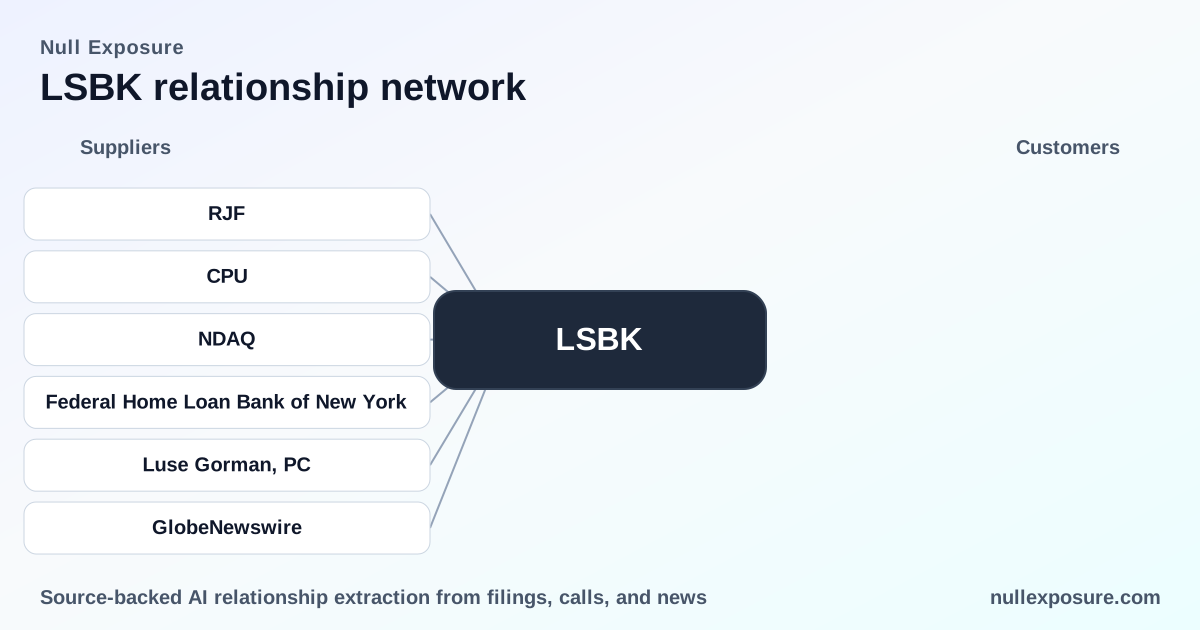
Lake Shore Bancorp is a small regional bank holding company that monetizes primarily through net interest margin on loans and interest-bearing assets, supplemented by fees and a modest dividend policy. Recent corporate actions — a subscription stock offering and a charter conversion — have engaged a familiar set of financial and professional services suppliers that shape short-term funding, investor communications, and corporate governance. For owners and counterparty managers, the supplier map tells a clear story about capital strategy, operational dependencies, and legal/regulatory hygiene.
Learn more about how we map supplier exposure at https://nullexposure.com/
How Lake Shore runs the business and why these suppliers matter
Lake Shore operates as a traditional community/regional bank: deposit gathering, mortgage and commercial lending, and incremental fee income. Episodic capital markets activity (stock offering) and conversion work elevated the importance of a few strategic suppliers — investment banks for distribution and marketing, a transfer agent for share handling, legal counsel for the conversion, and the Federal Home Loan Bank for contingent wholesale funding. These suppliers are not just vendors; they influence capital access, investor relations, and regulatory compliance.
Key operating-model characteristics:
- Contracting posture: Transactional for capital markets services (underwriting/marketing) and ongoing for transfer agent/legal counsel; contracts are typical of small-bank conversions and offerings.
- Concentration: Supplier concentration is moderate — a handful of counterparties handle major corporate actions, increasing vendor importance during conversion/offering windows.
- Criticality: Transfer agent and legal counsel are high-criticality for shareholder mechanics and regulatory filings; the Federal Home Loan Bank is a material but declining source of wholesale liquidity.
- Maturity: Relationships described are current and event-driven (FY2025–FY2026), consistent with an institution moving from federal to state-chartered structures and raising common equity.
Relationship readout: every supplier surfaced
Raymond James & Associates, Inc. — marketing agent (May 23, 2025)
Raymond James acted as the marketing agent for Lake Shore Bancorp’s stock offering, supporting distribution to investors during the subscription offering. According to a GlobeNewswire press release dated May 23, 2025, Raymond James handled marketing activities in connection with the transaction.
Computershare Trust Company, N.A. — transfer agent (July 8, 2025)
Computershare is Lake Shore’s transfer agent and managed Direct Registration System (DRS) book‑entry statements and interest check mailings for the subscription offering, with mailings scheduled around July 21, 2025. The detail comes from a GlobeNewswire release covering the closing date of the conversion transaction (July 8, 2025).
NASDAQ Global Market — listing venue (FY2026)
Lake Shore’s common stock trades on the NASDAQ Global Market under the symbol “LSBK,” which governs trading, reporting cadence, and listing compliance; this is noted in a QuiverQuant news aggregation referencing the FY2026 dividend announcement.
Raymond James & Associates, Inc. — marketing agent (July 8, 2025)
A separate GlobeNewswire notice on July 8, 2025 reiterates that Raymond James acted as the marketing agent for the subscription offering, confirming continuity between the offering launch and closing communications.
Federal Home Loan Bank of New York — wholesale funding counterparty (FY2025)
Lake Shore significantly reduced reliance on FHLBNY borrowings in 2025, repaying $8.3 million during the first nine months and carrying only $2.0 million outstanding as of September 30, 2025, signaling a de‑leveraging of wholesale funding. This repayment activity is discussed in a QuiverQuant report summarizing the bank’s third-quarter 2025 results.
Luse Gorman, PC — legal counsel for conversion (July 8, 2025)
Luse Gorman served as legal counsel to Lake Shore Bancorp and Lake Shore Federal Bancorp during the conversion and subscription offering, handling the regulatory and transactional documentation required for that corporate restructuring, as disclosed in the July 8, 2025 GlobeNewswire release.
Federal Home Loan Bank of New York — funding reduction confirmation (FY2025)
A second mention in a QuiverQuant summary reiterates the reduced outstanding balance with FHLBNY and emphasizes Lake Shore’s shift away from wholesale borrowings through 2025.
GlobeNewswire — press distribution and media channel (FY2026)
A QuiverQuant entry notes that a GlobeNewswire press release was summarized (with an AI-generated summary flag); GlobeNewswire was the distribution channel for Lake Shore’s corporate announcements on the conversion and dividend, underscoring how the company communicates material events to investors.
What this supplier map implies for investors
The supplier list is compact and event‑driven. Investment-banking, transfer-agency, and legal counsel roles were event-focused and essential to completing the conversion and stock offering, while FHLBNY functioned as a liquidity backstop that Lake Shore intentionally wound down in 2025.
- Concentration risk: Moderate — a handful of suppliers handled mission-critical tasks during the offering and conversion. Any service disruption during those windows would have been consequential.
- Operational risk: Low-to-moderate given the use of established counterparties (Raymond James, Computershare, Luse Gorman) with industry-standard capabilities.
- Liquidity posture: Improving — the bank materially reduced wholesale borrowings with FHLBNY, which reduces dependency on centralized wholesale liquidity but increases the importance of ongoing deposit stability.
- Governance and disclosure: Stronger — use of recognized transfer agent and external counsel suggests adequate controls around shareholder mechanics and regulatory filings.
For a concise investor checklist:
- Confirm ongoing engagement terms with Computershare and Luse Gorman to assess post-conversion operational continuity.
- Monitor any follow‑on engagement with Raymond James for future capital raises, which would affect dilution and funding costs.
- Track remaining FHLBNY exposure and deposit trends to validate the funding strategy.
Learn more about supplier exposure analysis at https://nullexposure.com/
Constraints and company-level signals
No explicit supplier constraints were provided in the materials reviewed; this is a company-level signal that no formal constraints or red‑flag supplier limitation excerpts were surfaced in the available relationship records. Investors should treat that absence as neutral — it is not evidence of unique guarantees or contingent liabilities from suppliers.
Conclusion — actionable next steps for investors
Lake Shore used a small, focused set of reputable suppliers to execute a conversion and equity offering while actively reducing wholesale borrowings. That combination de‑risks the funding profile while concentrating operational importance on a few professional services providers. For portfolio managers and counterparties, the relevant actions are: validate ongoing supplier agreements (transfer agent, legal counsel), watch for further capital-market engagements, and continue monitoring deposit trends as wholesale funding recedes.
For deeper supplier mapping and to benchmark counterparty concentration across your holdings, visit https://nullexposure.com/ and request a tailored exposure report.