Lightspeed Commerce (LSPD): What its supplier and capital partners reveal for investors
Lightspeed operates a cloud-native point-of-sale and commerce platform for SMBs and specialty verticals, monetizing through subscription SaaS fees, payments and financial services revenue, and bolt-on product modules that lift ARPU and lock in customers. Capital markets relationships historically finance growth and acquisitions, while a strategic payments partnership underpins Lightspeed’s merchant-facing financial products, delivering both revenue share and product integration that accelerate monetization.
If you want to map counterparty risk and supplier exposure for your portfolio or operations team, start here: https://nullexposure.com/
Why counterparties matter for a SaaS commerce platform
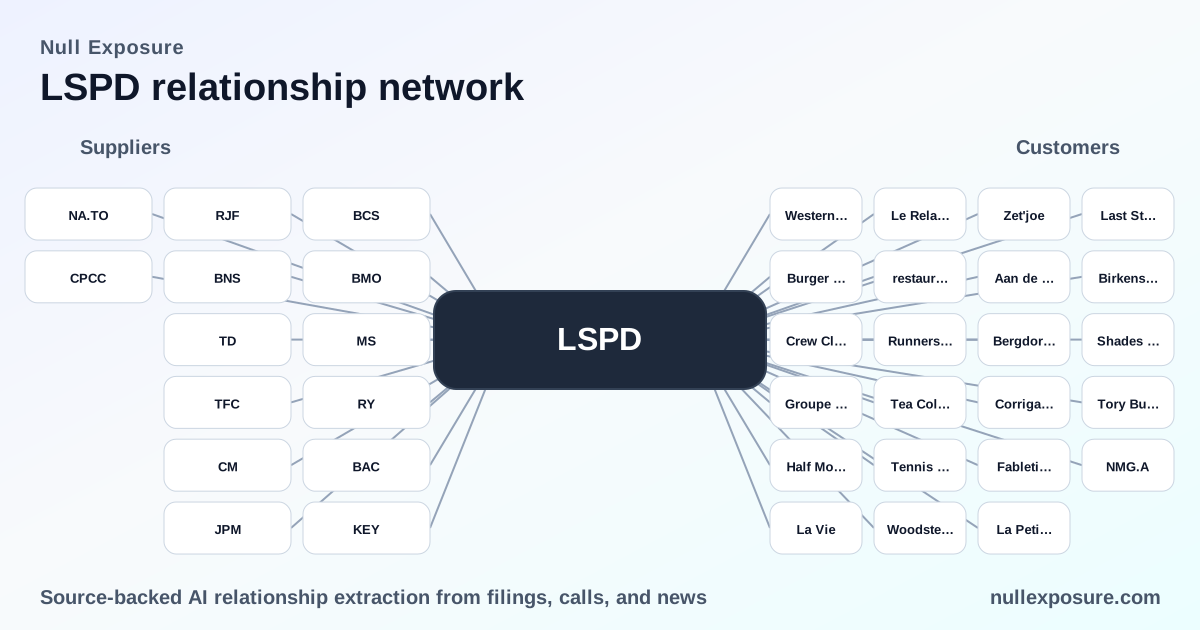
Lightspeed’s supplier map in the source material is dominated by investment banks (underwriters) tied to public offerings and a visible payments partner (Stripe) linked to product expansion. That mix signals a company that funds scale through capital markets activity while outsourcing a critical infrastructure element—payments—to a specialized provider. For investors, the net effect is simple: capital relationships reduce near-term cash constraints; the payments relationship controls product stickiness and regulatory exposure.
- Contracting posture: Lightspeed demonstrates a transactional contracting posture with underwriters for discrete capital raises and a strategic commercial contract with Stripe for payments integration.
- Concentration: Underwriting partners are diversified across global and Canadian banks, limiting syndicate concentration risk.
- Criticality: The Stripe relationship is functionally critical to Lightspeed’s payments offering and ARPU expansion.
- Maturity: These parties show a history of engagement dating to Lightspeed’s IPO and subsequent follow-on offerings, indicating established capital-market channels.
Explore a broader counterparty analysis at https://nullexposure.com/
The relationships, line by line
Below I cover every relationship extracted from the results with a concise, plain-English takeaway and a source cue.
- Barclays — Lightspeed named Barclays as a joint lead book-running manager on a public offering aimed at raising new capital to strengthen its balance sheet and fund growth initiatives. According to Betakit’s FY2021 coverage, Barclays was a joint lead on that offering.
- BMO Capital Markets — BMO supported multiple underwriting syndicates across Lightspeed’s capital raises, playing a recurring role in both IPO-era and follow-on transactions. Betakit references BMO’s involvement in FY2021 and earlier IPO coverage.
- Morgan Stanley — Morgan Stanley served as a joint lead book-running manager on key offerings, anchoring syndicates for both the IPO and subsequent public placements used to fund expansion. Betakit notes Morgan Stanley as a joint lead in FY2021 and FY2020.
- RBC Capital Markets — RBC appears repeatedly as a book-running manager and co-manager across Lightspeed’s public offerings, reflecting a sustained Canadian banking relationship. That role is documented in Betakit’s FY2021 and FY2020 coverage.
- Barclays (Newswire release) — A Newswire press release on the closing of a US $716.1M public offering confirms Barclays’ role as joint lead alongside Morgan Stanley on that specific FY2021 transaction.
- BMO Capital Markets (Newswire release) — The same Newswire release lists BMO Capital Markets as a book-running manager on the $716.1M offering, confirming syndicate support from Canada’s major banks.
- Morgan Stanley (Newswire release) — The Newswire closing statement reiterates Morgan Stanley’s position as a joint lead on the FY2021 follow-on, underscoring consistent underwriting leadership.
- RBC Capital Markets (Newswire release) — The Newswire confirms RBC’s inclusion in the syndicate for the FY2021 offering, aligning with prior coverage of cross-border underwriting support.
- BMO Capital Markets (Betakit FY2020) — Betakit’s FY2020 coverage of Lightspeed’s NYSE IPO lists BMO among the joint lead book-runners that took the company public.
- BofA Securities — Betakit’s FY2020 reporting identifies BofA Securities as a joint-bookrunner in the FY2020 transaction set, expanding the syndicate beyond Canadian banks to major U.S. dealers.
- KeyBanc Capital Markets — KeyBanc is recorded as a co-manager on the FY2020 IPO syndicate, indicating regional U.S. investment bank participation in Lightspeed’s public debut.
- Morgan Stanley (Betakit FY2020) — Betakit’s FY2020 account also names Morgan Stanley among the joint lead book-runners for the IPO, consistent with repeated Morgan Stanley engagement.
- Raymond James — Listed as a co-manager in FY2020 coverage, Raymond James provided distribution support during Lightspeed’s public transactions.
- RBC Capital Markets (Betakit FY2020) — Betakit shows RBC as a joint-bookrunner in the FY2020 IPO context, reflecting early and ongoing capital-market ties.
- Scotiabank — Scotiabank appears as a co-manager on IPO-era deals (FY2020 and FY2019 reports), offering domestic syndicate depth in Canadian capital markets.
- TD Securities — TD Securities is recorded as a co-manager across Lightspeed’s IPO-era syndicates, further diversifying Canadian bank participation.
- Truist Securities — Truist is included among co-managers for the FY2020 transaction set, adding U.S. regional bank distribution capacity.
- CIBC Capital Markets (FY2020) — CIBC is cited as a co-manager in FY2020 IPO coverage, representing another Canadian capital markets participant.
- Barclays (Betakit FY2020) — Betakit’s FY2020 write-up lists Barclays among IPO underwriters, confirming Barclays’ involvement across discrete transactions.
- BMO Capital Markets (Betakit FY2019) — Betakit’s FY2019 reporting on Lightspeed’s earlier offering names BMO as a lead underwriter, dating the bank’s relationship to Lightspeed’s early public-market history.
- CIBC World Markets Inc. (Betakit FY2019) — CIBC World Markets is identified as an underwriter on the FY2019 offering, corroborating sustained Canadian dealer support.
- J.P. Morgan Securities Canada Inc. — Betakit’s FY2019 coverage lists J.P. Morgan Securities Canada among the lead underwriters for the FY2019 placement, indicating global bank participation from the outset.
- National Bank Financial Inc. — Named in FY2019 reporting as a joint lead underwriter, National Bank adds regional capital markets reach to Lightspeed’s syndicates.
- Raymond James Ltd. (Betakit FY2019) — Raymond James is again listed on earlier coverage, showing continuity of distribution partners across years.
- Scotiabank (Betakit FY2019) — Scotiabank’s presence on FY2019 underwriting lists confirms multi-year involvement with the company’s capital activity.
- TD Securities Inc. (Betakit FY2019) — TD is recorded among FY2019 underwriters, reinforcing the bank’s role across Lightspeed’s financing lifecycle.
- CIBC Capital Markets (repeat FY2020 entry) — CIBC’s repeated mention across FY2019–FY2020 references confirms its participation across multiple offerings.
- Stripe (Betakit FY2021) — Betakit reports that Lightspeed partnered with Stripe to launch an integrated payments solution, positioning Stripe as a strategic technology and payments supplier for Lightspeed’s merchant services expansion.
- Stripe (Betakit FY2020) — Earlier Betakit coverage likewise documents an initial partnership announcement with Stripe tied to the payments product launch and subsequent SMB loan offerings.
What investors should take away from the roster
The relationship list is dominated by capital providers with repeated placements across FY2019–FY2021, indicating Lightspeed’s reliance on public markets to fund growth and acquisitions. The Stripe partnership is the single operational supplier that affects day-to-day product economics and risk—payments functionality, settlement flows, and regulatory scope are dependent on that integration. The bank syndicates reduce financing concentration risk but do not substitute for operational supplier diligence; payments remain the core vendor exposure.
Because the constraints payload returned empty, treat that as a company-level signal: no contract-level constraints were supplied in this dataset, which is a neutral data point rather than affirmative assurance of absence of risk.
If you want a rigorous counterparty exposure report tied to operational KPIs, start a review at https://nullexposure.com/ — our platform translates this supplier mapping into prioritized diligence tasks.
Bottom line
Lightspeed’s supplier footprint for investors is straightforward: diversified capital markets partners support an aggressive growth posture, while a strategic Stripe partnership runs the payments engine that drives ARPU expansion. For investors and operators evaluating supplier risk, focus on the contractual terms and service SLAs with Stripe and monitor any future shifts in underwriting patterns that would indicate financing stress or strategic change.
Final call to action: for deeper counterparty insights and to convert these relationships into actionable exposure scores, visit https://nullexposure.com/