Landstar (LSTR) — Supplier Map and What It Means for Investors
Landstar monetizes a non-asset, intermediary transportation model by matching customer freight with third‑party capacity and charging for integrated transportation management services and brokerage margins. The company’s economics depend on scale in agent distribution, dependable access to third‑party carriers, and technology that coordinates capacity across North America, turning variable purchased transportation costs into recurring revenue and market share capture.
For a compact view of current supplier relationships and the company-level constraints that shape operational risk, read on — or visit https://nullexposure.com/ for broader supplier intelligence and tracking.
How Landstar runs the business: a concise operating thesis
Landstar operates as an asset-light network: independent commission sales agents source freight, and the company exclusively uses third‑party capacity providers — a mix of independently leased owner‑operators, unrelated trucking companies, and multimodal carriers — to service customers. Landstar’s revenue is highly dependent on purchased transportation and on scale and stickiness of its contractor network, which together determine pricing leverage and margin capture.
A practical implication for investors: Landstar’s profit and growth profile is sensitive to capacity economics and service continuity, not fleet ownership cycles. If carriers tighten capacity or tracking/visibility degrade, Landstar’s ability to deploy loads and protect margins changes immediately.
The supplier relationships on record (what we found)
Below is every supplier relationship found in the provided results, summarized plainly with source attribution.
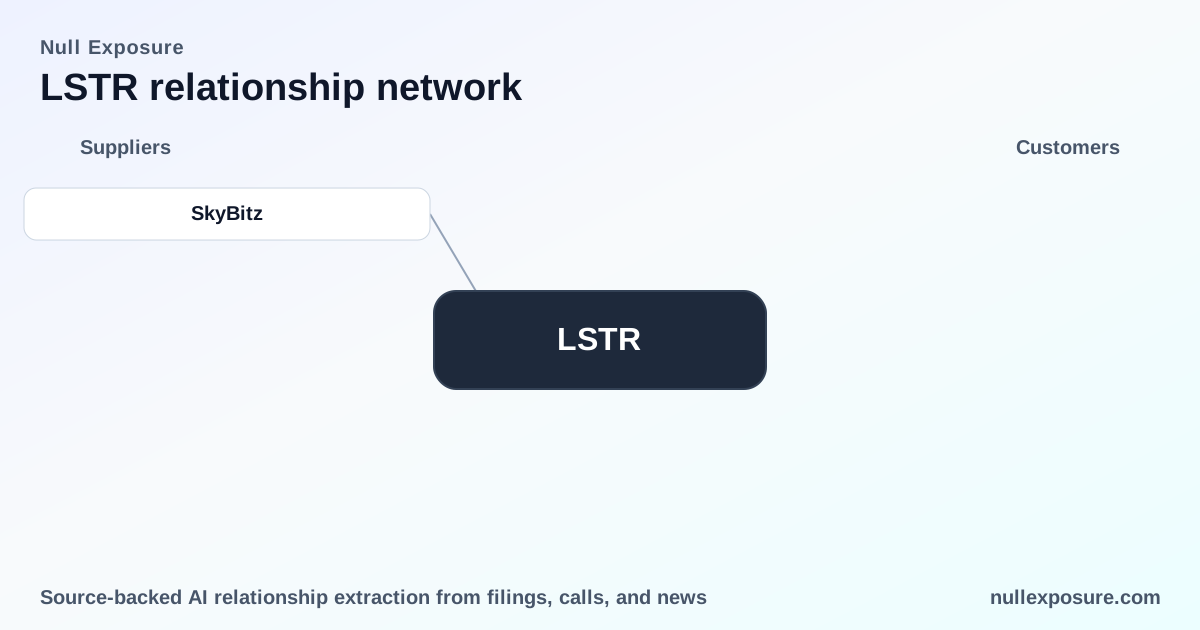
- SkyBitz — Landstar has selected SkyBitz’s GLS trailer‑tracking service to improve equipment visibility. TruckingInfo reported this selection on March 10, 2026, noting SkyBitz provides satellite‑based communications and trailer tracking for transportation equipment. (TruckingInfo, March 10, 2026)
Takeaway: Landstar is investing in third‑party telematics to standardize trailer visibility across its non‑asset network, which supports routing efficiency and customer service.
Constraints and what they signal about Landstar’s business model
The collected constraints are company-level signals that describe how Landstar contracts, where it operates, and how critical suppliers are to its financials. None of these constraints are attributed to an individual supplier unless explicitly named in the source material; they are presented as structural characteristics of Landstar’s model.
-
Contracting posture — long-term orientation. Excerpts describe BCO Independent Contractors operating under exclusive lease arrangements, indicating a prevalence of durable contractual relationships with a portion of Landstar’s capacity providers. This suggests predictable access to certain owner‑operators and an ability to lock in capacity for strategic lanes (max confidence 0.60).
-
Geographic focus — North America is core. Landstar’s integrated transportation platform and its revenue base are primarily North American, with recent fiscal revenue cited at approximately $4.8 billion. Investors should view Landstar as a North America‑centric logistics marketplace (max confidence 0.90).
-
Supplier materiality — critical dependence on third‑party capacity. Purchased transportation accounted for roughly 76.7%–78.0% of revenue in fiscal 2022–2023; in fiscal 2024, revenue from BCO Independent Contractors and Truck Brokerage Carriers comprised 38% and 52% of consolidated revenue, respectively. This is a critical dependency that directly ties Landstar’s operating margins to supplier availability and cost (max confidence 0.90).
-
Relationship role — suppliers act as service providers. The company markets through independent commission sales agents and “exclusively utilizes third party capacity providers” to move freight, confirming that vendors are operational service providers rather than passive commodity inputs (max confidence 0.90).
-
Relationship stage and segment — active and service‑oriented. The supplier base is actively engaged in providing services today and the business sits squarely in transportation services rather than asset ownership (relationship stage: active; segment: services).
Collectively, these constraints paint a picture of an asset‑light operator with concentrated operational reliance on third‑party carriers and a strategic emphasis on technology and agent distribution to manage that reliance.
What SkyBitz tells investors about strategy and risk
The SkyBitz relationship is a concrete example of Landstar’s tactical response to its operational constraints.
- Operational rationale: Implementing third‑party trailer tracking improves visibility across a highly distributed, non‑asset network and reduces load‑matching friction that would otherwise inflate purchased transportation costs.
- Risk mitigation: Improved telematics reduce service failures, deadhead miles, and claims exposure — all drivers that can protect margins in a business where purchased transportation dominates costs.
The SkyBitz deal is consistent with a strategy of outsourcing physical freight movement while investing in the connective technologies that make outsourcing efficient.
For investor-grade supplier monitoring and alerts on developments like this, see https://nullexposure.com/ — the platform centralizes supplier events for decision‑ready analysis.
Investor implications and actionable checklist
Landstar’s supplier profile creates a specific set of investment risks and operational levers:
- Margin sensitivity: With purchased transportation representing the majority of revenue, pricing power and carrier rates will be primary margin drivers.
- Concentration and continuity risk: A large portion of revenue flows through a network of independent contractors and truck brokerage carriers, so any disruption in contractor availability or regulatory changes affecting owner‑operators can materially impact performance.
- Technology as a competitive lever: Investments in telematics and load orchestration (as evidenced by the SkyBitz relationship) increase operational control without converting the balance sheet to an owner‑operator model; this is a durable differentiator.
- Geographic exposure: North America dominates revenue — macro or regional shocks to freight demand, fuel costs, or cross‑border flows will have outsized effects.
Suggested monitoring actions for investors:
- Track purchased transportation as a percentage of revenue each quarter.
- Watch rollouts of telematics and digital orchestration tools for evidence of measurable efficiency gains.
- Monitor contractor retention metrics and agent headcount trends for signs of capacity stress.
If you want to operationalize supplier risk monitoring for Landstar and similar non‑asset logistics operators, start with a platform that tracks supplier shifts, technology integrations, and contract posture — learn more at https://nullexposure.com/.
Bottom line
Landstar is a North America‑focused, asset‑light logistics marketplace whose performance hinges on third‑party carriers and the technology that coordinates them. The SkyBitz trailer‑tracking engagement is a tactical implementation of that strategy: mitigate the risks of outsourcing by owning visibility and orchestration. For investors, the primary levers to watch are carrier economics, purchased transportation trends, and the pace of operational technology adoption. Explore supplier intelligence and ongoing alerts at https://nullexposure.com/ to track these dynamics in real time.