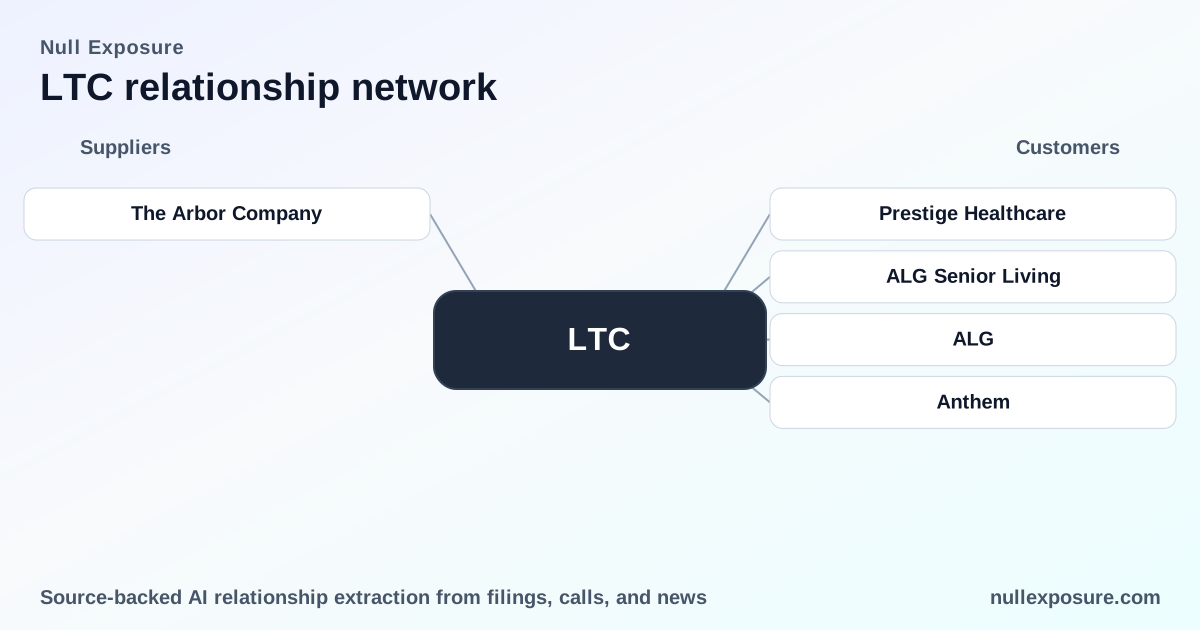
LTC Properties Inc — operator relationships and supplier risk
LTC Properties Inc (NYSE: LTC) is a healthcare-focused REIT that monetizes senior housing and skilled-nursing real estate through back-lease sales, mortgage financing, joint ventures, and structured finance (preferred equity and mezzanine loans). The firm’s economics are driven by contractual rent streams, credit yields on financing vehicles, and occasional capital gains on property dispositions; those cashflows support a sustainable dividend profile and a portfolio-level yield/valuation that investors can underwrite against operator performance and occupancy. If you are sizing counterparty operational risk or underwriting lease-backed credit, this supplier review isolates what matters at the relationship level. For additional supplier analyses, visit https://nullexposure.com/.
Executive snapshot: operator-managed, finance-first model
LTC runs an asset-light, finance-first REIT model: it rarely operates facilities directly and instead relies on third‑party operators to run resident services and day‑to‑day site management, while LTC holds long-term leases, mortgage positions, or preferred equity. That structure creates two simultaneous opportunities and risks: upside through durable lease and spread income, and counterparty concentration risk where operator performance directly affects occupancy, rent collection, and re-leasing economics.
Context from the company’s public profile: Market capitalization ~$1.89B, trailing EBITDA ~$111M, dividend yield ~5.8%, and high institutional ownership (~74%), which together indicate a professionally followed, income-oriented REIT with a governance and investor base sensitive to yield and cashflow stability.
Operator partner on the books: The Arbor Company
The Arbor Company manages a group of LTC’s communities that are 92% occupied and were built between 2014 and 2018, and LTC has confirmed that The Arbor Company will continue to operate those properties under existing arrangements. InsiderMonkey and Finviz coverage on March 10, 2026 carried this operational detail and occupancy figure, reflecting the same underlying company communications and market reporting. (InsiderMonkey / Finviz, March 10, 2026.)
Why this relationship matters to investors
- Occupancy and asset vintage: The reported 92% occupancy across these communities is a near-term revenue stabilizer; the properties’ 2014–2018 build vintage signals relatively modern plant and lower immediate capex needs versus legacy assets.
- Operator continuity: LTC’s decision to continue with The Arbor Company preserves operational continuity, which protects cashflow and reduces near-term leasing and transition risk.
- Credit and dividend linkage: LTC’s finance-driven cashflows depend on rent receipt and lease enforcement; strong operator performance translates to more predictable distributions and lower downside to NAV.
If you’re evaluating LTC’s counterparty book in depth, this single operator outcome is straightforwardly favorable on occupancy and vintage, though investors should quantify concentration across LTC’s full operator roster.
Company-level constraints and what they imply for supplier diligence
LTC’s public profile and operating model generate a set of persistent constraints that investors should treat as company-level signals (not tied to any single operator unless explicitly stated):
- Contracting posture — landlord and structured financier: LTC commonly structures relationships as long-term leases, mortgage loans, preferred equity, or mezzanine positions. That posture shifts operational risk to third-party operators while LTC retains financial exposure and counterparty credit risk.
- Counterparty criticality: Operator performance is functionally critical to LTC’s revenue—operators control occupancy, resident satisfaction, and on-site cost control—so operator diligence is a first-order underwriting task.
- Portfolio maturity: The presence of recently built communities (2014–2018) in reported assets indicates mid-life physical assets with limited near-term capex, improving near-term free cashflow visibility for financed positions.
- Investor composition and governance focus: With ~74% institutional ownership and modest insider concentration, LTC is subject to active investor scrutiny on yield sustainability, asset quality, and financing strategy; supplier payments and lease covenants will be reviewed through that lens.
- Concentration and re-leasing risk: While specific operator concentration metrics aren’t disclosed here, LTC’s model implies potential concentration exposures where a handful of operators control sizable portfolio slices—this elevates the importance of counterparty credit metrics, replacement cost, and re-leasing assumptions in scenario stress tests.
These constraints define the framing for supplier diligence: focus on contractual terms, operator financial health, lease covenants, and physical asset condition.
Practical due diligence checklist for operator relationships
- Confirm lease structure and term: back-lease vs. financed mortgage/ preferred equity—each has different cure rights and cashflow attachment.
- Validate operator financials and occupancy trends: multi-quarter occupancy and EBITDA trends are the immediate credit signals.
- Review capex obligations and replacement reserves in leases—who bears the mid-life capex cost matters to net returns.
- Stress-test dividend coverage under operator underperformance scenarios to estimate distribution resilience.
For a deeper set of supplier relationship profiles and credit-focused reads, see the analysis library at https://nullexposure.com/.
Investment implications and the trade-offs
- Positive near-term signal: The Arbor-managed portfolio’s 92% occupancy and modern build vintage are clear positives for LTC’s short-to-medium-term cashflow and dividend support.
- Residual risk: LTC’s business model still concentrates risk in operator execution and credit; any operator-level deterioration can transmit quickly to rent collections and require capital interventions.
- Valuation context: LTC trades with a Price/Book ~1.76 and EV/EBITDA ~13.8 (company-reported), implying the market prices a moderate premium for yield with an expectation of stable operator performance.
Bottom line — what investors should do next
LTC’s supplier profile is operationally simple but strategically material: strong occupancy and modern assets under The Arbor Company provide a supportive near-term read on cashflow, but ongoing monitoring of operator concentration, lease structures, and reserve funding is essential to protect distribution economics. For ongoing tracking of operator relationships and supplier risk signals, visit https://nullexposure.com/ for curated profiles and alerts.
Key actionable items:
- Verify lease documentation and cure rights for Arbor‑managed assets.
- Incorporate operator stress scenarios into dividend coverage models.
- Monitor announced operator changes and occupancy trends on a rolling basis.
Those steps will separate a good income thesis from a vulnerable one in LTC’s operator-dependent structure.