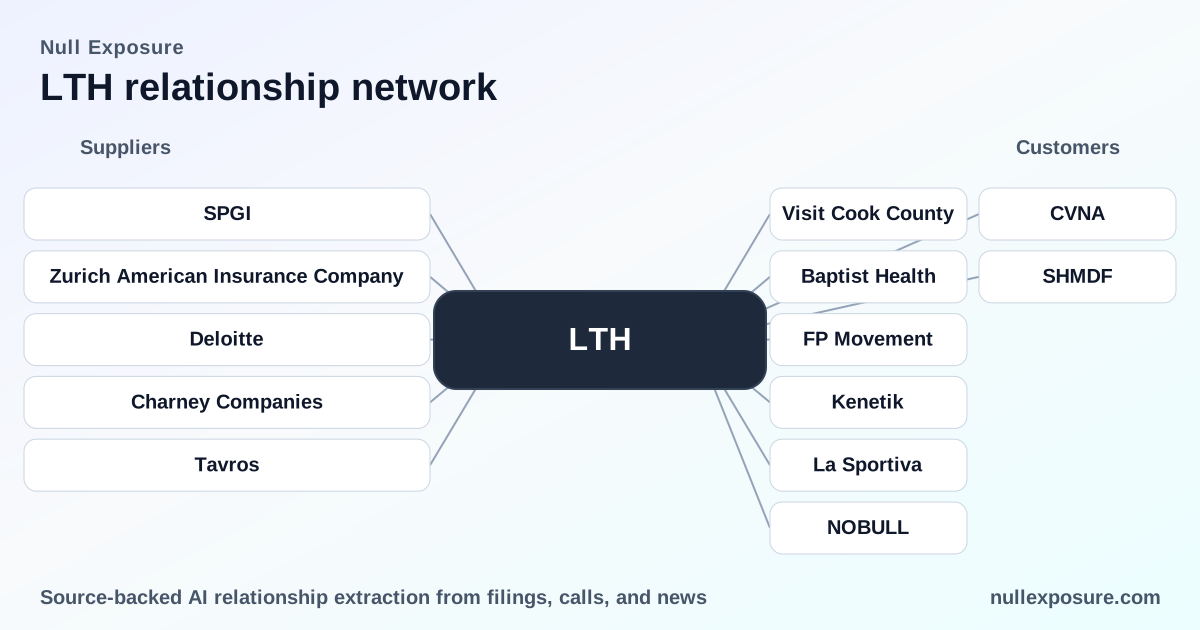
Life Time (LTH) supplier relationships — what investors and operators should price in
Life Time Group Holdings operates a vertically integrated health, fitness and wellness platform that monetizes through recurring membership fees, ancillary services (personal training, food & beverage, retail), real-estate leases and branded partnerships that embed clubs into mixed-use developments. Revenue durability depends on membership economics and real-estate commitments; financing costs and insurance recoveries are immediate drivers of free cash flow. For deeper supplier and counterparty analysis, visit https://nullexposure.com/.
Executive snapshot: what matters to shareholder value
Life Time’s model is capital- and lease-intensive, relying on long-term real estate commitments and a steady flow of contracted services for software, marketing and equipment. Recent events — a credit-rating upgrade and a material insurance settlement — move the needle on financing cost and one-off earnings adjustments, while new leases reflect steady network expansion into third-party developments. Management’s ability to control contracted spend and to extract proceeds from insurance and legal recoveries will determine near-term free cash flow volatility.
Supplier and counterparty map — line by line
Below are the relationships surfaced in recent reporting, each summarized in plain English with source context.
-
S&P Global Ratings (SPGI). Life Time disclosed that S&P upgraded its issuer credit rating to BB- from B+ on June 18, 2025, which reduced the interest-rate margin on a term loan by 0.25 percentage point to 2.25% effective June 19, 2025; this directly lowers funding cost and improves interest expense dynamics (see Life Time press release dated Feb 24, 2026 at https://news.lifetime.life/2026-02-24-Life-Time-Reports-Fourth-Quarter-and-Full-Year-2025-Financial-Results).
Source: Life Time investor release, Feb 24, 2026. -
Zurich American Insurance Company (payment for BI claims). Life Time reported that Zurich paid nearly $40 million in partial satisfaction of business-interruption claims tied to government-ordered COVID-19 closures, representing capped payments for multiple occurrences as established by a Minnesota Court of Appeals order (see Life Time releases on Feb 24, 2026 and PR Newswire prelim results).
Source: Life Time releases (Feb 24, 2026) and related PR Newswire filing. -
Deloitte (independent auditor). Life Time noted that its preliminary amounts are subject to final review by management, the audit committee and Deloitte, signaling normal year-end audit procedures before final financial statements are issued (see PR Newswire preliminary-year-end disclosure).
Source: PR Newswire, preliminary FY2025 filing, Feb 24, 2026. -
Charney Companies (real-estate landlord/partner). Life Time signed a lease at 175 Third Street, identifying Charney Companies as the owner/developer for a new club location, reflecting expansion via third-party development projects (reported via PR Newswire and aggregated by market pages).
Source: PR Newswire / market reporting (referencing PR Newswire announcement). -
Tavros (development partner at Gowanus Wharf). The lease at 175 Third Street also connects Life Time to Tavros, the co-developer of the Gowanus Wharf project where the new club will locate, demonstrating continued use of developer partnerships to scale locations.
Source: Market reporting citing PR Newswire / Finviz (announcement of lease at 175 Third Street). -
Zurich American Insurance Company (duplicate disclosure). A second disclosure reiterates the Zurich payment as the vast majority of the preliminary adjustment for FY2025, emphasizing the material accounting impact of the settlement in the company’s reported results (see PR Newswire prelim results and investor release).
Source: PR Newswire and Life Time investor release, Feb 24, 2026.
What the constraints reveal about operating posture
Life Time’s supplier constraints point to a mature, long-horizon contracting posture and measured variable spend:
- Leases run long. Excluding renewal options, center leases extend through August 2025–December 2054, a signal that real-estate obligations are long-dated and capital-intensive, locking occupancy costs and creating exit friction.
- Licence and contracted service exposure. The company contracts third parties for software licenses, support and marketing, indicating dependence on specialized vendors for member-facing systems and customer acquisition.
- Buyer and service-provider duality. Life Time functions principally as a buyer of equipment and services, with expected contracted services spend of approximately $11.1 million next 12 months and ~$4.3 million thereafter; contract terms position the company as a sophisticated procurer with predictable recurring spend.
- Spend scale is material but not dominant. Spend bands (both $1–10m and $10–100m) indicate mid-tier supplier relationships where single-vendor failures would cause disruption but not immediate systemic insolvency.
These constraints collectively show a company with high operating leverage to real estate and moderate dependence on third-party service providers, a combination that amplifies both upside from membership growth and downside from lease or vendor disruption.
For investors who want operational supplier intelligence integrated into their models, check out https://nullexposure.com/ for supplier-risk scoring and contractual signals.
Risk and opportunity trade-offs to price
- Positive: lower financing cost. The S&P upgrade and resultant term-loan margin reduction improve interest expense and raise the present value of future free cash flows. (Life Time investor release, Feb 24, 2026.)
- One-off earnings improvement. The Zurich settlement adds nearly $40 million to preliminary adjustments, improving FY2025 reported results and releasing reserves that were previously a drag. (Life Time investor release / PR Newswire, Feb 24, 2026.)
- Structural exposure to leases. Long-dated lease maturities through 2054 create fixed-cost leverage and constrain location flexibility—this is a structural risk if membership economics deteriorate.
- Vendor concentration and spend. Contracted services (~$11.1m next 12 months) and licensing dependencies create operational concentration in membership platforms and marketing functions; disruption to key vendors would increase churn risk and acquisition costs.
Due-diligence checklist for operators and buy-side teams
- Review the term-loan documentation to quantify the ongoing benefit of the S&P upgrade to cash interest savings.
- Validate the final audited treatment of the Zurich settlement in the FY2025 financial statements once Deloitte completes the audit.
- Inspect key license and software SLAs, renewal terms and change-of-control provisions to understand switching costs and potential cost escalations.
- Audit lease expiries and renewal options location-by-location to model downside scenarios for occupancy under lower membership demand.
Bottom line and next steps
Life Time’s recent disclosures reprice both financing and one-off insurance recoveries in favor of improved near-term cash flow, while reiterating the company’s structural reliance on long-term leases and third-party services. Investors should value the issuer with explicit adjustments for interest savings and normalized contracted-service spend; operators should prioritize vendor continuity and lease flexibility.
For a deeper, supplier-focused read and to map counterparty risk into your valuation model, visit https://nullexposure.com/.