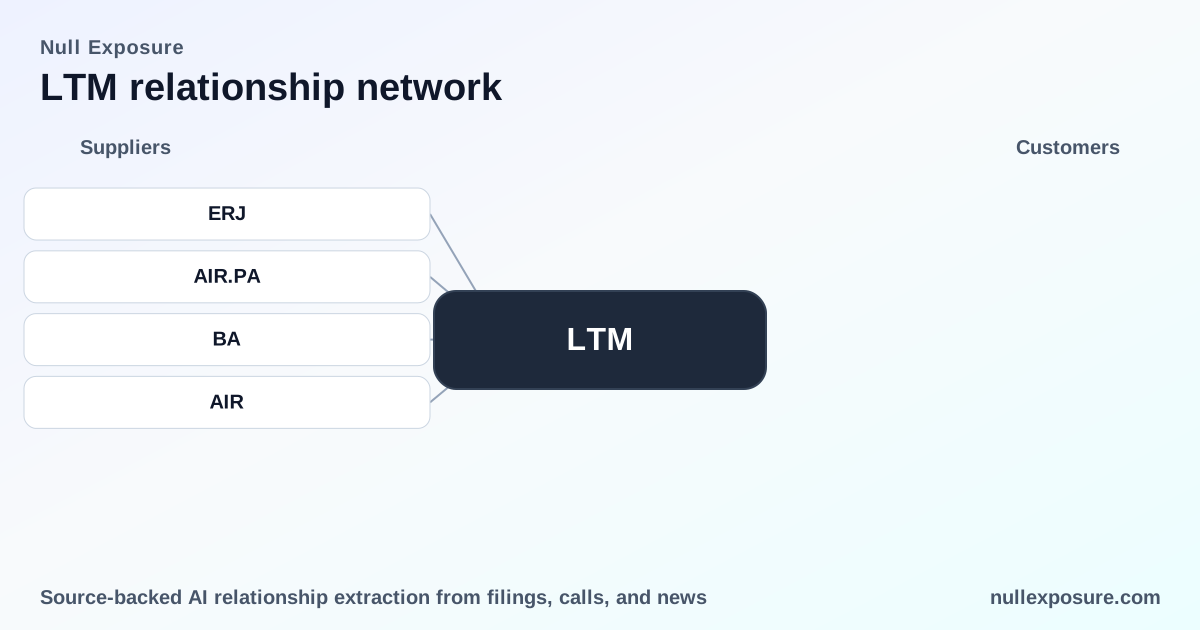
LATAM Airlines (LTM) — supplier relationships that shape fleet strategy and margin resilience
LATAM Airlines Group operates a capital-intensive regional and long-haul passenger and cargo network across Latin America and beyond, monetizing travel and cargo demand through ticket sales, ancillary services and freight operations while managing a large mixed fleet that drives both operating leverage and procurement exposure. Fleet composition and OEM relationships are central to LATAM’s cost base, route flexibility and capital allocation, and understanding supplier ties is essential for investors judging durable margins and refinancing risk. For a focused view of supplier exposures and procurement signals, visit the NullExposure homepage: https://nullexposure.com/.
Why supplier relationships matter for airline investors
LATAM’s economics are driven by seat-mile revenues and unit costs, but those unit costs are heavily shaped by aircraft fuel efficiency, lease profiles and maintenance agreements with OEMs. Commitments to specific manufacturers translate into long-term fuel-cost trajectories, spare-parts economics, and residual-value risk. Suppliers are not interchangeable: regional-jet deals affect short-haul density and feed into network growth differently than widebody orders used for international long-haul. Institutional investors evaluating capital allocation, covenant risk and operational resilience must therefore treat supplier relationships as strategic exposures rather than administrative details.
What constraints and operating signals tell us
There were no supplier-contract excerpts included in the record that impose explicit contractual constraints on LATAM. As a company-level signal, that absence is itself informative: the public record here provides fleet composition and new-order disclosure rather than detailed lease covenants or supplier-credit terms, so investors should assess contracting posture using fleet commitments, delivery schedules and OEM concentration as proxies for contract rigidity, concentration risk and supplier criticality.
From the available information, derive these operational conclusions:
- Contracting posture — capital-intensive, long-dated commitments. Fleet orders and deliveries indicate multi-year capital commitments that lock in efficiency gains and financing needs.
- Concentration — manufacturing concentration is material. Airbus and Boeing together account for the bulk of the mainline fleet while Embraer is positioned for regional growth, concentrating supplier counterparty risk across a small set of OEMs.
- Criticality — strategic suppliers for operations. Airframe suppliers are mission-critical: late deliveries or warranty/parts disruptions would immediately affect capacity and revenue.
- Maturity — fleet renewal in progress. New E2 orders and a mixed widebody fleet suggest a mid-cycle renewal rather than start-up fleet-building.
For a quick supplier-risk checklist and tracking tools, see https://nullexposure.com/.
Supplier relationships — the facts investors need (every reported item)
Below I list each reported supplier mention from the recent reporting window with a concise plain-English summary and the source context.
Embraer (ERJ) — fleet expansion order for regional E2 jets
LATAM signed for up to 74 Embraer E2 aircraft, with 24 scheduled for delivery through 2027 to enhance regional connectivity and achieve a reported ~30% fuel-efficiency improvement per seat versus prior regional equipment, positioning LATAM to densify short-haul networks. This was disclosed in an earnings-transcript style report picked up by The Globe and Mail during FY2026 commentary (March 10, 2026).
Airbus (AIR.PA) — narrow-body backbone in fleet disclosure (Globe & Mail)
As of December 31, 2025, LATAM reported 291 Airbus narrow-body aircraft and three Airbus wide-bodies on short-term leases among a total fleet of 371 aircraft, underscoring Airbus as the backbone of short- to medium-haul capacity. This fleet composition detail was reported by The Globe and Mail in a FY2026 period article (March 10, 2026).
Boeing (BA) — widebody presence in fleet disclosure (Globe & Mail)
The same December 31, 2025 disclosure shows 57 Boeing wide-body aircraft and 20 Boeing cargo freighters, indicating significant reliance on Boeing for long-haul passenger and dedicated freighter capacity. This fleet snapshot was reported by The Globe and Mail during FY2026 coverage (March 10, 2026).
Airbus (AIR) — fleet composition cited in Yahoo Finance summary
A Yahoo Finance synopsis of LATAM’s Q4/FY commentary reiterated the company’s 371-aircraft fleet with 291 Airbus narrow-bodies, three Airbus wide-bodies (short-term leases), 57 Boeing wide-bodies and 20 Boeing freighters as of year-end 2025, reinforcing the Airbus-centric narrow-body position in FY2026 reporting (SG Yahoo Finance, March 10, 2026).
Boeing (BA) — aircraft type list cited in analyst commentary (MarketScreener)
MarketScreener’s piece summarizing broker coverage noted LATAM’s passenger fleet mix includes Airbus A319-100 and A350-900, and Boeing 767-300ER, 787-8, 787-9 and 777-300ER, highlighting the variety of widebody vintages and implications for maintenance and capacity deployment. This detail was presented in March 2026 coverage of an analyst downgrade and price-target adjustment (MarketScreener, March 10, 2026).
Boeing (BA) — repeated fleet snapshot in Yahoo Finance summary
A second Yahoo Finance entry re-stated the year-end 2025 fleet split emphasizing the company’s mixed Airbus/Boeing widebody and freighter exposure, echoing earlier reporting on the same day and underscoring the message that Boeing supplies represent core long-haul and freighter capacity (SG Yahoo Finance, March 10, 2026).
Airbus (AIR) — aircraft-type confirmation in MarketScreener analyst brief
MarketScreener’s analyst-summary also listed Airbus types within LATAM’s passenger fleet, confirming Airbus narrow-body models alongside Boeing widebodies and reinforcing the multi-OEM fleet mix cited in FY2026 analyst notes (MarketScreener, March 10, 2026).
What investors should read into these relationships
- Operational risk is concentrated on a small set of OEMs. Airbus and Boeing represent the lion’s share of capacity; Embraer handles regional growth. That concentration drives supplier credit and parts-market exposure.
- Fuel-efficiency upgrades are explicit and quantifiable where disclosed. The Embraer E2 order carries a stated fuel-efficiency delta that directly lowers expected unit costs on regional routes.
- Mixed vintages and short-term leases create near-term maintenance and liquidity considerations. Multiple widebody types and short-term leased wide-bodies increase maintenance complexity and create rollover risk in tight funding environments.
Key investor takeaways: fleet commitments equal long-term capital requirements; OEM concentration equals counterparty and residual-value risk; targeted regional renewals improve unit economics but require disciplined financing.
For a tailored supplier-risk scoring and monitoring setup, visit https://nullexposure.com/ to explore supplier-level analytics.
Final assessment and actionable signals
LATAM’s supplier footprint shows a deliberate balance: Airbus-dominant narrow-body scale, Boeing-dominant widebody/freighter capacity, and a fresh regional push with Embraer E2s. That mix supports recovery and network flexibility while embedding procurement concentration and refinancing needs into the capital structure. Investors should prioritize covenant timelines, lease expiry schedules and delivery calendars when modeling free cash flow and refinancing windows.
If you are evaluating exposure to airline supply chains or building an exposure-weighted model, start with these supplier anchors and then map lease maturities and delivery schedules against LATAM’s debt and liquidity profile.
For continuous monitoring and supplier relationship mapping, return to the NullExposure hub: https://nullexposure.com/.