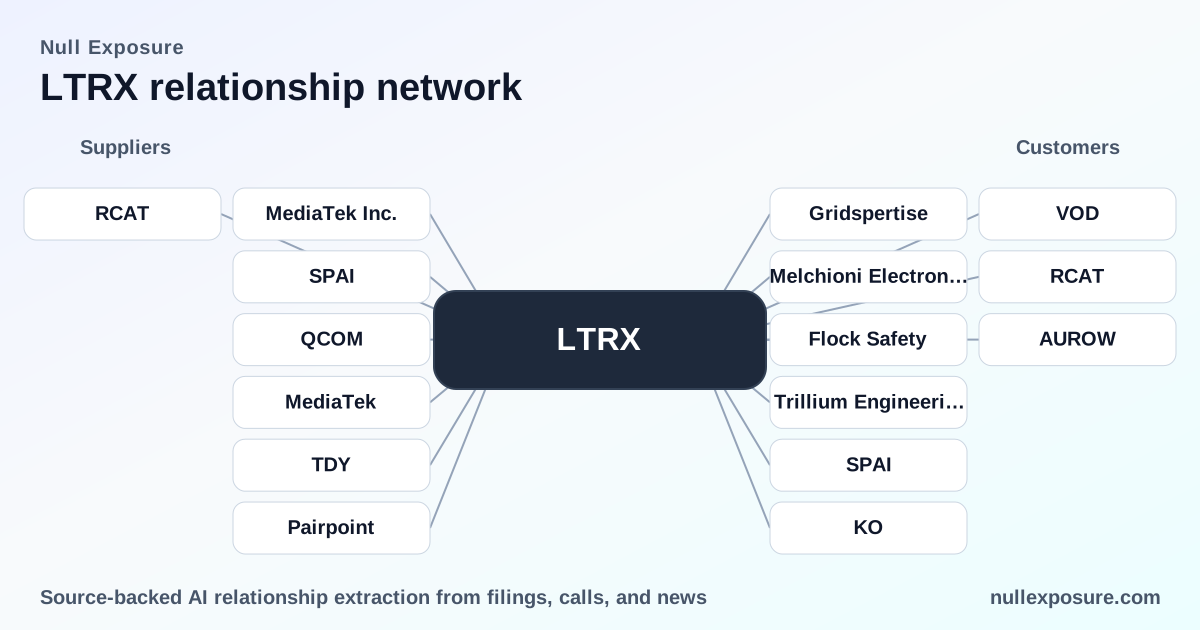
Lantronix (LTRX): Supplier relationships accelerating an edge-AI product roadmap
Lantronix operates a hybrid hardware-plus-software model: it sells System-on-Module (SOM) hardware, gateways and integrated edge systems while monetizing software, device enablement and engineering services for IoT, Edge AI and Remote Environment Management customers. Revenue comes from product sales of compute modules and gateways, recurring SaaS/firmware services and contract engineering for integration with defense, drone and industrial surveillance customers. Learn more about how we map supplier exposure at https://nullexposure.com/.
Partner-led scaling: what FY2026 reveals about the go‑to‑market
In FY2026 Lantronix is executing a clear strategy to scale its embedded compute portfolio through chipset and software partnerships that lower time‑to‑market for edge‑AI applications. The company is layering media‑grade SoMs from major silicon vendors, integrating third‑party AI models and adding security partners — a classic supplier-driven product acceleration play. This approach increases product breadth quickly but concentrates technology and supply risk with a small set of critical suppliers.
A mid‑cycle check shows three themes: (1) chip vendor diversification — new MediaTek SOMs alongside Qualcomm‑based modules; (2) software/content integrations — third‑party AI models embedded on device; and (3) security and sensor ecosystem ties — thermal cameras and post‑quantum security partners for defense/industrial customers. For a deeper supplier-risk mapping, visit https://nullexposure.com/.
Counterparty relationships — what every investor needs to know
Below are the counterparties cited in Lantronix’s recent filings and press coverage with concise, source‑backed summaries.
-
MediaTek Inc. — Lantronix announced a strategic expansion of its SOM lineup using MediaTek’s Genio family of SoCs to broaden embedded compute options for edge AI devices, signaling diversification away from single‑chip reliance. According to a GlobeNewswire press release dated March 5, 2026, the new SOM solutions are explicitly based on MediaTek Genio platforms (GlobeNewswire, Mar 2026).
-
Safe Pro Group Inc. (SPAI) — Lantronix entered a partnership to integrate Safe Pro’s Object Threat Detection (SPOTD) AI models into Lantronix Qualcomm‑based Open‑Q SOMs, positioning the company for on‑device, cloud‑independent hazard detection (e.g., landmines). This collaboration was announced in a GlobeNewswire release and covered in a Lantronix FY2026 earnings summary (GlobeNewswire, Jan 27, 2026; Yahoo Finance, FY2026).
-
Qualcomm / Qualcomm Technologies (QCOM) — Qualcomm is a foundational silicon partner: Lantronix’s Open‑Q SOM family uses Qualcomm Dragonwing and QRB/QCS series processors (QRB5165, QCS6490, QCS8550) for high‑performance, low‑latency edge inference. Lantronix referenced these Qualcomm‑powered modules both in product press releases and on earnings calls (GlobeNewswire Jan 2026; LTRX Q3 2025 earnings call).
-
Teledyne / FLIR (TDY) — Lantronix integrates Teledyne/FLIR thermal camera modules with its SOMs to enable fused thermal/RGB pipelines for ISR, inspection and autonomous navigation; management cited a new AI‑powered camera solution pairing Lantronix compute modules with FLIR hardware on earnings calls (LTRX Q3 & Q4 2025 earnings calls; GlobeNewswire Jan 5, 2026).
-
Pairpoint — Lantronix signed a Memorandum of Understanding with Pairpoint to explore embedding post‑quantum cryptography (Pairpoint SECURE) into industrial IoT hardware, reflecting a strategic move to harden device security for high‑value verticals. This MoU was announced at MWC/4YFN and reported by Asianet News and StockTwits (AsianetNews, FY2026; StockTwits, FY2026).
-
Red Cat Holding (RCAT) — Red Cat referenced Lantronix’s experience supporting defense contracts (notably Teal drones) in the context of the Safe Pro partnership, indicating Lantronix’s supplier role in established unmanned systems stacks. The association was noted in the GlobeNewswire coverage of the Safe Pro partnership (GlobeNewswire, Jan 27, 2026).
Each of the above relationships is documented in public press releases, investor coverage and Lantronix‑hosted calls; investors should treat them as productive go‑to‑market tie‑ups that also create concentrated technology dependencies.
Why the constraints matter: manufacturing, concentration and criticality
Lantronix discloses a manufacturing model that relies on third‑party contract manufacturers primarily in APAC. All products are produced through third‑party contract manufacturers and foundries in Thailand, Taiwan and China, and the company names vendors such as Hana Microelectronics, Honortone, In‑Tech, Tailyn, Info‑Tek and Rubytech in filings. This is a company‑level signal about supply‑chain posture and geographic concentration (evidence excerpt in company disclosures).
Operationally that implies:
- Contracting posture: Lantronix is an outsourcing operator for manufacturing; control over lead times and quality depends on partners rather than captive fabs.
- Geographic concentration: Manufacturing clusters in APAC create exposure to regional logistics, tariff and geopolitical dynamics.
- Supplier criticality: Chip and camera vendors (Qualcomm, MediaTek, Teledyne/FLIR) are strategically critical — they supply differentiated compute and sensors that Lantronix integrates but does not substitute overnight.
- Maturity and scalability: The partner model accelerates product releases and customer integrations but requires mature supplier management to prevent single‑source bottlenecks.
Strategic implications and risk calibration
-
Upside: Partner diversification across MediaTek and Qualcomm reduces single‑chip risk, while integrations with Safe Pro, Pairpoint and Teledyne/FLIR open defense and high‑security verticals that command premium pricing. These relationships enhance Lantronix’s plug‑and‑play value proposition for OEMs and drone/system integrators.
-
Downside: Supply‑chain concentration in APAC and dependence on a small set of silicon and sensor suppliers create execution risk — disruptions at a contract manufacturer or a chipset roadmap change at Qualcomm/MediaTek could compress product availability and margins. Investors should price in operational sensitivity to component lead times and integration cycles.
Actionable takeaways for investors
- Supplier diversification is real but still concentrated. MediaTek additions are meaningful, but Qualcomm and a handful of contract manufacturers remain critical to delivery timelines.
- Partnerships move Lantronix up‑market into defense and autonomous systems, increasing per‑unit value but also raising certification and security requirements (hence the Pairpoint MoU).
- Monitor procurement disclosures and inventory cadence for signs of manufacturing stress or substitution delays; supplier announcements from Qualcomm, MediaTek or Teledyne will materially affect product timelines.
For a granular supplier exposure map and ongoing monitoring of Lantronix’s ecosystem, visit https://nullexposure.com/. If you want regular supplier risk briefs and counterparty heatmaps for tech suppliers, subscribe at https://nullexposure.com/ and get notified when we publish the next update.
Lantronix’s FY2026 partner activity shows a company scaling capability through external suppliers and software partners — a high‑leverage play that rewards execution but demands disciplined supplier governance.