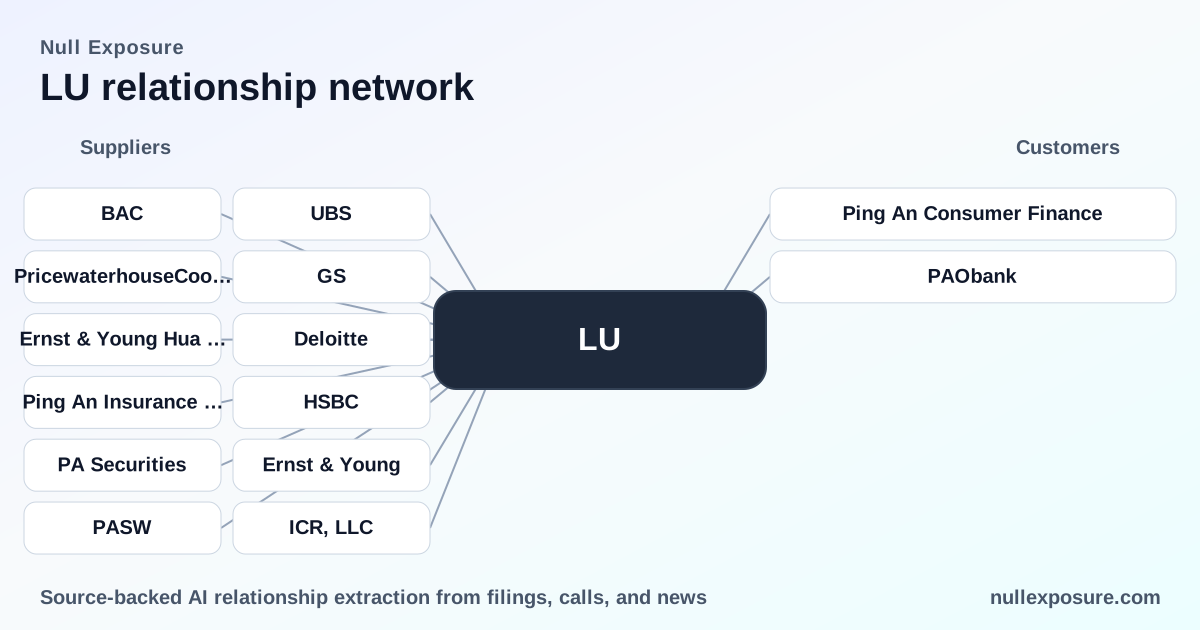
Lufax (LU) — supplier relationships that shape capital, controls and counterparty risk
Lufax is a technology-led personal financial services platform headquartered in Shanghai that monetizes through lending facilitation, wealth-management product distribution and insurance agency services, collecting fee income, servicing spreads and asset-management fees from retail and small-business clients. Revenue of roughly USD 28.4 billion (TTM) and a large gross-profit base coexist with negative net margins and recent accounting revisions, so supplier and advisor relationships increasingly determine Lufax’s access to capital, audit credibility and distribution channels. For a focused view of counterparties and what they signal for investors, see the analysis below — and review primary coverage on the Null Exposure homepage for the full supplier map: https://nullexposure.com/
Why suppliers matter for Lufax: governance, capital and distribution
Lufax's supplier set is composed of global investment banks that underwrote its IPO, Big Four and international audit firms that have rotated through its accounts, investor-relations contractors and a dominant related-party commercial group. That mix creates three structural dynamics: (1) capitalization and market access are supported by large global banks, (2) financial reporting credibility is contingent on auditor stability and review quality, and (3) distribution and product revenues are influenced by related-party commercial arrangements. These are not peripheral relationships — they directly affect liquidity, regulatory scrutiny and investor confidence.
If you want immediate access to Lufax’s supplier intelligence and ongoing monitoring, start here: https://nullexposure.com/
Company-level operating signals (what the supplier list implies)
- Contracting posture: Lufax contracts internationally for capital markets work and investor relations while selecting Big Four audit firms, indicating a preference for globally recognized providers to signal credibility to international investors.
- Concentration and criticality: The supplier map shows concentration around a single strategic commercial partner for product distribution and high criticality on external auditors and lead underwriters — failures or disputes in these relationships translate into material reputational and operational risk.
- Maturity and escalation: Auditor turnover and a public restatement point to a corporate governance inflection: Lufax is shifting from early-stage scaling to a phase where audit quality and regulatory compliance are company-critical rather than peripheral.
All identified supplier and advisor relationships — concise investor notes
-
UBS — Lufax tapped UBS as one of the lead underwriters for its IPO, reflecting UBS’s role in providing primary capital market underwriting services. Source: Insurance Journal (Oct 9, 2020) reporting on the IPO underwriters.
-
Goldman Sachs — Goldman Sachs served as a lead underwriter at the IPO, which underlines Lufax’s access to premier global investment-bank distribution at the time of listing. Source: Insurance Journal (Oct 9, 2020).
-
BofA Securities — BofA Securities was also named among the lead underwriters for the IPO, supporting Lufax’s market access and syndication capability in its primary issuance. Source: Insurance Journal (Oct 9, 2020).
-
HSBC — HSBC participated as a lead underwriter on Lufax’s IPO, contributing regional and international placement capacity during the public offering. Source: Insurance Journal (Oct 9, 2020).
-
PA Securities — PA Securities was listed alongside global banks as a lead underwriter for the IPO, representing a smaller boutique presence within the syndicate. Source: Insurance Journal (Oct 9, 2020).
-
Deloitte — Lufax engaged Deloitte to conduct independent evaluations of internal controls across corporate governance and related-party transaction management, signaling management’s effort to shore up control frameworks. Source: Sahm Capital analysis (July 23, 2025).
-
PricewaterhouseCoopers (PwC) — PwC had been the external auditor and expressed reservations before being dismissed by Lufax earlier in the review period, a change that contributed to heightened investor scrutiny. Source: Sahm Capital (July 23, 2025).
-
Ernst & Young (E&Y) — Lufax appointed Ernst & Young as its new auditor and subsequently restated IFRS-based consolidated financial statements for 2022 and 2023, with E&Y engaged for the revised 2024 annual results. Source: The Globe and Mail reporting on FY2026 disclosures.
-
Ernst & Young Hua Ming China — E&Y’s China affiliate, Ernst & Young Hua Ming, was brought in to support local audit work alongside the global network, reflecting a dual domestic/international audit arrangement. Source: Sahm Capital (July 23, 2025).
-
Ping An Insurance Group — Ping An’s subsidiaries figure prominently in Lufax’s related-party dealings, a structural commercial linkage that creates significant revenue and governance implications. Source: The Globe and Mail report on the restatement and related-party probes (FY2026).
-
Ping An (insurance products) — Lufax’s insurance agency subsidiary entered an arrangement to sell Ping An’s health insurance products, extending distribution deadlines and underscoring Ping An’s product-channel significance to Lufax’s insurance revenue stream. Source: Sahm Capital (July 23, 2025).
-
ICR, LLC — Lufax uses ICR, LLC for investor relations contact and communications, a standard IR outsourcing decision for firms maintaining international investor engagement. Source: Yahoo Finance Singapore and Manila Times/PR Newswire filings summarizing investor-relations contacts (2025–2026).
What these relationships mean for risk and return
-
Audit and reporting risk is elevated. The replacement of PwC, the hiring of Ernst & Young and a public restatement for 2022–2023 are not technicalities; they directly affect investor trust and the cost of capital. Lufax’s negative diluted EPS and negative profit margins amplify the importance of audit credibility. (Company filings and media reporting, FY2025–FY2026.)
-
Related-party concentration is a material structural risk. Close business ties with Ping An create both distribution upside and governance vulnerability; investors must treat related-party revenue as a concentration factor when modeling earnings quality. (The Globe and Mail coverage of related-party dealings, FY2026.)
-
Capital markets access is intact but historic. Participation by Goldman Sachs, UBS, BofA and HSBC in the IPO syndicate demonstrates prior market access; however, future equity or debt raises will trade on current governance and audit clarity rather than IPO pedigree. (Insurance Journal, Oct 2020.)
-
Investor communications are centralized. Engagement of ICR, LLC for IR is consistent with a company managing external messaging to rebuild investor confidence after restatements and auditor changes. (Corporate releases summarized by Yahoo Finance Singapore and Manila Times, 2026.)
If you require a live supplier map or ongoing alerts tied to these counterparties, visit our overview and monitoring tools: https://nullexposure.com/
Practical next steps for investors and operators
- Demand clarity in upcoming filings on the scope and findings of auditor work covering 2022–2024; treat audit confirmations and related-party disclosures as leading indicators of residual risk.
- Re-assess revenue quality by segment to isolate earnings tied to Ping An versus third-party distribution, and adjust valuation multiples for concentration and governance haircut.
- Monitor underwriter and banker engagement as any new capital-market activity will reveal how counterparties price Lufax’s governance and audit risk into new issuance.
For deep supplier due diligence and tracking of Lufax’s counterparty shifts, consult our research hub at https://nullexposure.com/
Conclusion: Supplier relationships at Lufax are not peripheral — they are central to valuation and risk. Audit turnover, related-party ties and the profile of capital-market partners create a compound risk profile investors must price explicitly into any investment thesis.