Lucky Strike Entertainment (LUCK): Supplier and Real-Estate Relationship Intelligence for Investors
Lucky Strike Entertainment monetizes experiential leisure through upscale bowling venues that bundle food & beverage, nightlife, and private events. The company generates revenue from admissions, F&B spend, group/event bookings and ancillary services while operating a largely leased portfolio in core urban/suburban markets. This operating model drives predictable unit-level cash flow but creates outsized sensitivity to lease negotiations, supply contract terms, and local landlord dynamics. For a concise gateway to our supplier intelligence stream, visit https://nullexposure.com/.
How Lucky Strike’s business converts foot traffic into cash
Lucky Strike runs a branded network of venues that convert discretionary consumer spend into multi-stream revenue: game play and lane fees, premium F&B, private-event margins, and branded merchandise. On a macro basis the company shows scale: Revenue TTM $1.240B and EBITDA $274.1M, with institutional ownership at ~89%, which drives market attention and liquidity. Operating margin sits at ~11.7%, while net profitability is negative on an EPS basis (-$0.66), indicating non-operating or one-time items are suppressing the bottom line despite healthy gross profit conversion.
Investors evaluating supplier and landlord risk should consider the balance between a scaled consumer brand and the franchise-like exposure to real estate and short-dated contracts. For ongoing monitoring of supplier and exposure signals, see https://nullexposure.com/.
Real estate and supplier posture you need to internalize
Lucky Strike’s operating model is highly dependent on leased real estate and short-term supplier contracts, which creates both flexibility and execution risk.
- Contracting posture — short-term: Company disclosures indicate multiple short-term supply contracts with a limited set of suppliers; this increases renegotiation frequency and supplier bargaining leverage but reduces long-term fixed commitments. (Company-level signal from corporate commentary.)
- Asset base — predominantly leased: The company reports 345 leased vs 14 owned locations (total 359 U.S. locations), underscoring exposure to landlord decisions, rent resets, and mall or retail property repositioning. (Company-level signal from location data.)
- Relationship stage — active: The footprint is operational and active across markets, which delivers current cash flow but also concentrates downside if multiple lease expirations align.
- Concentration and criticality: Limited supplier counts increase concentration risk for critical inputs (F&B vendors, technology providers, specialty maintenance), while leased sites increase dependency on landlord continuity.
These operating signals are not isolated statistics; they drive negotiation dynamics with suppliers and landlords and determine how fast Lucky Strike can scale or contract a market presence.
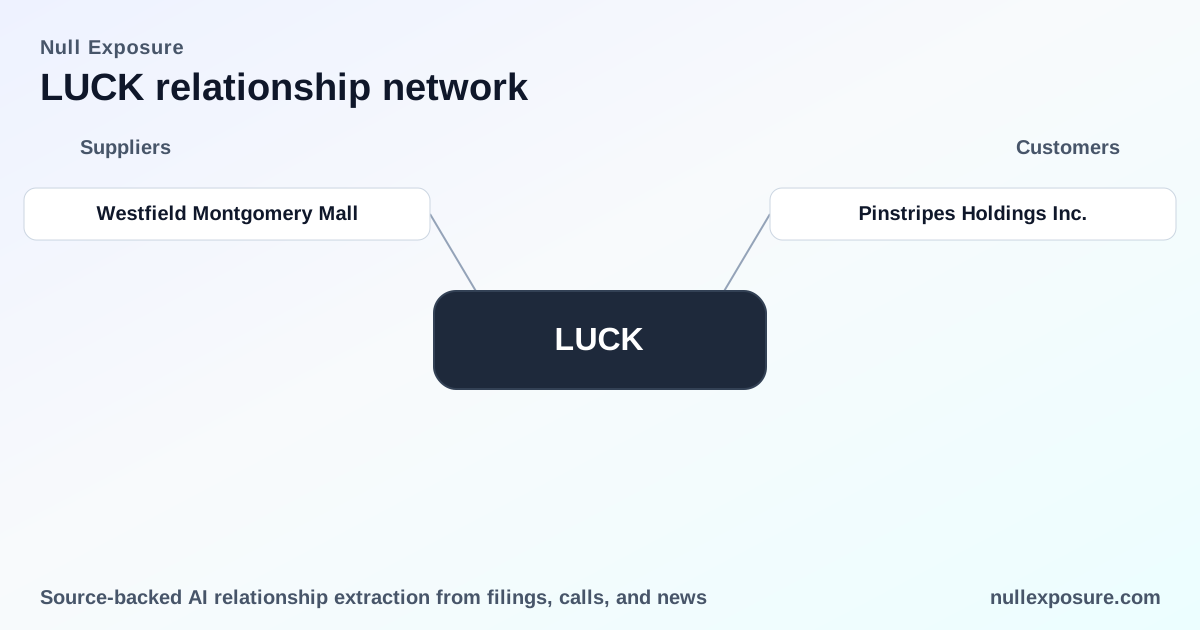
Individual supplier/partner event: Westfield Montgomery Mall closure
Lucky Strike will permanently close its Westfield Montgomery Mall location after nearly eight years when the lease expires on January 4, 2026; the company elected not to renew the lease, according to local reporting. A MoCoShow article dated January 2, 2026 recorded the closure and quoted a representative explaining the decision as lease-driven. (Source: MoCoShow, January 2, 2026 — https://mocoshow.com/2026/01/02/lucky-strike-to-close-permanently-after-nearly-eight-years/)
This single-location closure is consistent with a portfolio strategy that uses leasing to retain flexibility, but it highlights the real operational consequence when landlord relationships and site economics fail to align.
Why this matters to operators and investors
The Westfield Montgomery Mall event is a discrete example of a persistent structural theme: lease expirations force location-by-location decisions that directly affect revenue and brand presence. When leases end, management chooses between renewal at new economics, relocation, or exit. Given Lucky Strike’s high proportion of leased sites, aggregated non-renewals or unfavorable rent resets would compress revenue and increase unit-level breakeven.
Key market signals to watch:
- Lease expirations schedule and landlord concentration — clustered expirations are a capital and operating risk.
- Supplier contract renewal cadence — short-term supplier contracts create rollover risk and price volatility in key input categories.
- Local demand elasticity — closures in mall-based or suburban locations provide a real-time test of market elasticity for experience-driven entertainment.
Quick, actionable due diligence checklist for LUCK counterparties
- Obtain an itemized lease-expiration and renewal-cost schedule by market and landlord.
- Verify supplier roster and contract lengths for critical categories (F&B, POS/technology, specialty maintenance).
- Stress-test revenue under scenarios where 5–15% of leased locations are non-renewed in 12–24 months.
- Review analyst coverage and sell-side assumptions: 7 Buys and 3 Holds, analyst target price $11.11 offers a consensus view on upside.
- Monitor corporate cash flow trends: Revenue $1.24B, EBITDA $274M, operating margin ~11.7% to assess whether operating cash flow covers redevelopment or relocation costs.
Market implications and valuation context
Lucky Strike’s capitalization (Market Cap ~$1.111B) and valuation multiples (EV/Revenue ~3.17, EV/EBITDA ~11.74) price a growth and execution story that depends on stable site economics and supplier continuity. High institutional ownership (89%) increases the probability of disciplined capital allocation, but it also raises sensitivity to near-term operational shocks that trigger analyst revisions. The company’s forward P/E ~51x signals that the market expects earnings recovery or multiple expansion; therefore, landlord-driven closures or supplier cost inflation would compress that implicit upside.
Closing note and next step
For investors and operators, the core dynamic is clear: Lucky Strike’s model delivers attractive unit economics when locations operate, but lease and supplier rollovers are the primary operational levers that control growth and margin trajectory. Track landlord negotiations and short-term supplier renewals as early-warning signals for revenue volatility.
Explore more supplier-level intelligence and track evolving relationship events at https://nullexposure.com/. For a direct view into our coverage and alerts tailored to leisure and venue operators, visit https://nullexposure.com/ to subscribe and stay ahead of lease and supplier developments.