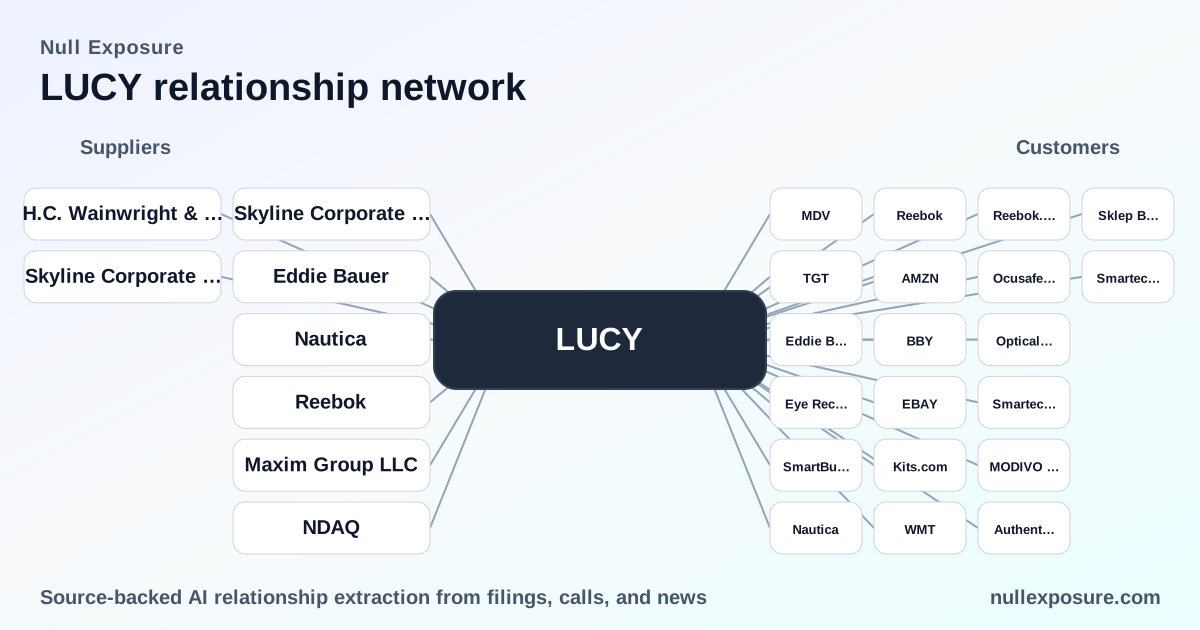
LUCY supplier map: where revenue and risk intersect
Innovative Eyewear Inc. (NASDAQ: LUCY) designs smart eyewear in the United States and monetizes through direct product sales, branded licensing partnerships, and periodic capital raises; the company sells “Powered by Lucyd” devices under its own Lucyd label and licensed brands (Reebok, Eddie Bauer, Nautica), collects royalties under multi‑year license agreements, and supplements operating cash via equity and warrant financings. For investors and operators, the critical lens is clear: revenue growth depends on brand licensing and retail distribution while cash stability relies on occasional placement financings and public market access. Learn more on the firm’s profile at https://nullexposure.com/ if you need an institutional view of counterparty exposures.
The bottom line on how LUCY works and gets paid
Innovative Eyewear manufactures product in Asia to U.S. designs, sells through branded retail channels and direct-to-consumer, and recognizes royalties and retail margins on licensed collections. Primary monetization vectors are product sales under owned and licensed brands, and guaranteed minimum royalty commitments embedded in license contracts. Recurrent capex or working capital pressure is mitigated by periodic financing transactions and placement agents that convert warrants and equity into cash when needed. For direct access to coverage and counterparty mapping, visit https://nullexposure.com/.
Supplier and partner roll call — concise takeaways (every relationship in the record)
Below I enumerate each relationship captured in the information set and give a one‑line commercial summary plus the citation for verification.
-
Skyline Corporate Communications Group, LLC — Investor relations and PR contact used across multiple press releases and announcements; Scott Powell is repeatedly listed as the company’s IR contact. Source: PR Newswire releases and NewsfileCorp items (FY2022–FY2026), e.g., https://www.prnewswire.com/news-releases/innovative-eyewear-inc-announces-closing-of-7-35-million-initial-public-offering-301607844.html and related PRs.
-
Skyline Corporate Communications Group LLC (variant listing) — The same IR/communications provider appears in separate news items announcing product features and commercial developments, indicating a stable communications outsourcing relationship. Source: NewsFile press release (FY2024), https://www.newsfilecorp.com/release/216953/Innovative-Eyewear-Inc.-Announces-the-First-WalkieTalkie-Feature-for-Smart-Eyewear.
-
Eddie Bauer — A licensing partner whose branded collection (Eddie Bauer Smart Eyewear) is part of LUCY’s strategy to accelerate consumer adoption by leveraging established retail brands. Source: Digital Journal and PR Newswire product launch coverage (FY2024–FY2026), https://www.digitaljournal.com/business/smart-eyewear-pioneer-lucyd-expands-premium-brand-portfolio-with-reebok-eddie-bauer-and-nautica-collections/article and https://www.prnewswire.com/news-releases/innovative-eyewear-inc-launches-eddie-bauer-smart-eyewear-with-chatgpt-302158073.html.
-
Nautica — Branded license partner contributing to the company’s collection diversification and retail channel penetration under guaranteed royalty structures. Source: PR Newswire and Digital Journal (FY2024–FY2026), https://www.prnewswire.com/news-releases/innovative-eyewear-inc-launches-eddie-bauer-smart-eyewear-with-chatgpt-302158073.html and https://www.digitaljournal.com/business/smart-eyewear-pioneer-lucyd-expands-premium-brand-portfolio-with-reebok-eddie-bauer-and-nautica-collections/article.
-
Reebok — A strategic licensing partner that enables LUCY to meet shoppers through a recognized athletic brand and reduce adoption friction for smart eyewear. Source: Digital Journal and a Nasdaq/FinanceWire announcement (FY2024–FY2026), https://www.digitaljournal.com/business/smart-eyewear-pioneer-lucyd-expands-premium-brand-portfolio-with-reebok-eddie-bauer-and-nautica-collections/article and https://finance.yahoo.com/news/innovative-eyewear-inc-announces-reebok-130600167.html.
-
Maxim Group LLC — Investment bank that acted as sole book‑running manager for LUCY’s initial public offering, providing underwriting and capital markets access that funded earlier corporate growth. Source: PR Newswire (FY2022), https://www.prnewswire.com/news-releases/innovative-eyewear-inc-announces-closing-of-7-35-million-initial-public-offering-301607844.html.
-
The Nasdaq Capital Market (NDAQ) — Listing venue where LUCY’s securities began trading in August 2022, providing public liquidity and the regulatory framework for subsequent financings. Source: PR Newswire notice of listing (FY2022), https://www.prnewswire.com/news-releases/innovative-eyewear-inc-announces-closing-of-7-35-million-initial-public-offering-301607844.html.
-
H.C. Wainwright & Co. — Placement agent for warrant transactions that raised gross proceeds, indicating recurring reliance on capital markets intermediaries to convert derivative instruments into operating capital. Source: PR Newswire (FY2025), https://www.prnewswire.com/news-releases/innovative-eyewear-inc-announces-4-8-million-of-gross-proceeds-raised-from-warrant-transactions-302488112.html.
-
Skyline Corporate Communications Group, LLC (additional PR entries) — Multiple FY2025–FY2026 PR filings list Skyline as IR contact on product launches, distribution agreements (including a major European retailer), and app features, underlining an ongoing role in communications for both corporate finance and commercial messaging. Source: PR Newswire releases (FY2025–FY2026), e.g., https://www.prnewswire.com/news-releases/innovative-eyewear-inc-announces-new-distribution-with-major-european-retailer-modivo-group-302694893.html.
(Each of the records above maps to one of the source documents in the public release set; URLs provided for verification.)
What the relationship list implies for investors and operators
-
Licensing is central to go‑to‑market. LUCY’s commercial strategy depends on multi‑year licensing deals with Reebok, Eddie Bauer and Nautica to scale retail distribution and reduce customer acquisition friction. Source: company releases and Digital Journal (FY2024–FY2026).
-
Public market access and placement agents are part of the cash strategy. Maxim Group and H.C. Wainwright have been used for IPO and warrant placements, respectively; these relationships underpin recurring liquidity events when internal cash generation is insufficient. Source: PR Newswire (FY2022, FY2025).
-
Communications outsourcing is consolidated. Skyline Corporate Communications is the recurring IR/PR partner across product, distribution, and financing announcements — signaling centralized external communications and investor relations. Source: multiple PR Newswire and NewsFile items (FY2022–FY2026).
Constraints and strategic signals you need to model
Treat these as company‑level operating signals rather than single counterparty facts:
-
Long‑term licensing posture with embedded exit mechanics. The company reports license agreements with base terms of 10 years that are cancellable by the company in year five, indicating long-duration commercial commitments but with managerially controlled mid-term exit options.
-
Manufacturing concentrated in APAC. Products are designed in Miami and manufactured in Asia (China referenced explicitly), which implies supplier concentration, lead‑time risk, and exposure to APAC logistics and tariff dynamics.
-
Manufacturer and supplier relationships are material and mature. Inventory prepayments and prototype development in China point to an established manufacturing supply chain and meaningful working capital tied to external factories.
-
Licensing economics include guaranteed minimum royalties. The company is contractually obliged to minimum royalty payments; the aggregate minimums disclosed total approximately $14.01 million, indicating medium-term cash commitments in the $10m–$100m band.
-
Operational stage: active supplier and cost management. Management actions to control lens costs and engage alternative suppliers (including a Miami lens supplier) show active vendor management and some supply‑base diversification.
Investment implications and next steps
- Upside case: brand licensing and retail shelf placement could accelerate unit growth without linear SG&A expansion; licensed collections are the fastest path to scale.
- Key risks: manufacturing concentration in Asia, guaranteed royalty minimums, and frequent small financings that dilute equity or depend on placement agents.
- Operational focus: evaluate the robustness of manufacturing contracts, the enforceability and schedule of minimum royalties, and the cadence of capital raises before underwriting upside.
For a deeper counterparty map and risk scoring tailored to institutional investment committees, visit https://nullexposure.com/ — our platform provides cross‑checked supplier profiles and contract‑level signals.
Actionable next step: model LUCY’s cash runway under three scenarios (base, upside, downside) that incorporate royalty minimums and expected warrant conversions, and re‑assess counterparty concentration in APAC manufacturing. For assistance or to license the relationship feed used here, go to https://nullexposure.com/.