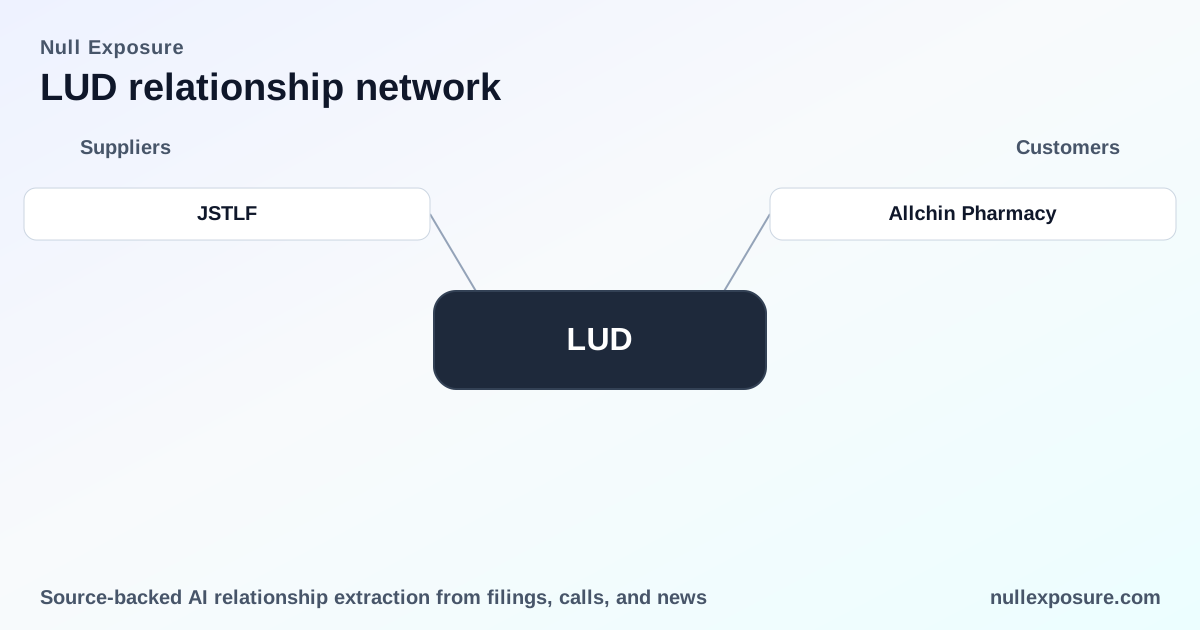
LUD Supplier Profile: Digital pharmacy enablement and a gateway into delivery platforms
LUD operates as a supplier that partners with pharmacy retailers and digital delivery platforms to digitize inventory and route pharmacy orders from consumer-facing apps into local pharmacies; it monetizes through collaboration agreements that generate order flow and through transaction or service fees tied to those orders. For investors, the company’s value proposition rests on embedding pharmacy supply into larger consumer delivery networks and capturing ongoing per-order economics as partners scale.
Explore supplier relationships and third‑party risk signals at https://nullexposure.com/ for deeper diligence.
How LUD turns pharmacy digitization into recurring revenue
LUD bundles software, connectivity and commercial integration for pharmacies so that inventory and availability are visible on partner platforms, which in turn route consumer orders back to pharmacies. Revenue is derived from collaboration agreements that convert digital order flow into fee-bearing transactions, rather than from one-off hardware sales or pure ad revenue. This model creates a two-sided dependency: partners gain on-platform pharmacy inventory and convenience, while LUD captures fee revenue and a potential share of expanded pharmacy sales.
The operating posture implied by this model is one of commercial integration and dependency on partner distribution channels. Contracts with large delivery platforms amplify scale quickly but also concentrate commercial risk if a partner changes routing economics or replaces an integration. Visit https://nullexposure.com/ to map concentration and revenue dependency for suppliers like LUD.
The single documented relationship: Just Eat
According to a Pharmacy.biz report published 10 March 2026, LUD—operating as Luda Partners in that coverage—completed a collaboration with Just Eat that enabled pharmacies to receive orders from users purchasing via the Just Eat app; the article notes that in its first live week the integration already started delivering initial pharmacy orders. The partner ticker referenced in the coverage is JSTLF. (Pharmacy.biz, March 10, 2026.)
This relationship is straightforward in commercial terms: LUD provides the integration layer that routes consumer pharmacy orders from Just Eat into physical pharmacies, and Just Eat supplies consumer reach and transaction volume. The source citation: Pharmacy.biz coverage of Luda Partners’ initiative with Just Eat (first seen 2026‑03‑10).
What this single relationship reveals about LUD’s business characteristics
- Contracting posture — channel integration over long-form exclusivity. The collaboration with Just Eat is presented as a platform integration rather than a supplier of exclusive pharmacy inventory, implying LUD structures commercial agreements to enable order flow rather than locking partners into multi-year exclusive supply contracts.
- Concentration — platform dependency. A marquee integration with a major delivery app creates sizable incremental volume quickly, but reliance on a small number of platform partners would concentrate risk. The currently documented relationship is with one major platform, which highlights customer concentration as a material factor for investors.
- Criticality — operationally meaningful to partner value propositions. Enabling pharmacy ordering inside a mainstream delivery app is functionally valuable to partner apps that want to expand gross merchandise value and increase frequency; that gives LUD negotiating leverage on fee structure if multiple platforms find the integration critical.
- Maturity — early commercial rollouts. The coverage describes first-week order receipts, indicating this integration is in early production stages rather than a mature, widely scaled deployment; early-stage rollouts imply both upside from scale and execution risk around reliability and commercial terms.
Because no contractual constraints or third‑party restrictions are disclosed in the available supplier records, investors should treat the absence of constraint data as a company-level signal: publicly disclosed third‑party contractual limitations are not present in this record, which can reflect either limited public filings on supplier obligations or low-complexity commercial terms that do not surface in filings. This absence requires active diligence — request contract terms, fee schedules and volume guarantees when evaluating vendor dependency.
Operational and financial risks investors should weigh
The Just Eat collaboration demonstrates a clear go‑to‑market path but also surfaces classic supplier risks:
- Revenue concentration if a significant share of order volume funnels through one or two platforms.
- Commercial re‑pricing risk if platforms internalize the integration or negotiate lower per‑order fees as volumes grow.
- Execution risk during scale‑up given the integration is newly live; early operational incidents could slow platform adoption or produce penalty clauses.
- Data and compliance obligations from handling pharmacy transactions in regulated categories, which can increase cost of servicing partners and raise operational complexity.
Practical implications for portfolio and vendor managers
For investors and operators evaluating exposure to LUD, the decisive questions are contract economics, volume concentration, and operational SLAs:
- Obtain copies of collaboration agreements or term sheets with platform partners and confirm fee mechanics and any minimum volume commitments.
- Verify service-level metrics and escalation rights that protect revenue if integrations underperform.
- Assess customer concentration by asking management for the share of order volume by partner and the roadmap for additional platform integrations.
Two recommended next steps: review LUD’s partner term sheets and platform road map, and benchmark fee economics against alternative pharmacy‑integration providers. For a comprehensive supplier risk mapping and more supplier relationship intelligence, visit https://nullexposure.com/.
Bottom line and action items
LUD’s integration with Just Eat is a meaningful commercial proof point that validates the company’s route-to-market: embedding pharmacy ordering into mainstream delivery apps creates immediate order flow and monetization opportunities. However, the relationship is early-stage and currently concentrated, which places a premium on contract terms and operational resilience.
Action items for investors and procurement teams:
- Demand partner-level revenue and SLA disclosures.
- Negotiate minimum volume protections and clear termination or repricing clauses.
- Monitor rollout cadence across platforms to track de‑risking of concentration.
For ongoing supplier intelligence and to compare LUD against other providers, visit https://nullexposure.com/ — the fastest way to translate supplier integrations into investment-grade risk assessments.