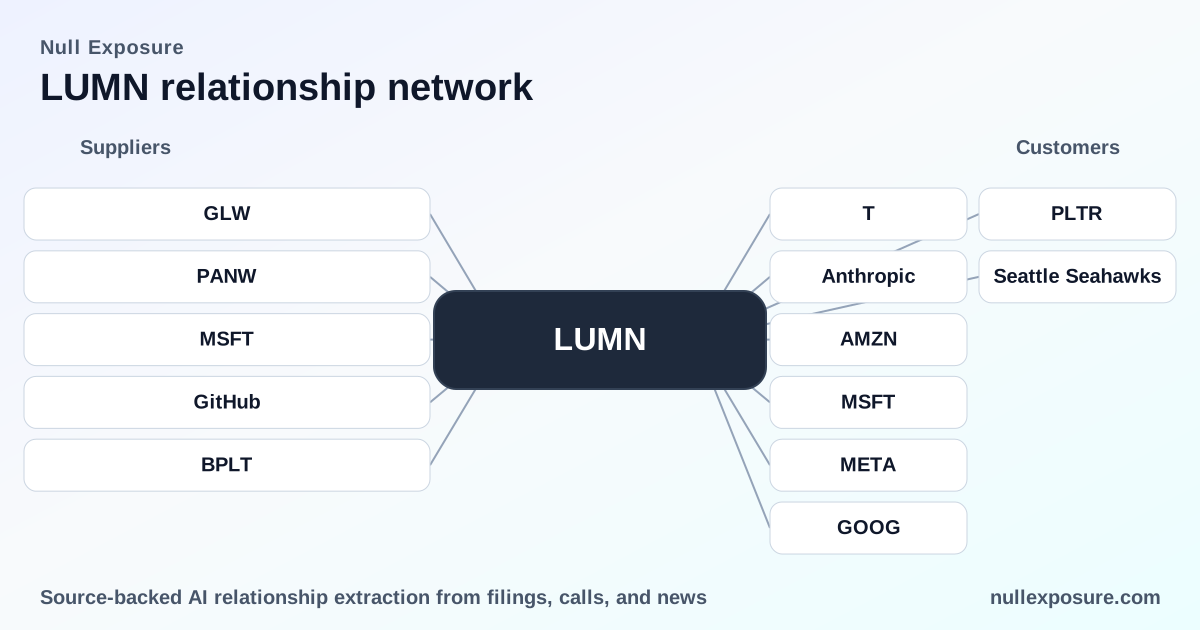
LUMN supplier map — what investors and operators need to know
Thesis: Lumen Technologies (LUMN) monetizes a high-capacity network and managed services platform by selling fiber connectivity, edge compute, cloud and security services to enterprise and hyperscaler customers; it funds and scales this model through long-term supplier commitments for fiber and integrated partnerships with cloud and security vendors that lower time-to-market for advanced offerings. Revenue and margin expansion depend on securing prioritized fiber capacity, embedding third‑party cloud/security stacks into managed services, and automating operations with AI partners. For a deeper supplier-risk readout and monitoring, visit https://nullexposure.com/.
Why these supplier ties matter to valuation and operations
Lumen’s supplier relationships are not optional procurement line items — they are structural levers that determine capacity, service differentiation, and time-to-revenue. The supplier set shown here highlights four operational characteristics investors should treat as primary:
- Contracting posture: Lumen executes multi-year, capacity-focused contracts (including capacity reservations) that trade near-term cash and balance-sheet commitments for prioritized supply and predictable throughput.
- Concentration: Reservations that take material slices of a single OEM’s production (see Corning) create dependence on a small number of suppliers for core physical capacity.
- Criticality: Fiber, cloud platform access, and security orchestration are mission-critical to Lumen’s service bundle; any supply interruption or integration failure would directly impact customer SLAs and churn.
- Maturity: Lumen’s partnerships with tier‑one names (Microsoft, Palo Alto, Corning) indicate a mature vendor strategy focused on co‑development and go‑to‑market alignment rather than ad‑hoc sourcing.
Company-level contract signals also matter: Lumen’s public disclosures document multi-year payment and revenue commitments and a mix of owned versus leased network assets, and the firm operates an established vendor-risk program to monitor third‑party access to systems and data.
For ongoing tracking of these supplier tie-lines and their market implications, see https://nullexposure.com/.
Relationship-by-relationship: succinct takeaways for investors
Corning (GLW)
Lumen secured a two‑year agreement that reserved 10% of Corning’s global fiber production capacity, which represented Lumen’s largest fiber purchase at the time and signals prioritized access to optical materials critical for network expansion (reported mid‑2024). Lumen reiterated that the expanded partnership provides priority access to state‑of‑the‑art fiber technology as the company builds its AI backbone (company remarks in FY2026 earnings commentary). Sources: SDxCentral (mid‑2024) and Lumen FY2026 earnings call transcript coverage (InsiderMonkey, FY2026).
Palo Alto Networks (PANW)
Lumen is integrating Palo Alto Networks’ Cortex XSIAM platform to unify XDR, SOAR, ASM and SIEM capabilities into its managed security offering, a move intended to simplify SOC workflows and accelerate automated incident response. This collaboration is positioned as a capability play to raise managed‑security revenue and operational efficiency (Manila Times coverage, Feb 2026).
Microsoft (MSFT)
Lumen runs parts of its platform on Microsoft Azure and participated in early deployment of Microsoft 365 Copilot, reflecting deep cloud platform alignment that supports Lumen’s enterprise productivity and cloud‑native service bundles. The Microsoft case study highlights how Azure underpins Lumen’s service stack and modernization efforts (Microsoft customer story, FY2026).
GitHub
Working with Microsoft, Lumen sponsored a GitHub Copilot pilot for nearly 600 engineers at its Bangalore site, indicating an internal productivity and developer‑enablement program meant to accelerate software delivery tied to Lumen’s platform evolution. This pilot demonstrates operational investment in developer tooling to speed feature delivery for network and cloud services (Microsoft customer story, FY2026).
Blue Planet (BPLT)
Lumen has adopted Blue Planet AI agents across network operations to automate network tasks and fault remediation, a signal that Lumen is pushing AI-driven operations to reduce manual toil and improve reliability. This relationship is an operational automation play rather than a core-capacity contract (SimplyWall analysis, FY2026).
Company-level constraints and what they imply for the operating model
Lumen’s public disclosures and related excerpts provide three firm-level signals that frame supplier risk and financial exposure:
- Dual role in the market: Lumen is both buyer and service provider. Disclosures describe reciprocal ordering commitments: Lumen expects to pay approximately $373 million over three years under some purchase agreements, and to receive approximately $67 million over three years under reciprocal orders. This reflects a contracting posture where Lumen locks supply while also monetizing services through counterparties.
- Asset mix and leasing posture: While Lumen owns a substantial portion of its telecom equipment, it leases facilities, network capacity and equipment from third parties. That mix reduces near‑term capex but increases operating leverage on supplier availability.
- Vendor risk governance: Lumen maintains an established vendor risk management program with ongoing monitoring for third‑party access to data and systems, underscoring the criticality and sensitivity of its supplier integrations.
Together these constraints describe a company that deliberately trades capital for strategic supply certainty, accepts concentrated supplier exposure for scale, and invests in governance to mitigate operational risk.
Investment implications — balancing upside and concentration risk
- Upside: Priority fiber capacity (Corning) plus cloud and security integrations (Microsoft, Palo Alto) position Lumen to capture AI and enterprise cloud spending, accelerating revenue per fiber mile and managed‑service ARPU. Strategic supplier commitments reduce roll‑out risk for time‑sensitive projects.
- Risk: Material reservation of OEM capacity increases supplier concentration risk and operational counterparty exposure; leased network resources create service delivery dependencies outside Lumen’s balance sheet. Operational and integration failures at major partners would have direct revenue consequences.
- Operational playbook: Automation partners (Blue Planet) and developer productivity pilots (GitHub Copilot) reduce Opex and time‑to‑market but require disciplined change management to realize expected TCO gains.
For investors and operators who want continuous visibility into how supplier commitments map to capacity, contractual exposure, and concentration metrics, explore our monitoring tools at https://nullexposure.com/.
What to watch next
- Announcements that convert capacity reservations into capital projects or sales will materially affect capital allocation and near‑term revenue growth.
- Progress metrics on security integration and SOC automation (time‑to‑detect, incident closure rates) will signal whether Palo Alto integration is translating to commercial differentiation.
- Developer productivity outcomes from the GitHub Copilot pilot will indicate whether Lumen can sustainably accelerate feature cadence without rising engineering costs.
Final thought: Lumen’s supplier strategy is deliberate — it leverages prioritized capacity and heavyweight platform partners to accelerate enterprise offerings while accepting concentration and integration risk. Investors should monitor the conversion of these supplier commitments into contracted revenue and margin expansion.
For a practical supplier-risk dashboard and continuous updates on Lumen’s partner exposures, visit https://nullexposure.com/.