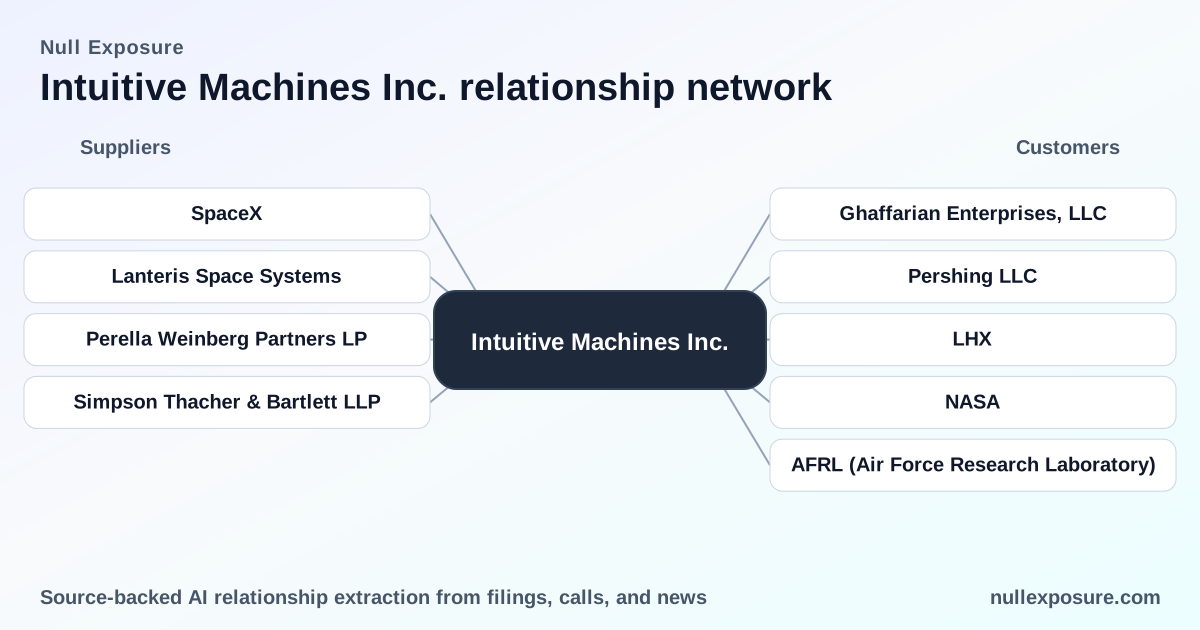
Intuitive Machines (LUNR): supplier relationships that drive mission delivery and operational leverage
Intuitive Machines monetizes integrated lunar mission services by selling spacecraft design, payload delivery, mission operations and data management to government and commercial clients; revenue comes from milestone-based contracts (including NASA awards), commercial payload fees and, increasingly, manufacturing and vertical integration after the Lanteris acquisition. The company’s model combines high fixed operational cost (long-term leases and equipment financing) with large, contract-backed receivables and concentrated supplier commitments that influence cash flow and delivery risk. Learn more about supplier risk scoring and due diligence at https://nullexposure.com/.
How Intuitive Machines makes money and why suppliers matter
Intuitive Machines commercializes lunar logistics through a blend of government programs and commercial engagements. Revenue TTM was $219.9 million, but profitability is negative (TTM EPS -2.46) and gross margins are compressed, which makes supplier terms and capital commitments a central determinant of near-term cash flow and mission cadence. The company outsources critical capabilities — notably launch services — while building in-house manufacturing capacity through strategic M&A. That combination creates both operational leverage when missions execute and concentration risk when a small set of partners control key inputs.
Visit https://nullexposure.com/ to benchmark supplier exposure across the space sector and prioritize due diligence.
The supplier and advisor relationships that matter right now
SpaceX — the launch provider for core missions
Intuitive Machines has contracted three NASA lunar missions to fly on SpaceX’s Falcon 9, and its IM-2 lander was encapsulated within a SpaceX payload fairing ahead of launch, underscoring SpaceX’s operational criticality to LUNR’s schedule. According to the company’s mission update in March 2026, the IM-2 Nova-C lander completed integration and was encapsulated for launch on a SpaceX vehicle (Intuitive Machines post, Mar 2026: https://www.intuitivemachines.com/post/intuitive-machines-im-2-mission-lunar-lander-encapsulated-and-scheduled-for-launch).
Lanteris Space Systems — acquired to internalize spacecraft manufacturing
Intuitive Machines completed an $800 million acquisition of spacecraft manufacturer Lanteris Space Systems, a move described by market reports as vertical integration designed to strengthen manufacturing scale and product control. Market coverage in March 2026 noted the acquisition as a transformational transaction that drove a share-price re-rating on the news (Finviz and InsiderMonkey coverage, Mar 2026: https://finviz.com/news/277034/intuitive-machines-lunr-jumps-125-on-lanteris-buyout-completion; https://www.insidermonkey.com/blog/intuitive-machines-lunr-jumps-12-5-on-lanteris-buyout-completion-1675235/?amp=1).
Perella Weinberg Partners LP — financial adviser on the Lanteris deal
Perella Weinberg served as Intuitive Machines’ financial adviser in the Lanteris acquisition, indicating the company engaged top-tier M&A advisory resources to structure the transaction and financing strategy (company release on the acquisition, Mar 2026: https://www.intuitivemachines.com/post/intuitive-machines-to-acquire-lanteris-space-systems-creating-the-next-generation-commercial-civil).
Simpson Thacher & Bartlett LLP — legal adviser on the acquisition
Simpson Thacher acted as legal counsel to Intuitive Machines on the Lanteris acquisition, which signals experienced legal support for large, cross-border aerospace M&A and reduces execution risk on integration and regulatory matters (company release on the acquisition, Mar 2026: https://www.intuitivemachines.com/post/intuitive-machines-to-acquire-lanteris-space-systems-creating-the-next-generation-commercial-civil).
What the documented constraints reveal about the operating model
Company filings and public disclosures show several durable characteristics that shape supplier relationships and strategic risk:
- Long-term commitments and fixed-cost posture. Intuitive Machines holds multiple real estate leases with terms from roughly 52 months up to 250 months, and equipment leases largely in the 36–60 month range, some structured as finance leases and some with extension or termination options. This is a long-duration cost base that reduces short-term flexibility but supports facility and manufacturing scale (company filing language referencing lease terms as of Dec 31, 2024).
- Buyer behavior concentrated on mission-critical vendors. The company discloses material non-cancelable purchase commitments — $97.1 million in remaining obligations as of Dec. 31, 2024 — reflecting long-dated procurement for launch services and key components tied to revenue contracts. About $39.0 million was due in 2025, $37.8 million in 2026 and $20.3 million in 2027, creating a defined near-term cash outflow schedule (company disclosures, Dec 31, 2024).
- Single-provider exposure for launches is critical. With three NASA missions scheduled on SpaceX Falcon 9 vehicles and a recent IM-2 encapsulation event, launch-provider selection is a central operational dependency that directly affects schedule and revenue recognition.
- Maturity and integration posture post-M&A. The Lanteris acquisition signals a shift toward vertical integration—a strategic effort to internalize manufacturing and reduce supplier margin leakage—while introducing execution and integration risk typical of large transformational deals.
Investment implications — what to watch and why it matters
Intuitive Machines’ supplier footprint and contractual profile produce a clear set of investment signals:
- Execution leverage: If missions launch and deliver to contract, the company converts milestone revenue into outsized operating leverage because many costs are fixed. Successful integration of Lanteris accelerates that upside.
- Concentration risk: Dependence on a small number of launch and component suppliers (notably SpaceX for Falcon 9 missions) is a single-point operational risk; any launch disruption cascades to revenue recognition and cash flow.
- Cash flow timing pressure: The $97.1 million of non-cancelable purchase commitments with near-term maturities creates a financing and liquidity hinge—monitor cash balance, receivables, and financing arrangements as Lanteris integration proceeds.
- Execution risk mitigation through advisors: Engagement of Perella Weinberg and Simpson Thacher indicates professional execution support on the acquisition, which reduces, but does not eliminate, integration risk.
Key monitoring checklist for investors:
- Mission cadence and actual launch outcomes for IM-2 and other lunar missions (SpaceX schedule adherence).
- Integration milestones and capital needs following the Lanteris acquisition.
- Quarterly updates on purchase obligation burn rates and the company’s liquidity runway.
- Any change in lease profiles or renegotiations that affect fixed-cost flexibility.
Explore supplier exposure scoring and comparative benchmarks for aerospace suppliers at https://nullexposure.com/ to convert these signals into actionable diligence.
Bottom line
Intuitive Machines operates a high-leverage, contract-driven business where supplier relationships determine both upside and downside. Vertical integration through the Lanteris acquisition increases manufacturing control and potential margin expansion, but introduces integration and financing risk against a backdrop of material, non-cancelable purchase obligations and concentrated launch-provider dependency with SpaceX. For investors and operators evaluating supplier relationships, the critical questions are whether Intuitive Machines can execute scheduled missions, integrate Lanteris efficiently, and manage near-term cash outflows without dilutive financing. For structured supplier due diligence and risk scoring across the space sector, visit https://nullexposure.com/.