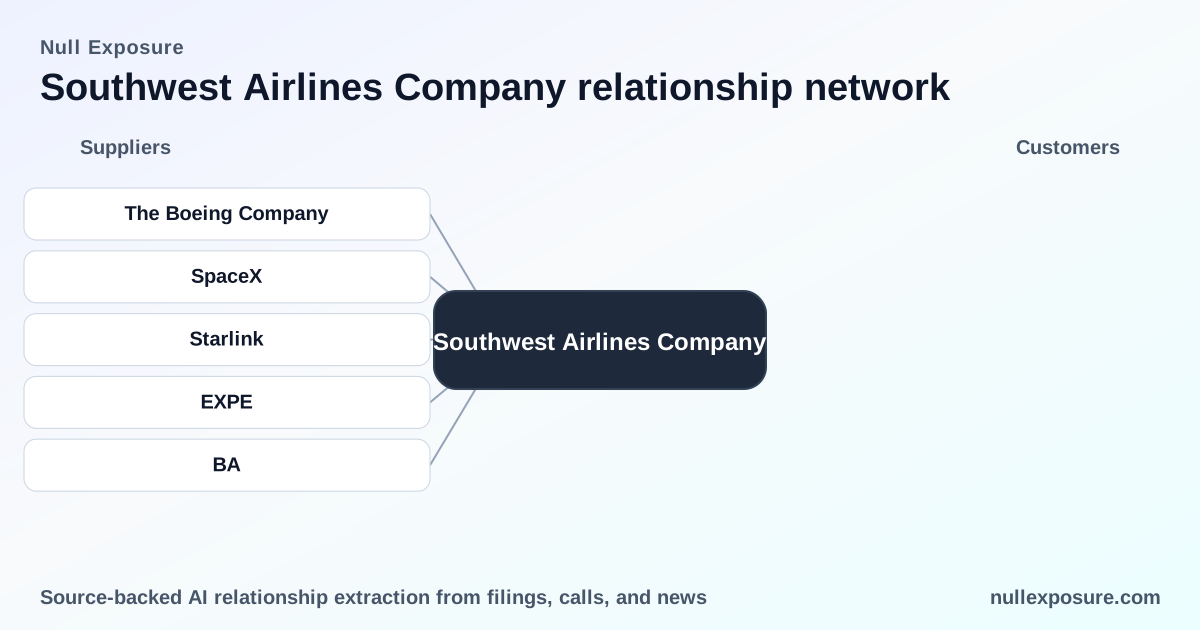
Southwest Airlines (LUV) — supplier map and what it means for investors
Southwest Airlines operates a single-fleet, low-cost carrier model that monetizes through high-frequency point-to-point flying, ancillary fees, and partnerships that lift revenue per passenger while keeping unit costs low. Supplier relationships drive both capacity and customer experience: aircraft and engine suppliers determine fleet growth and utilization, while connectivity and distribution partners affect ancillary revenue and brand competitiveness. For a concise supplier risk dashboard and continuous monitoring, visit https://nullexposure.com/.
Fleet dependency: Boeing is the backbone of capacity and a strategic counterparty
Southwest runs a very concentrated aircraft program: 803 Boeing 737 aircraft in service as of December 31, 2025, with both operating and finance leases embedded in the fleet structure. The company’s 2025 Form 10‑K explicitly identifies Boeing as the sole manufacturer of Southwest’s aircraft and describes how Boeing delivery delays have forced Southwestern capacity replanning and ongoing adjustments to delivery expectations. (Source: Southwest 2025 10‑K, FY2025.)
- Key investor takeaway: Boeing is not an interchangeable supplier for Southwest’s core product; delivery schedules, deposit timing, and aircraft pricing are direct drivers of unit capacity, capital spending, and short‑term margin dynamics.
In‑flight connectivity as a growth lever: SpaceX / Starlink rollout
Southwest has publicly announced a move to integrate SpaceX’s Starlink service across its fleet to deliver next‑generation in‑flight Wi‑Fi in up to 11 countries, positioning connectivity as both a customer experience upgrade and a potential ancillary-revenue channel. Multiple news outlets reported the February 11, 2026 announcement that Southwest will roll out Starlink across its network. (Sources: Finviz report, Feb 2026; SimplyWallSt and InsiderMonkey coverage, Feb–Mar 2026.)
- Key investor takeaway: Starlink is a strategic service-provider relationship that can increase ancillary revenue per passenger and support premium product differentiation.
Distribution partnership: Expedia and revenue diversification
Southwest has engaged distribution partnerships, including with Expedia, as part of efforts to lift revenue per passenger and broaden fare options. Brokerage and market commentary cite the Expedia distribution partnership as an element of the company’s strategy to diversify channels and boost revenue mix. (Source: SimplyWallSt coverage, FY2026.)
- Key investor takeaway: Distribution partners are operational levers to extract higher yields per booking, but their value depends on customer acceptance and execution.
Supplier-by-supplier quick take
-
Boeing — Southwest is dependent on Boeing as the sole manufacturer of its aircraft and has re‑planned capacity repeatedly because of Boeing delivery delays; the 10‑K also reports 803 Boeing 737 aircraft in service at year-end 2025, with a mix of operating and finance leases. (Source: Southwest 2025 10‑K, FY2025.)
-
SpaceX — Southwest announced plans to integrate SpaceX’s Starlink into its fleet to provide next‑generation Wi‑Fi across an international footprint, signaling a shift toward higher‑quality connectivity as a customer experience and ancillary‑revenue engine. (Source: Finviz news, Feb 11, 2026; additional reporting in SimplyWallSt and InsiderMonkey, Feb–Mar 2026.)
-
Starlink — The Starlink service is the specific connectivity product Southwest will deploy in-flight across 11 countries, per company announcement coverage, suggesting a vendor‑service relationship that touches passenger experience and potential service fees. (Source: SimplyWallSt coverage, Feb–Mar 2026.)
-
Expedia (EXPE) — Market commentary highlights an Expedia distribution partnership as part of Southwest’s push to diversify channels and lift revenue per passenger, placing distribution strategy squarely in the commercial playbook. (Source: SimplyWallSt coverage, FY2026.)
How the constraints shape the operating model and risk profile
Southwest’s supplier posture is defined by a small set of structural constraints that investors must fold into valuation and scenario work:
-
Long‑term contracting posture: The company reports firm deliveries and options for specific aircraft types as of December 31, 2025, indicating multi‑year purchase commitments and deposit schedules that tie up cash and set capital expenditure trajectories. This is a company-level signal from the 2025 filing.
-
High spend and capital intensity: Management projects $3.0–$3.5 billion in net capital spending for 2026, driven largely by aircraft deliveries, which establishes a high absolute spend band and ongoing capital funding requirement. (Source: Southwest 2025 10‑K, FY2025.)
-
Concentration and criticality: Southwest’s reliance on sole or limited suppliers for engines, parts, repairs, and aircraft manufacturing creates single‑point dependency risk; the 10‑K warns the company would be materially impacted by unavailability of engines, parts, or repair services. This is a company-level signal that elevates operational risk if supply bottlenecks occur.
-
Dual roles: manufacturer and service provider: The filing explicitly names Boeing as the manufacturer of the company’s aircraft (so the manufacturer role is tied to Boeing), while separate vendor relationships for maintenance, cybersecurity, and in‑flight services function as external service providers with contractual risk allocation and performance obligations. (Source: Southwest 2025 10‑K, FY2025.)
-
Maturity and contractual structure: Deposits on flight equipment purchase contracts are capitalized until delivery, showing a contractual structure that front-loads cash outflow and then converts deposits into flight equipment on delivery — a standard but binding capital cadence for fleet renewal. (Source: Southwest 2025 10‑K, FY2025.)
What investors should watch and actionable signals
-
Delivery cadence vs. capacity plans: Track Boeing delivery schedules and any public re‑planning language; delivery delays translate directly into constrained capacity and potential revenue shortfalls. The 10‑K already records prior replanning due to Boeing delays.
-
Capex funding and liquidity: Given the $3.0–$3.5 billion capex guide, monitor cash flow, debt issuance, and deposit timing to ensure fleet growth is funded without compressing margins.
-
Execution of Starlink roll‑out: Starlink integration is a tangible upside if Southwest monetizes connectivity through ancillary channels; early adoption metrics and take rates will be leading indicators of revenue upside.
-
Distribution economics: Monitor how the Expedia partnership affects yield and booking mix; distribution deals can increase revenue per passenger but may also shift commission and channel costs.
For a continuous, investor‑grade view of these supplier exposures and how they move with Boeing deliveries, connectivity rollouts, and capex cycles, explore our supplier risk tools at https://nullexposure.com/ — the data and signal layering are built for active research teams.
Bottom line: concentrated suppliers create both leverage and vulnerability
Southwest’s supplier relationships are a classic case of high operating leverage to a small set of critical vendors. Boeing’s role as the fleet manufacturer makes aircraft delivery and pricing the single most important operational dependency; connectivity and distribution partners offer staged upside to revenue per passenger. Investors should price in both the downside from supplier delays and the upside from monetized service partnerships when modeling earnings and capital needs.
For a focused supplier risk brief and ongoing monitoring tailored to institutional workflows, visit https://nullexposure.com/ and request the LUV supplier briefing pack.