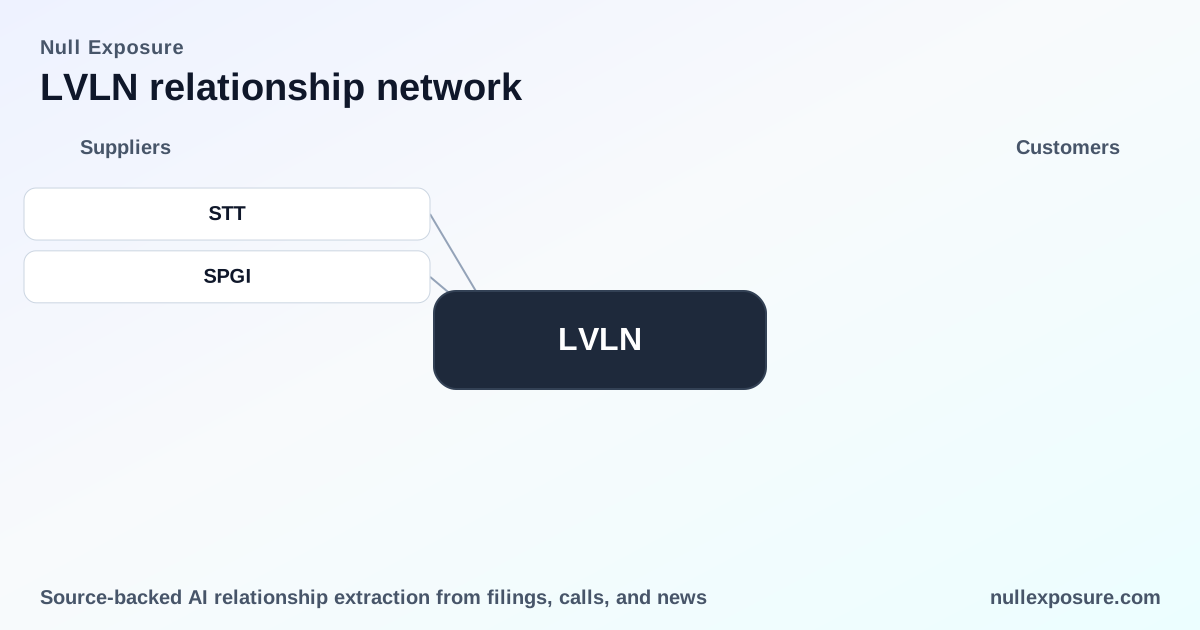
LVLN supplier relationships: what investors need to know
LVLN operates as a leveraged-loan exchange traded product that gives investors diversified exposure to the investable leveraged loans market by tracking the S&P USD Select Leveraged Loan Index; it monetizes through management fees, trading spreads and usual ETF service economics while paying index licensing and other third-party provider fees. Understanding who supplies the index, custody, market-making and competitive product set is central to underwriting distribution risk and fee capture.
For a quick exploration of supply-chain risk and relationship intelligence, visit https://nullexposure.com/.
Why the supplier map matters for ETF investors
Suppliers determine index integrity, licensing fragility, and competitive pressure. An ETF like LVLN relies on a small set of external providers for the index methodology, pricing, and secondary-market liquidity; those suppliers exert outsized influence on product economics and reputational risk. Where an index is licensed and where competing issuers introduce similar low-cost alternatives directly affects asset flows and fee compression.
Relationship snapshots you can act on
Below I cover every supplier relationship appearing in the available results. Each entry is a concise, plain-English summary with the relevant source cited.
State Street Investment Management (STT)
State Street is a direct competitor in the leveraged-loan ETF space, having launched a low-cost leveraged loan ETF that targets the same category and positions as LVLN’s product set; that competitive launch increases pricing pressure and distribution competition in FY2025–FY2026. According to a Benzinga report (March 10, 2026), State Street rolled out a low-cost leveraged-loan ETF as a rival to other market offerings, expanding its fixed-income roster: https://www.benzinga.com/etfs/new-etfs/25/11/48959723/state-street-rolls-out-low-cost-leveraged-loan-etf-a-rival-to-its-own-srln.
S&P (S&P Global / SPGI)
LVLN follows the S&P USD Select Leveraged Loan Index, which makes S&P the critical index licensor and methodology provider for the product; index governance and licensing terms directly influence tracking error, replication costs and licensing fees paid by LVLN. Benzinga’s coverage identifies the index linkage explicitly (March 10, 2026): https://www.benzinga.com/etfs/new-etfs/25/11/48959723/state-street-rolls-out-low-cost-leveraged-loan-etf-a-rival-to-its-own-srln.
How these supplier relationships translate into constraints and operational signals
There are no explicit constraint documents in the available payload, so the following are company-level signals derived from how ETFs typically operate and from the supplier map above:
- Contracting posture: LVLN operates under standard index licensing and service-provider contracts; licensing from S&P is a bottleneck that is contractual and ongoing rather than one-off. Contracts with market makers, custodian banks and exchanges will determine daily liquidity economics.
- Concentration: Index licensing concentration is high—S&P is a single critical supplier for the referenced index—creating dependency risk if licensing terms change or are renegotiated. That concentration sits alongside commoditized execution and custody services that are replaceable but costly to transition.
- Criticality: The index provider is mission-critical; loss or change of the S&P license would force product relisting or rebranding and risk outflows. Competitive launches from major issuers (State Street) are also critical because they compress fees and can quickly divert flows.
- Maturity of relationship: Index licensing and ETF servicing are mature, standardized relationships with established playbooks—this reduces operational novelty but increases the importance of unit economics and distribution efficiency.
- Supplier governance levers: LVLN’s negotiating leverage is a function of assets under management and distribution channel strength; fee sensitivity will be the primary governance pressure point when large incubators (State Street) pursue low-cost entrants.
What investors should watch next
- Index licensing costs and any public filing language about licensing renewals—these carry asymmetric risk because S&P is the listed index.
- AUM flows vs. State Street’s new product—observe seed flows and fee adjustments over the next two quarters; incumbent ETFs lose market share quickly when a low-cost alternative debuts.
- Tracking error and roll-cost disclosures in LVLN filings—tight spreads and effective replication are the product’s value proposition versus cheaper alternatives.
For immediate intelligence and ongoing monitoring on LVLN and comparable products, see https://nullexposure.com/.
Risk and opportunity — concise, actionable takeaways
- Index dependency is high. S&P’s role as the referenced index provider makes them a single point of strategic concentration for LVLN.
- Competitive pressure from large issuers is active. State Street’s entry into leveraged-loan ETFs increases the risk of fee compression and outflow velocity.
- Operational maturity reduces execution risk but raises commercial risk. ETF mechanics are standardized; the decisive battleground is distribution and price.
- Governance focus should be on distribution partnerships and expense ratio flexibility. Those levers determine whether LVLN can retain flows when low-cost alternatives proliferate.
Bottom line and recommended next steps
LVLN is a classic index-based ETF whose economics hinge on index licensing and product-level fee competitiveness. S&P is a core supplier whose license shapes product viability; State Street is an active competitive supplier/issuer reshaping the product landscape. Investors and operators should prioritize monitoring licensing disclosures, AUM and fee actions from competitors, and any operational changes in replication methodology.
If you want ongoing supplier-level intelligence and actionable alerts on LVLN and similar products, visit https://nullexposure.com/ for subscription options and deep-dive briefs.