Las Vegas Sands (LVS) — Supplier Relationships and Operational Tailwinds
Thesis: Las Vegas Sands operates and monetizes a portfolio of integrated resorts by combining long-term management and brand licensing, third‑party service providers, and proprietary software and systems to run gaming, hospitality, and conference businesses; revenue flows are concentrated in high‑margin resort operations while costs and risk exposures are governed through multi‑decade contracts and outsourced operational relationships. For investors evaluating supplier counterparties, the company’s contracting posture and insurance relationships are the most material supplier‑side signals to monitor. Explore full supplier profiles at https://nullexposure.com/.
How LVS structures its operating relationships — the big picture
Las Vegas Sands structures its operations around a hybrid model: long‑dated management agreements and franchise/license arrangements for hotels, complemented by a mix of third‑party service providers for specialized functions (security, IT, cybersecurity assessments) and internally developed and commercial software to run core processes. Company disclosures state that many hotel management agreements carry non‑cancelable terms from 14 to 40 years, with extension provisions and some early‑termination options; that footprint creates both predictable operating continuity and extended contractual obligations for counterparties.
- Contracting posture: The emphasis on long‑term, non‑cancelable management agreements implies elevated supplier lock‑in and long lead times to replace key operators.
- Outsourcing pattern: LVS regularly employs third‑party management companies and technical vendors for day‑to‑day operations and risk assessments; these vendors perform critical operational functions it does not fully control.
- Technology posture: The company relies on a mixture of proprietary and commercial systems to protect, monitor, and process guest and corporate data, making software suppliers and information system providers consequential to resilience and regulatory compliance.
If you want a consolidated view of LVS supplier relationships and risk exposures, visit https://nullexposure.com/ for the full supplier mapping.
A named license agreement that signals long horizons
A company disclosure notes that in September 2024, Venetian Orient Limited (a wholly owned subsidiary of LVS) entered a franchise agreement with Marriott International granting the right to operate the Londoner Grand under Marriott’s Luxury Collection brand effective January 1, 2025, for 15 years. This is a clear example of the group’s strategy to secure brand affiliation through multi‑year license arrangements, locking in brand recognition and distribution while sharing operating risk with global hotel operators. (Company disclosure, 2024–2025.)
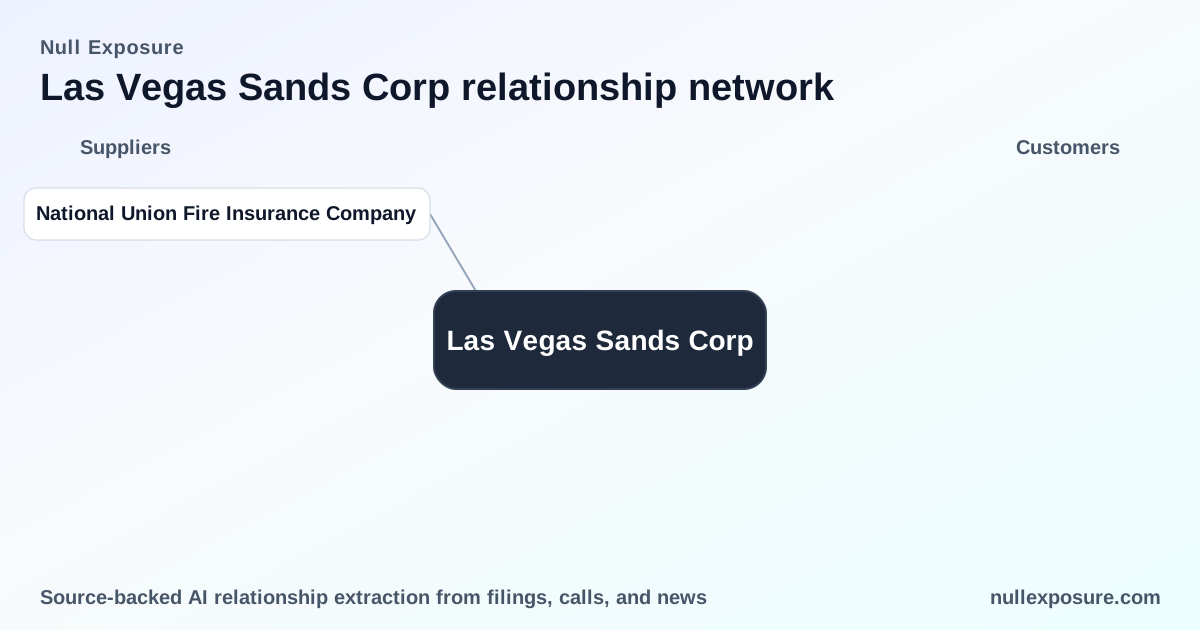
Insurance and coverage: National Union Fire Insurance Company
National Union Fire Insurance Company denied coverage based on a contractual liability exclusion that the insurer interpreted to bar claims “alleging, arising out of, based upon or attributable to any actual or alleged contractual liability of the [Insured] under any express contract or agreement.” A client alert discussing the Las Vegas Sands v. National Union matter was published by Crowell on March 10, 2026, describing the insurer’s position and the court’s rejection of an all‑or‑nothing approach to D&O coverage exclusions. Insurance counterparty disputes like this illustrate the exposure LVS accepts under long contracts and the importance of policy wording for protecting against contractual liabilities. (Crowell client alert, March 10, 2026.)
Relationship inventory — what the record shows
This dataset identifies one explicit insurer relationship disclosed in public commentary and several company‑level supplier characteristics extracted from filings:
- National Union Fire Insurance Company — National Union denied coverage invoking a contractual liability exclusion; the matter was analyzed in a Crowell client alert in March 2026 that reviewed the exclusion’s impact on available coverage. (Crowell, March 10, 2026.)
- Venetian Orient Limited / Marriott International — Venetian Orient Limited entered a 15‑year franchise arrangement with Marriott to operate the Londoner Grand under the Luxury Collection brand, effective January 1, 2025. (Company disclosure, Sept 2024 – 2025.)
- Third‑party hotel management companies — Company filings state that several hotel properties operate under third‑party management agreements where the operator controls day‑to‑day operations and LVS retains limited approval rights; these agreements have non‑cancelable periods of 14 to 40 years. (Company filings.)
- Cybersecurity and technical service providers — LVS engages third‑party providers for periodic risk‑based cybersecurity assessments and uses internal audit supported by third‑party technical experts to audit cybersecurity programs. (Company filings.)
- Information systems and software vendors — The company relies on a combination of proprietary and commercial systems and software to process, transmit, and store corporate and customer data. (Company filings.)
Each of the above is either cited directly in company disclosures or discussed in legal commentary; together they form the supplier landscape investors should prioritize.
What these relationships mean for investors — concentrated exposures and embedded options
The supplier footprint communicates four investment‑relevant signals:
- Concentration and lock‑in: Multi‑decade management and franchise contracts create revenue predictability but introduce supplier concentration and switching friction. Replacing a management company or brand partner is operationally and financially intensive.
- Operational criticality: Service providers supply core operational and security functions that LVS does not fully control; disruptions to these vendors would have immediate operational and reputational impacts.
- Insurance dependency: Litigation over policy exclusions underscores that insurance protections are not absolute; contract wording determines the boundary between corporate contractual liabilities and insured losses.
- Technology reliance: Dependence on both proprietary and commercial software elevates vendor management and cybersecurity as continuous governance priorities.
For a deeper supplier risk assessment and to monitor changes in LVS counterparties, visit https://nullexposure.com/.
Risk mitigants and governance points investors should watch
- Monitor renewal windows and extension options in management agreements: they are the primary driver of exit flexibility.
- Scrutinize insurance policy language and litigation outcomes related to coverage exclusions, which redefine balance‑sheet risk transfer.
- Evaluate vendor concentration metrics for key technology and cybersecurity services; diversification or in‑house capability are potential mitigants.
- Track contractual approval rights and control levers the company retains over third‑party operators to assess actual governance over day‑to‑day operations.
Bottom line and investor action
Las Vegas Sands’ supplier architecture is defined by long‑dated contracts, strategic licensing, and critical third‑party service dependencies. These features deliver predictability and scale but concentrate operational and contractual risk with a limited set of counterparties and insurance terms. Investors should prioritize contract expiration timelines, insurance coverage disputes, and cybersecurity vendor profiles when assessing execution risk.
To review full supplier profiles and track changes to LVS counterparties, visit https://nullexposure.com/ for the complete supplier mapping and ongoing updates. For tailored briefings or portfolio impact analysis, head to https://nullexposure.com/ and request a supplier risk report.