Lightwave Acquisition Corp (LWAC): underwriter lock-up and what it means for investors
Lightwave Acquisition Corp operates as a special-purpose acquisition company that monetizes by selling IPO units and founder shares to build a trust for a future business combination; value accrual to public investors depends on successful deal sourcing and the sponsor/underwriter mechanics that control share supply and secondary liquidity. For investors and operators evaluating supplier relationships, the single material counterparty disclosed in the supplier scope is the underwriting representative, and its contractual controls directly shape near-term liquidity and governance. For immediate comparative diligence, see https://nullexposure.com/.
The concise investor thesis
LWAC is a capital-raising vehicle that earns its economics through sponsor promote and transaction fees tied to completing a business combination; its commercial dynamics are transactional and underwriter-centric, not recurring-sales driven. That underwriting relationship and associated lock-up provisions are the most consequential supplier agreement in the public record for assessing concentration, timing risk, and potential share supply shocks post-IPO. For additional supplier-risk intelligence, visit https://nullexposure.com/.
What the BTIG lock-up tells investors about supply control
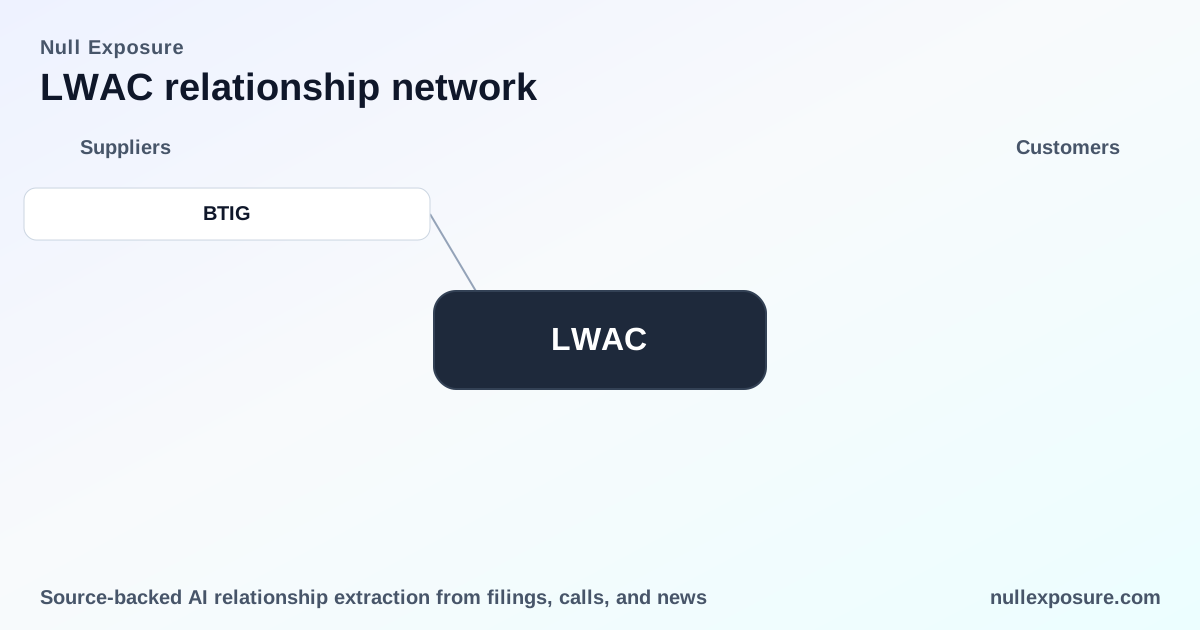
The one supplier-level relationship disclosed in the results is with BTIG acting as the representative of the underwriters. According to a MarketScreener notice dated March 10, 2026, LWAC’s officers and directors agreed to a 180-day lock-up that prevents them from selling units, warrants, ordinary shares or founder shares without the prior written consent of BTIG as the underwriter representative. The lock-up language also covers a wide set of transfer mechanics — pledges, options, loans, and other dispositions — indicating broad control over insider and sponsor liquidity (MarketScreener, March 10, 2026; https://www.marketscreener.com/news/certain-units-of-lightwave-acquisition-corp-are-subject-to-a-lock-up-agreement-ending-on-21-dec-202-ce7d50d2d881f024).
- Key takeaway: The underwriting agreement serves as a gating mechanism on insider supply for the first 180 days post-prospectus, which materially reduces immediate secondary selling pressure and concentrates control with the underwriter.
Counterparty detail every investor must see
BTIG — The underwriter representative who enforces the lock-up. Officers and directors are restricted from transferring units, warrants, ordinary shares, founder shares, or any convertible securities for 180 days from the prospectus without BTIG’s written consent; the clause also prevents lending and pledging of those securities (MarketScreener, March 10, 2026). This is the lone supplier-level disclosure in the supplier results.
How that relationship maps to LWAC’s operating model and business constraints
The dataset contains no separate constraints entries, so present signals below are company-level observations about how LWAC runs and what to expect from supplier dynamics:
- Contracting posture: Transaction-focused and standard for SPACs — underwriting agreements and prospectus covenants set the dominant contractual terms rather than long-term supply contracts. This creates a bargaining posture that favors the underwriter and sponsor in the IPO window and early post-IPO period.
- Concentration: A single underwriting representative controls a material gating right over insider supply for a 180-day period, concentrating counterparty influence in one financial services firm.
- Criticality: The underwriter’s consent functions as a critical dependency for any early insider monetization or sponsor sell-downs, so the counterparty is high-criticality in governance and liquidity outcomes.
- Maturity: The commercial relationships are early-stage and event-driven: the firm’s value realization is tied to a future business combination, making supplier relationships dynamic and short-dated rather than long-term operating partnerships.
These are company-level signals coming from the public underwriting covenant rather than from any separate constraint dataset.
Risk and governance implications for operators and investors
- Liquidity control reduces near-term dilution risk. The 180-day lock-up prevents rapid insider liquidation and protects the public float from immediate insider selling pressure, supporting price stability during the early lifecycle of the listing.
- Counterparty concentration elevates single-point risk. The underwriter’s role as gatekeeper means any negotiation between insiders and BTIG over post-lock-up sales or exceptions will carry outsized leverage.
- Governance and alignment are two sides of the same coin. Lock-ups align insiders with public investors for the early period, but they also centralize discretion in the underwriter to permit exceptions — that discretion should be monitored for potential conflicts of interest.
- Event dependence increases binary outcomes. Because LWAC is a SPAC-like vehicle, value depends on executing a business combination; underwriting and sponsor mechanics determine timing and secondary supply, making the underwriting relationship an operational lever for deal economics.
Practical tracking checklist for investors and operators
- Monitor the 180-day lock-up clock and any amendments or waivers issued by BTIG; public filings and prospectus supplements will show changes.
- Track any underwriter consents for insider dispositions; these are market-moving because they expand supply.
- Watch for sponsor secondary sale announcements and how they’re coordinated with the underwriter — these indicate shifts in alignment and concentration risk.
- Follow warrant and unit conversion mechanics disclosed in prospectus language because those instruments can convert into floating supply after restrictions lapse.
Midway through diligence, if you want a structured view of counterparties and contract-level controls, check https://nullexposure.com/ for supplier-risk scoring and alerts.
Bottom line and recommended actions
BTIG’s lock-up is the dominant supplier-level disclosure for LWAC and materially shapes early liquidity and governance. For investors, the underwriter relationship is not a routine vendor tie — it is a control node that influences timing, supply, and ultimately the success of the capital-to-deal conversion that creates public value. For operators and sponsors, engaging proactively with the underwriter on clear post-lock-up plans reduces execution risk and market uncertainty.
- Action for investors: prioritize monitoring lock-up developments and any public filings showing underwriter waivers.
- Action for operators: document and disclose a disciplined timetable for post-lock-up liquidity to preserve investor confidence.
For ongoing counterparty monitoring and supplier-risk intelligence on LWAC and comparable names, return to https://nullexposure.com/ and subscribe for alerts.