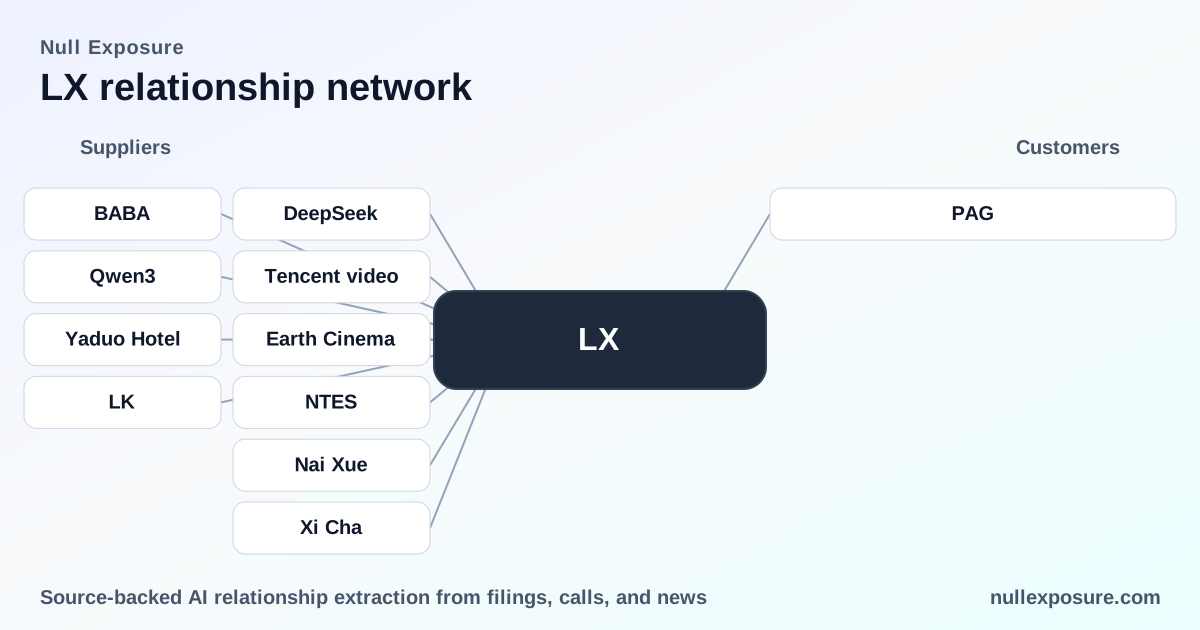
LexinFintech (LX): Supplier relationships that shape distribution, product and AI-driven modernization
LexinFintech operates as an online consumer finance and lifestyle platform for young professionals in China, originating credit and embedding financial services into consumer experiences. The company monetizes through interest and fee income on consumer loans, interchange and service fees on co-branded cards and partnerships, and platform monetization tied to merchant promotions and loyalty programs; Lexin’s trailing revenue of roughly RMB 14.0 billion and operating margin roughly 12.6% show a structured lending core supplemented by partnership-driven distribution. For a detailed supplier-focused view, see NullExposure’s portal: https://nullexposure.com/
Why supplier links matter to investors: distribution, engagement and product leverage
Lexin’s disclosed supplier relationships split into two strategic buckets: consumer-facing co-marketing partners (entertainment, food & beverage, travel, on-demand services) that amplify customer acquisition and card usage, and technology model providers that advance product personalization and decisioning. This dual approach moves the company from a pure lender toward a platform that monetizes network effects — card spend and subscription engagement feed loan volume and fee income. For direct supplier profiles consult https://nullexposure.com/ for sourcing and context.
How partnerships translate into customer economics
- Co-branded cards and equity sub-cards with youth-oriented brands support lower acquisition cost and higher lifetime value through cross-promotions.
- Integration of large models and search/AI tools signals product modernization that can compress underwriting cost and improve credit selection.
A mid-article supplier deep-dive is below; you can return to the NullExposure homepage for more supplier detail: https://nullexposure.com/
Relationship inventory: who Lexin is working with (concise, sourced)
Below I list every relationship present in the supplier feed with a short, plain-English summary and an explicit source note.
-
DeepSeek — Lexin is an early adopter of DeepSeek for search/AI capabilities, deploying the model across parts of its platform to improve discovery and personalization. Source: Yahoo Finance coverage of AI deployments (finance.yahoo.com, first seen Mar 10, 2026).
-
Qwen3 — Lexin integrated Qwen3 as part of its ongoing strategy to incorporate cutting‑edge language models into product workflows for personalization and automation. Source: Yahoo Finance article summarizing model integrations in 2025–2026 (finance.yahoo.com, Mar 10, 2026).
-
Tencent video — Lexin has offered co-branded or equity sub-cards that include benefits for Tencent Video users as part of a broader youth-brand card program to drive engagement and spend. Source: Futunn report referencing FY2020 partnership activity (news.futunn.com, reported Mar 10, 2026).
-
Earth Cinema — Lexin partnered with Earth Cinema to launch joint cards under the "U + Leca" initiative, using cinema-related perks to attract younger cardholders. Source: Futunn coverage on FY2020 card partnerships (news.futunn.com, Mar 10, 2026).
-
NetEase Cloud Music — NetEase Cloud Music was included among the brands whose benefits are embedded in Lexin’s equity sub-cards, aiming to increase card take-up among music-streaming users. Source: Futunn write-up on partnership programs (news.futunn.com, FY2020 reference; reported Mar 10, 2026).
-
Nai Xue — The tea chain Nai Xue is one of the merchant brands mapped into Lexin’s sub-card ecosystem to generate frequent, low-dollar transactions and boost engagement. Source: Futunn report citing the FY2020 co-card program (news.futunn.com, Mar 10, 2026).
-
Xi Cha — Xi Cha is another consumer brand used within Lexin’s joint card lineup to capture lifestyle spend from younger cohorts. Source: Futunn coverage of card partnerships (news.futunn.com, FY2020; Mar 10, 2026).
-
ele.me — Lexin’s card benefits include food delivery partners such as ele.me to lift transaction volumes and recurring usage tied to dining spend. Source: Futunn reporting on the FY2020 partnership slate (news.futunn.com, Mar 10, 2026).
-
Yaduo Hotel — Lexin’s partnership mix includes travel and lodging offers like Yaduo Hotel to capture periodic higher-ticket transactions and diversify spend categories. Source: Futunn post summarizing co-brand and sub-card partners (news.futunn.com, FY2020; reported Mar 10, 2026).
-
Lucky Coffee — Lucky Coffee is named among the brands included in Lexin’s card ecosystem, supplying habitual small-ticket transactions that strengthen monthly active card metrics. Source: Futunn reporting on the collaboration program (news.futunn.com, FY2020; Mar 10, 2026).
Each listing above is drawn from the supplier feed and clearly links Lexin’s card- and platform-led distribution strategy to recognizable consumer brands and modern AI suppliers.
Operational signals and contractual posture (company-level)
The supplier feed did not include explicit contract terms, exclusivity clauses, durations, or revenue‑share details. This absence is itself a signal: available public supplier mentions emphasize marketing and product integration rather than durable, high-capital vendor commitments. From that signal we infer company-level characteristics:
- Contracting posture: transactional and co-marketing focused rather than long-term lock‑ins; partnerships are oriented toward customer acquisition and wallet share.
- Concentration: supplier mix is diversified across media, food & beverage, travel and AI vendors, implying low single-supplier revenue concentration for distribution.
- Criticality: merchant partners are important for growth and spend activation, but not necessarily critical to credit origination infrastructure; AI model integrations are more material to underwriting and product efficiency over time.
- Maturity: many consumer-brand partnerships date back to FY2020 while AI integrations are reported in FY2025, showing a dual maturity track—established co-marketing channels plus recent technology upgrades.
Because contract-level constraints were not provided, investors should treat revenue attribution to these relationships as operationally meaningful but not contractually transparent.
Investment implications: what operators and investors should take from this
- Upside: Co-branded cards with lifestyle brands help lower acquisition costs and increase card spend; modern AI integrations promise better underwriting and automation that can expand margins. Lexin’s low trailing P/E and EV/Revenue multiples relative to revenue suggest the market is pricing either regulatory or execution risk; supplier strategy is one lever to change that dynamic.
- Risk: Partnerships are largely marketing and benefits-driven, which means stickiness is earned through continued rewards rather than contractual lock‑ins; competitive pressure on card economics and regulatory scrutiny in China’s consumer finance sector remain material.
For a consolidated supplier risk scorecard and primary-source links, visit NullExposure: https://nullexposure.com/
Bottom line and next steps
Lexin’s supplier relationships show a coherent strategy: use lifestyle co-branding to drive transactions and adopt advanced AI to improve product economics. Investors and operators should monitor two variables closely — the depth of AI integration into underwriting and the sustainability of card economics across these merchant partnerships. For ongoing supplier monitoring and primary-source access, see NullExposure’s supplier hub: https://nullexposure.com/
Bold takeaway: Lexin combines a high-frequency merchant partnership network with recent AI model adoption—this is a distribution-plus-technology thesis that can materially improve unit economics if card economics and regulatory conditions hold.