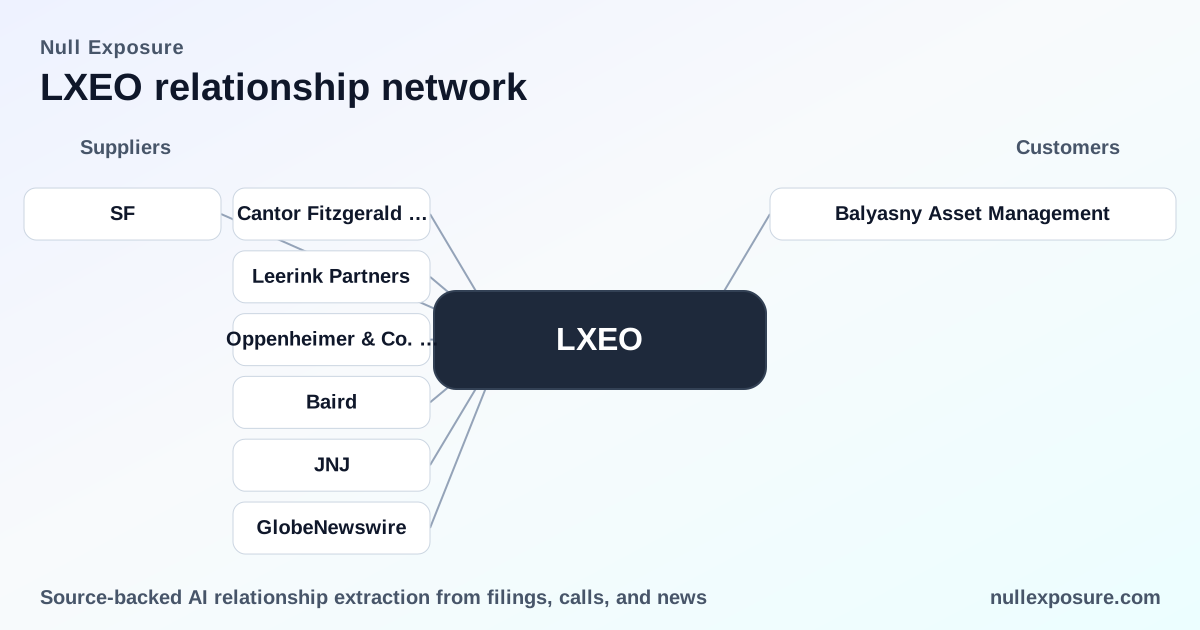
Lexeo Therapeutics (LXEO): Supplier relationships and what they mean for investors
Lexeo Therapeutics operates as a clinical-stage genetic medicine company focused on cardiovascular gene therapies. It monetizes by progressing clinical assets (notably LX2020 and related AAV programs) through clinical proof points to unlock licensing, partnership, or eventual commercialization value; until commercialization, capital markets activity and strategic collaborations drive funding and de‑risking. Capital raises and third‑party development partners are therefore central to Lexeo’s operating model and investor returns. Want a consolidated supplier-risk view for downstream diligence? Visit https://nullexposure.com/ for an integrated supplier map.
How Lexeo funds and runs development: an operator’s summary
Lexeo runs lean: pre-revenue, outsourced R&D and manufacturing, and periodic equity offerings to fund trials. The company has no product revenue and negative operating margins; its market cap and analyst coverage reflect a value proposition tied to clinical progression and partnership potential. Underwriting syndicates and strategic collaborators materially shape capital availability and technical progress.
Capital markets partners that provided immediate liquidity
Lexeo closed a public offering in October 2025 that involved a group of investment banks acting as underwriters. These relationships are transactional but high‑impact: underwriters supply primary market access and distribution that directly influence dilution, pricing, and investor composition.
Cantor Fitzgerald & Co.
Cantor acted as one of the joint book‑running managers for Lexeo’s public offering that closed in October 2025, providing distribution and placement capacity for the equity raise. This was disclosed in the company’s offering release distributed via GlobeNewswire (Oct 20, 2025).
Leerink Partners
Leerink served as a joint book‑running manager on the same offering and played a central role in order building and investor targeting for the transaction (GlobeNewswire, Oct 20, 2025).
Oppenheimer & Co. Inc.
Oppenheimer participated as a joint book‑running manager on the offering, contributing placement and syndicate execution to the capital raise (GlobeNewswire, Oct 20, 2025).
Baird
Baird acted as the lead manager for the public offering, a role that typically coordinates syndicate activity and distribution logistics for the transaction (GlobeNewswire, Oct 20, 2025).
Stifel
Stifel was named among the underwriting group as a joint manager, participating in the offering’s book‑running and distribution efforts (GlobeNewswire, Oct 20, 2025).
Strategic development partner: Johnson & Johnson
Lexeo announced a research collaboration with Johnson & Johnson to investigate localized cardiac delivery of AAV gene therapy using Impella heart pump technology. This collaboration represents a technical de‑risking pathway and potential validation by a large medtech/pharma partner, which can materially increase program value if it advances beyond research stages (company release summarized on QuiverQuant, FY2026).
Corporate communications and news distribution
GlobeNewswire is the distributor for Lexeo’s formal offering announcement and other press releases; investor-facing disclosures and syndicate details were published via GlobeNewswire on October 20, 2025. Note that third‑party aggregators flagged an AI‑generated summary of one press release distributed through GlobeNewswire; investors should reference original filings and full press releases for accuracy (QuiverQuant flagged the summary, FY2026).
What the supplier constraints tell you about Lexeo’s operating posture
Lexeo’s public disclosures signal a consistent outsourced, short‑term contracting posture and a classic clinical‑stage supplier profile:
- The company discloses services agreements for manufacturing and research that are terminable on 30–60 days’ notice, indicating high flexibility but lower term certainty for critical suppliers (company disclosure language).
- Lexeo relies on third‑party manufacturers (CMOs) for drug product supply and on CROs for trial conduct; the reporting categorizes these roles as manufacturer, distributor, and service provider with active engagements supporting ongoing trials.
- These supplier relationships are operationally critical—manufacturing and CRO relationships are necessary for on‑time clinical milestones—but mature and long‑dated contracts are not the norm, increasing supplier switching risk but enhancing Lexeo’s ability to renegotiate or pivot when needed.
Collectively, these traits create an operating model where cash runway, rapid contract agility, and the ability to secure qualified CMOs/CROs are the primary operational levers.
(If you want a visual map of these supplier connections and contract signals, see https://nullexposure.com/.)
Investor and operator implications
- Dilution and timing risk remain primary investment risks. Underwriting syndicates enable financing but also control dilution mechanics; watch future equity issuance cadence against clinical milestones.
- Operational continuity hinges on outsourced partners. Short‑notice termination rights improve flexibility but create execution risk if a CMO or CRO shifts capacity; operators should prioritize fallback suppliers and longer term supply agreements for pivotal stages.
- Strategic partnerships are de‑risking signals. The Johnson & Johnson collaboration is the most material non‑financial relationship: it validates a delivery strategy and could accelerate clinical development or create partnership economics.
Practical next steps for diligence: confirm the identity and capacity of CMOs/CROs on pivotal programs, review offering prospectus terms for investor protections and dilution triggers, and monitor progression of the Johnson & Johnson research collaboration for concrete milestones and IP arrangements. For an actionable supplier-risk checklist tailored to clinical-stage biotechs, visit https://nullexposure.com/.
Relationship-by-relationship roll call
- Cantor Fitzgerald & Co.: Cantor served as a joint book‑running manager on Lexeo’s October 2025 public offering, providing underwriting and distribution services (GlobeNewswire, Oct 20, 2025).
- Leerink Partners: Leerink acted as a joint book‑running manager on the same offering, contributing to order building and placement strategy (GlobeNewswire, Oct 20, 2025).
- Oppenheimer & Co. Inc.: Oppenheimer participated as a joint book‑running manager on Lexeo’s offering, supporting syndicate execution (GlobeNewswire, Oct 20, 2025).
- Baird: Baird served as the lead manager for the public offering, coordinating syndicate activity and distribution logistics (GlobeNewswire, Oct 20, 2025).
- Stifel: Stifel was part of the group of joint book‑running managers on the offering, providing underwriting support (GlobeNewswire, Oct 20, 2025).
- Johnson & Johnson: Lexeo entered a research collaboration with Johnson & Johnson to investigate localized cardiac AAV delivery using Impella technology, a program-level technical partnership that advances delivery and safety profiling (company announcement summarized via QuiverQuant, FY2026).
- GlobeNewswire: GlobeNewswire distributed Lexeo’s offering announcement and related press releases (Oct 20, 2025); one third‑party feed noted an AI‑generated summary of a press release, so investors should consult the original GlobeNewswire release for the authoritative text (GlobeNewswire, Oct 20, 2025; QuiverQuant, FY2026).
Final take
Lexeo’s supplier landscape is classic for a clinical‑stage biotech: short-term, outsourced execution combined with targeted strategic partnerships and active capital markets relationships. For investors and operating teams, the primary actionable risks are financing cadence and manufacturing/CRO continuity; the Johnson & Johnson collaboration is the most significant upside de‑risking event on the horizon. For a deeper supplier and counterparty risk review tailored to your diligence workflow, explore our resources at https://nullexposure.com/.