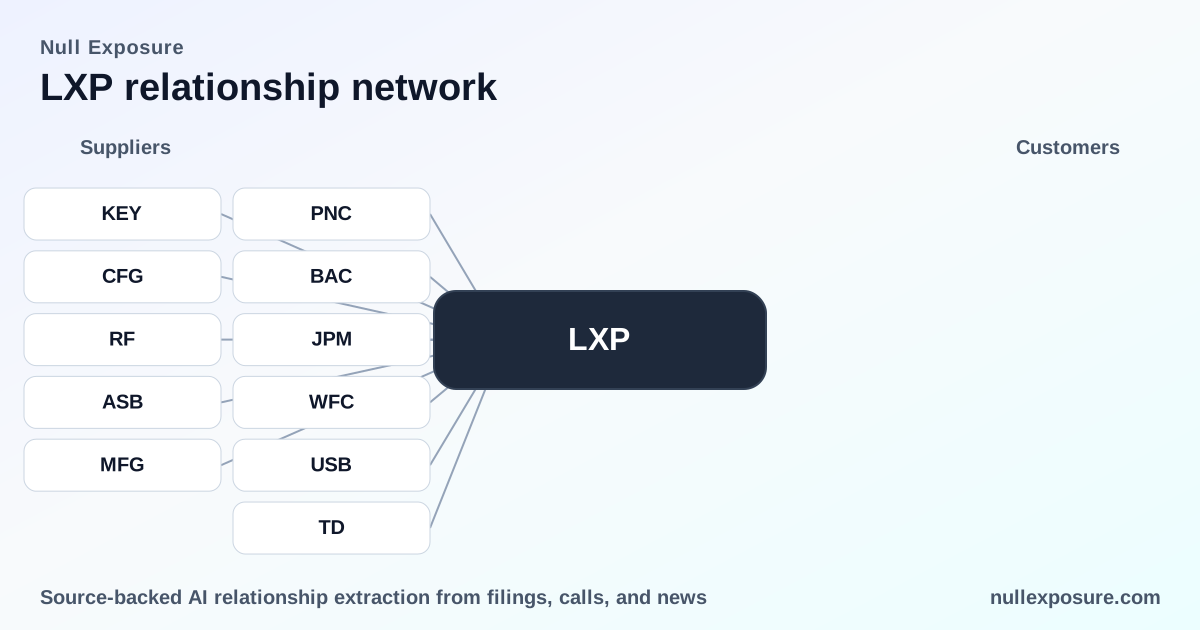
LXP Industrial Trust: lender syndicate, service suppliers and what operators should price in
LXP Industrial Trust operates as a focused industrial REIT that owns and manages logistics properties and monetizes through leased rental income and disciplined capital markets activity—including secured and unsecured credit facilities that lower cost of capital and support portfolio growth. The firm's recent capital actions concentrate funding relationships with national banks and capital markets desks, which is strategically important for portfolio liquidity and refinancing flexibility. For deeper supplier and counterparty intelligence, visit https://nullexposure.com/ for transaction-level context and tracking.
The financing move that reorganized the counterparty map
In January 2026 LXP closed a material financing package: a $600 million unsecured revolving credit facility and a $250 million unsecured term loan. That transaction reestablishes committed bank capacity and reshapes the syndicate that underwrites its working capital and near-term investment runway. According to a GlobeNewswire press release on January 14, 2026, the deal assembled a broad group of documentation agents and participating banks while KeyBank was designated as Administrative Agent with Wells Fargo and Regions in syndication roles.
This is a deliberate capital posture: unsecured, broadly syndicated bank lines increase balance-sheet optionality but raise reliance on relationship banks and capital markets desks. For active investors and operators, that shifts emphasis from single-bank dependency to counterparty management across a top-tier bank group. Learn how we map these supplier linkages at https://nullexposure.com/.
Counterparty roll call: the lenders, arrangers and documentation agents
Below I list every counterparty cited in public transaction announcements, with a concise plain-English summary and source for each relationship.
Bank of America, N.A.
Bank of America acted as one of the documentation agents on LXP’s January 2026 financing, putting it in a formal role for contract execution and loan documentation. Source: GlobeNewswire press release, January 14, 2026.
Citizens Bank, N.A.
Citizens Bank participated as a documentation agent on the unsecured facilities, indicating its role as a formal lender and processor for the credit package. Source: GlobeNewswire press release, January 14, 2026.
Mizuho Bank, Ltd.
Mizuho was listed among documentation agents supporting the credit agreement, providing international banking capacity to the syndicate. Source: GlobeNewswire press release, January 14, 2026.
JPMorgan Chase Bank, N.A.
JPMorgan served as a documentation agent in the transaction, reflecting inclusion of a major global bank in LXP’s financing base. Source: GlobeNewswire press release, January 14, 2026.
PNC Bank, National Association
PNC participated as a documentation agent in the financing, adding regional bank lending capacity to the deal structure. Source: GlobeNewswire press release, January 14, 2026.
TD Bank, N.A.
TD Bank was cited as a documentation agent on the facilities, broadening the syndicate’s North American banking reach. Source: GlobeNewswire press release, January 14, 2026.
U.S. Bank National Association
U.S. Bank was one of the documentation agents, confirming its operational role in administering parts of the credit agreement. Source: GlobeNewswire press release, January 14, 2026.
Associated Bank, National Association
Associated Bank is named as a participating bank in the transaction, signaling inclusion of midsize regional lenders in the lending pool. Source: GlobeNewswire press release, January 14, 2026.
KeyBank National Association
KeyBank is designated as the Administrative Agent for LXP’s amended and restated credit agreement, centralizing agent responsibilities and day-to-day lender coordination. Source: GlobeNewswire press release, January 14, 2026; TradingView coverage of KeyBank’s agent role, March 2026.
Wells Fargo Bank, National Association
Wells Fargo served as a Syndication Agent and its securities arm, Wells Fargo Securities, acted as a Joint Lead Arranger and Joint Bookrunner—placing Wells Fargo across both syndication and capital markets execution roles. Source: GlobeNewswire press release, January 14, 2026.
Wells Fargo Securities, LLC
As a Joint Lead Arranger and Joint Bookrunner, Wells Fargo Securities led capital markets placement work for the credit package alongside KeyBanc and Regions. Source: GlobeNewswire press release, January 14, 2026.
KeyBanc Capital Markets, Inc.
KeyBanc Capital Markets served as a Joint Lead Arranger and Joint Bookrunner, anchoring the institutional distribution and pricing effort for LXP’s facility. Source: GlobeNewswire press release, January 14, 2026.
Regions Bank
Regions Bank acted as a Syndication Agent for the transaction, participating in allocation and distribution responsibilities within the bank group. Source: GlobeNewswire press release, January 14, 2026.
Regions Capital Markets
Regions Capital Markets joined as a Joint Lead Arranger and Joint Bookrunner, contributing to bookrunning and market access functions. Source: GlobeNewswire press release, January 14, 2026.
KeyBank (TradingView reference)
TradingView reported that LXP signed an amended and restated credit agreement with KeyBank as agent, confirming the administrative agency role and amendment to the existing facility in FY2026. Source: TradingView news, March 2026.
What the supplier map says about LXP’s operating model
The collection of relationships and public constraints paints a clear operational profile:
-
Contracting posture: LXP uses a mix of syndicated unsecured credit and long-term property-level lease structures; the company-level evidence highlights the presence of long-term ground leases that anchor asset cash flows. This duality—portfolio cash flow stability from leases plus flexible unsecured liquidity—defines its capital posture.
-
Service outsourcing and criticality: LXP explicitly outsources core functions—managed IT, virtual CTO/CISO services, internal audit (big-four support), and national property management—indicating reliance on established service providers for operations and compliance. These are company-level signals of a managed operating model where third-party vendors are critical to daily operations.
-
Concentration and maturity: The lending syndicate spans top-tier national banks and capital markets desks, reducing single-counterparty concentration but increasing dependence on relationship banking and capital markets capacity. The presence of established arrangers and bookrunners signals a mature capital-raising approach.
Investment implications and risk signals
-
Positive: diversified bank relationships and active capital markets partners improve liquidity access and lower refinancing risk under normal market conditions. The administrative role of KeyBank and bookrunning by KeyBanc/Wells/Regions demonstrates established market channels.
-
Watchlist: service-provider dependency—outsourced IT, audit, and property management are operationally critical; vendor disruptions could have outsized operational impact. Long-term ground leases create durable cash flow but can constrain redevelopment optionality.
-
Credit nuance: unsecured facilities improve flexibility but leave lenders relying on covenant packages and enterprise credit quality rather than collateral execution; underwriting and covenant terms in the credit documents should be reviewed for downside protection.
For a transaction-level supplier map and ongoing monitoring of counterparties, go to https://nullexposure.com/.
Final takeaways and next steps
LXP has structured a broad, high-quality lending syndicate while consolidating operational delivery through specialized service providers—this is a capital-efficient model that trades increased service-vendor dependency for financial optionality. Active investors should monitor covenant text, vendor contracts for critical functions, and the evolution of bank roles in upcoming filings.
If you evaluate supplier concentration, contract maturity, or counterparty risk for portfolios, start your analysis at https://nullexposure.com/ to see how these relationships change in real time and where exposure clusters.