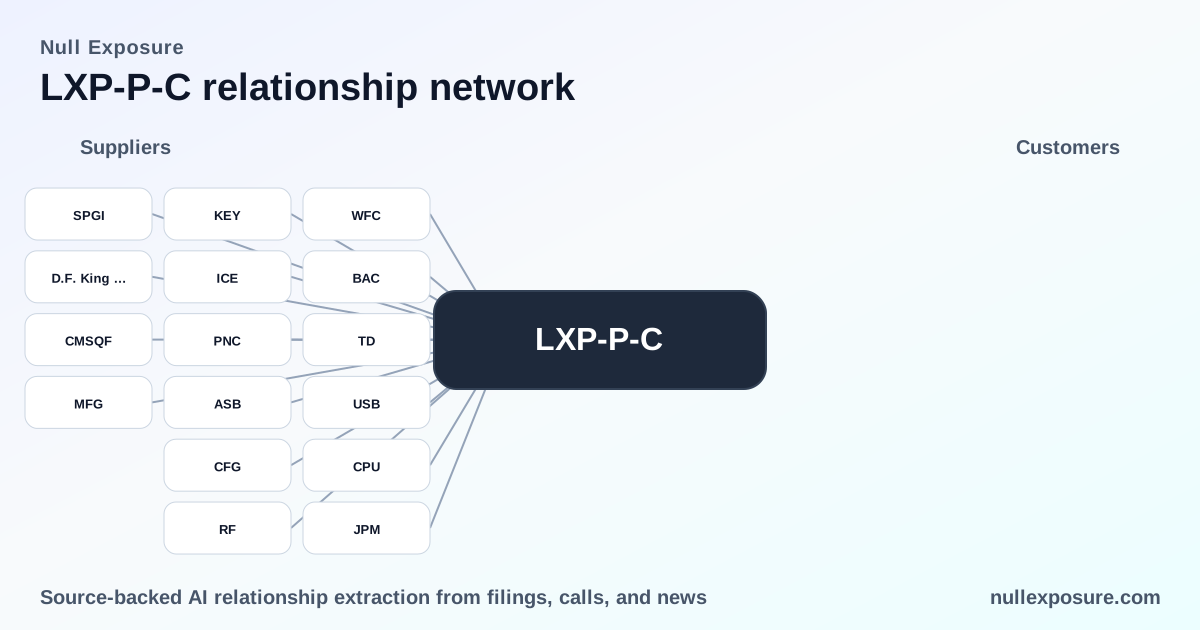
LXP-P-C: Preferred equity anchored by a diversified REIT with a broad bank syndicate
Thesis: Lexington Realty Trust Preferred Convertible Series C (LXP-P-C) is a fixed-income-style exposure to Lexington’s commercial real estate platform; the security delivers preferred dividends and derives value from the underlying REIT’s portfolio and balance-sheet management. Lexington monetizes through leasing and property operations while financing growth and liability management via syndicated bank facilities, capital markets transactions and targeted tender actions. For investors evaluating counterparty risk, the recent wave of credit activity and transfer-agent actions clarifies both funding sources and operational touchpoints. Learn more on the platform: https://nullexposure.com/
How LXP-P-C fits into Lexington’s capital stack
As a preferred equity instrument, LXP-P-C sits above common equity in claim priority and is structured to provide a steady dividend stream backed by a diversified commercial-property portfolio. Lexington funds operations and growth primarily through rental income and a mix of secured and unsecured credit facilities, supplemented by capital markets issuance and targeted debt tender or refinancing executed with dealer managers and bookrunners. The issuer’s recent financing and corporate actions demonstrate active liability management and reliance on a bank syndicate and investment banks for execution.
Why the recent bank facility matters to preferred holders
In January 2026, Lexington closed a combined credit package that materially extends its debt maturities and increases liquidity headroom. According to a GlobeNewswire release (Jan 14, 2026), the deal consisted of a $600 million unsecured revolving credit facility and a $250 million unsecured term loan, arranged by a multi-bank group. That facility reduces near-term refinancing risk and supports preferred dividend coverage through improved financing flexibility. See the press release for facility details: https://www.globenewswire.com/news-release/2026/01/14/3218495/0/en/LXP-Industrial-Trust-Closes-on-600-Million-Unsecured-Revolving-Credit-Facility-and-250-Million-Unsecured-Term-Loan.html
If you want an operational view on counterparties and exposure, review our supplier analysis at https://nullexposure.com/.
The capital markets execution layer — who ran these deals
Lexington used established dealer managers and bookrunners to execute tender and debt transactions, indicating market access and institutional relationships that support preferred-holders’ confidence in liquidity of corporate actions. For example, KeyBanc, Wells Fargo Securities and Regions Capital Markets acted as joint lead arrangers and bookrunners on the January 2026 financing (GlobeNewswire, Jan 14, 2026). Separately, Wells Fargo Securities served as dealer manager for a prior cash tender offer related to outstanding notes (GlobeNewswire, Oct 16, 2025). Active engagement with marquee dealers signals a commercial contracting posture and broad access to institutional capital.
Operational controls and shareholder mechanics
Lexington routes shareholder operational matters through professional transfer agents and information agents when executing corporate actions. Computershare and D.F. King handled transfer-agent and tender-agent functions in 2025–2026 communications, ensuring orderly processing of reverse splits and tender materials (GlobeNewswire Oct 30, 2025; GlobeNewswire Oct 16, 2025). The New York Stock Exchange handled the mechanics of share re-listing and split-adjusted trading after the reverse split (QuiverQuant report, Nov 2025). These vendors are procedural but critical — transfer and information agents determine the practical timeline for settlements and fractional-share payments.
Balance-sheet signaling: ratings and management commentary
S&P Global Ratings revised Lexington’s outlook to positive in late 2025, a formally published rating action cited by an earnings-call transcript (InsiderMonkey, Q4 2025) and echoed in management commentary tied to the January 2026 financing. Chief Financial Officer Nathan Brunner highlighted reduced leverage and improved maturity profile as drivers for the rating action (Sahm Capital summary, Jan 14, 2026). A positive rating outlook combined with active deleveraging reduces tail risk for preferred holders by supporting coverage and market confidence.
Explore deeper counterparty mapping and implications at https://nullexposure.com/.
Relationship rundown — who does what (concise, by counterparty)
- Wells Fargo Securities, LLC — Served as dealer manager for a cash tender offer and as a joint lead arranger/bookrunner on the January 2026 facilities, anchoring Lexington’s capital markets distribution and underwriting competence (GlobeNewswire Oct 16, 2025; GlobeNewswire Jan 14, 2026).
- Bank Of America, N.A. — Acted as a Documentation Agent on the January 2026 credit package, participating in loan documentation and execution for the $600M revolver and $250M term loan (GlobeNewswire Jan 14, 2026).
- TD Bank, N.A. — Named among the Documentation Agents for the January 2026 credit closing, part of the broader bank group supporting the facilities (GlobeNewswire Jan 14, 2026).
- U.S. Bank National Association — Participated as a Documentation Agent on the January 2026 financing, contributing to loan administration and credit support (GlobeNewswire Jan 14, 2026).
- Wells Fargo Bank, National Association — Served as a Syndication Agent on the January 2026 package and was part of the agent group that distributed the facility among lenders (GlobeNewswire Jan 14, 2026).
- KeyBanc Capital Markets, Inc. — One of the Joint Lead Arrangers and Joint Bookrunners on the January 2026 financing, leading syndication and placement among institutional lenders (GlobeNewswire Jan 14, 2026).
- KeyBank National Association — Designated the Administrative Agent for the facility, responsible for agent duties and ongoing administrative coordination of the loan (GlobeNewswire Jan 14, 2026).
- JPMorgan Chase Bank, N.A. — Included as a Documentation Agent on the January 2026 transaction, helping finalize loan legal and commercial terms (GlobeNewswire Jan 14, 2026).
- PNC Bank, National Association — Participated as a Documentation Agent on the January 2026 financing package (GlobeNewswire Jan 14, 2026).
- Regions Bank — Served as a Syndication Agent and was noted among syndication participants for the January 2026 facilities (GlobeNewswire Jan 14, 2026).
- Regions Capital Markets — Listed among the Joint Lead Arrangers and Bookrunners on the January 2026 package, supporting distribution to credit investors (GlobeNewswire Jan 14, 2026).
- Computershare — Lexington’s transfer agent for the reverse share split and related shareholder communications, handling fractional-share cash payments and investor inquiries in late 2025 (GlobeNewswire Oct 30, 2025; QuiverQuant Nov 2025).
- New York Stock Exchange — Executed split-adjusted trading mechanics following the November 2025 reverse share split, ensuring market continuity for common shares (QuiverQuant Nov 2025).
- D.F. King & Co., Inc. — Acted as the Information and Tender Agent for the October 2025 tender offer, distributing offer materials and processing tenders (GlobeNewswire Oct 16, 2025).
- Associated Bank, National Association — Participated in the January 2026 financing as a participant bank supporting the revolving facility documentation (GlobeNewswire Jan 14, 2026).
- Citizens Bank, N.A. — Included among the Documentation Agents on the January 2026 credit facilities (GlobeNewswire Jan 14, 2026).
- Mizuho Bank, Ltd. — Served as a Documentation Agent in the January 2026 financing, representing an international banking participant (GlobeNewswire Jan 14, 2026).
- S&P Global Ratings — Publicly revised Lexington’s outlook to positive in late 2025, a credit signal cited by management as validation of deleveraging and improved liquidity (InsiderMonkey Q4 2025 transcript).
Operating-model signals and material constraints investors should weight
- Contracting posture: Lexington relies on a broad bank syndicate and major investment banks for documentation, syndication and capital-markets execution — this reduces single-counterparty concentration in funding.
- Concentration and criticality: The bank group and transfer agents are operationally critical — the credit facilities materially affect liquidity and the transfer agents determine shareholder settlement speed; disruption to these functions would have immediate operational impact.
- Maturity posture and market access: Recent extend-and-refinance activity indicates an active liability-management strategy that improves runway and lowers near-term roll risk.
- Maturity of relationships: Engagement with established institutions (KeyBanc, Wells Fargo, Bank of America, etc.) signals mature market access and repeatable execution capability.
Investment implications and final take
For investors and operators, the combination of firm bank sponsorship, active capital-markets execution, and a positive rating outlook materially lowers refinancing risk for LXP-P-C holders relative to a REIT without such relationships. The practical operational dependencies—transfer agent processing and administrative agent functions—remain important execution risks to monitor around corporate actions. Review the primary filings and press releases cited above for transaction-level detail, and map counterparty exposure against your own credit limits.
For a deeper supplier-risk profile and automated counterparty monitoring, visit our research hub: https://nullexposure.com/
If you need a tailored counterparty report or onboarding due diligence for LXP-P-C counterparties, we offer focused supplier intelligence and subscription services at https://nullexposure.com/.