Lexicon Pharmaceuticals (LXRX): What the underwriting and supply signals tell investors
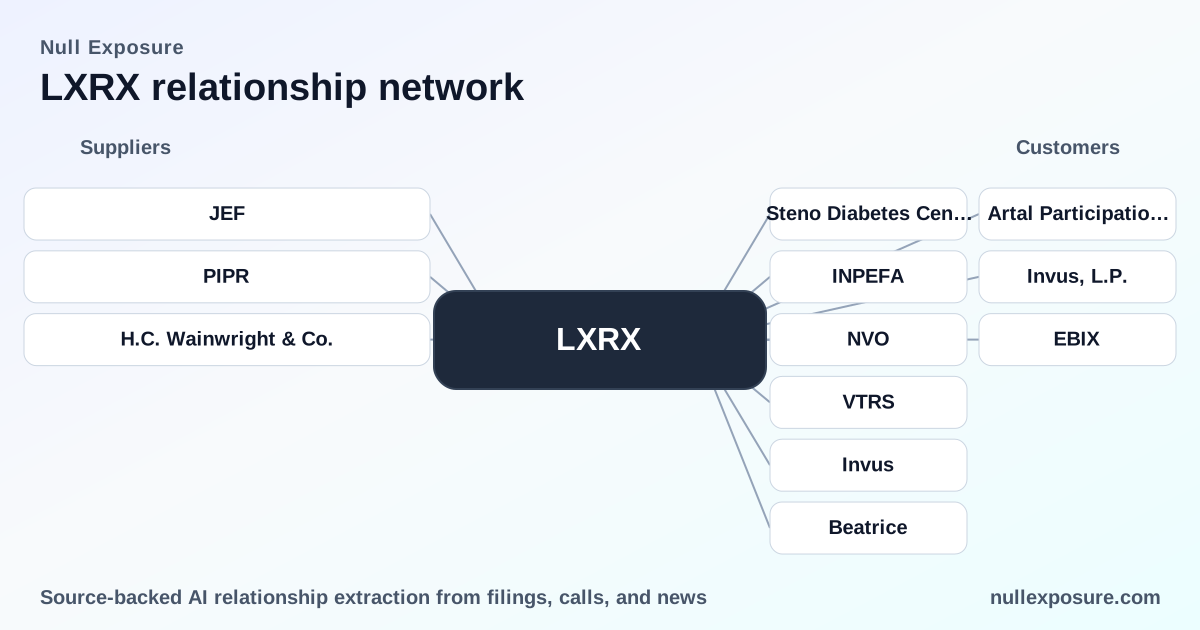
Lexicon Pharmaceuticals operates as a small-cap biopharma that discovers, develops and commercializes therapeutics and monetizes through product sales (commercial supply of INPEFA) and periodic capital markets activity to fund operations. The company relies on third-party contract manufacturers and a concentrated logistics footprint to deliver commercial product, and it taps institutional underwriters when it needs balance sheet refreshes — most recently in FY2026. For a deeper view of counterparties and supplier constraints, visit https://nullexposure.com/.
Why the underwriting roster matters to an operator like Lexicon
Capital raises reveal both market access and the counterparty network that supports an issuer through underwriting, distribution and investor placement. In FY2026 Lexicon completed a public equity offering with multiple managers; the identity and role of those managers matters to execution, pricing and timing. Underwriters provide distribution capability and signal institutional support; for small biotech issuers, the choice of lead and co-managers directly affects the speed and costs of capital.
Counterparty breakdown — who Lexicon worked with in FY2026
Below are the counterparties identified in news reports around Lexicon’s FY2026 equity activity, with concise plain-English descriptions and source notes.
Jefferies (Jefferies LLC)
Jefferies acted as one of the joint book‑running managers on Lexicon’s public offering, providing underwriting and placement services as a primary distributor to institutional investors. According to a QuiverQuant report covering the offering on March 10, 2026, Jefferies was named alongside Piper Sandler as a book‑running manager (https://www.quiverquant.com/news/Lexicon+Pharmaceuticals+Completes+Public+Offering+of+Common+Stock+and+Concurrent+Private+Placement).
Piper Sandler (Piper Sandler & Co.)
Piper Sandler was appointed as a joint manager for the offering and functioned as a co‑underwriter, reinforcing institutional distribution capacity for the deal. A StocksToTrade article and TradingView summary from early 2026 noted Piper Sandler’s role as a joint manager (https://stockstotrade.com/news/lexiconpharmaceuticalsinc-lxrx-news-2026_01_31/ and https://www.tradingview.com/news/tradingview:83cd79e7c8f56:0-lexicon-pharmaceuticals-signs-multiple-material-agreements/).
H.C. Wainwright & Co.
H.C. Wainwright served as the lead manager for the public offering, responsible for primary syndicate coordination and marketing to its institutional client base. A QuiverQuant posting from March 10, 2026 identifies H.C. Wainwright as the lead manager on the offering announcement (https://www.quiverquant.com/news/Lexicon+Pharmaceuticals+Completes+Public+Offering+of+Common+Stock+and+Concurrent+Private+Placement).
What the supplier constraints reveal about Lexicon’s operating model
Beyond the underwriting relationships, Lexicon’s supplier disclosures highlight structural operational features that impact resilience, cost and execution:
- Global raw material sourcing: Active use of raw materials from suppliers in Asia and Europe creates multi‑regional sourcing exposure that is beneficial for competitive pricing but raises logistical and regulatory complexity. This is a company-level sourcing signal drawn from Lexicon’s public statements on API raw materials.
- Third‑party manufacturing posture: Lexicon uses multiple contract manufacturing organizations (CMOs) to produce commercial INPEFA and clinical supplies, indicating a predominantly outsourced manufacturing model rather than in‑house production; this reflects a strategic contracting posture that reduces fixed capital but increases third‑party dependency.
- Concentration in drug product manufacturing and logistics: The company relies on a sole‑source drug product contract manufacturer in North America and a single third‑party logistics provider (with two distribution locations), a combination that creates high operational concentration and single‑point‑of‑failure risk for commercial supply.
- Active mitigation and maturity signal: Lexicon is actively establishing a backup supplier for the API and has identified a backup for the commercial drug product manufacturer, showing operational maturation and proactive risk management to address single‑source exposures.
These constraints are company-level signals based on Lexicon’s disclosures and should be considered independent of the underwriter relationships.
Investment implications: balance-sheet access vs. supply concentration
Lexicon’s use of reputable underwriters — H.C. Wainwright as lead, with Jefferies and Piper Sandler as joint book‑runners — confirms the company’s ability to access institutional capital efficiently in FY2026 and supports liquidity management for near-term operations. (See coverage cited above for each manager.)
However, the operational profile presents tangible execution risk: sole‑source drug product manufacturing in North America and a single logistics provider amplify the consequences of a supplier disruption. While multiple CMOs and multi‑region raw material sourcing reduce some upstream risk, the current downstream concentration means that operational interruptions could have outsized revenue and margin impacts until backup suppliers are fully qualified and validated.
For investors evaluating supplier relationships, the combination of (1) demonstrated capital markets access through experienced underwriters and (2) concentrated operational dependencies creates a mixed risk-return profile. Capital access lowers funding risk; supply concentration increases execution and revenue risk.
If you are tracking counterparty exposure or need a structured view of supplier concentration for LXRX, check our analytical tools at https://nullexposure.com/.
Practical takeaways for investors and operators
- Capital markets strength: The FY2026 offering was distributed by known institutional underwriters — a positive for short‑term funding and investor outreach.
- Operational single points of failure: Sole‑source drug product manufacturing in North America and a single logistics provider create material supply‑chain risk until backups are fully operational.
- Active risk remediation: Identification of backup suppliers signals management is addressing concentration, reducing but not removing near‑term operational risk.
Final view and next steps
For investors, Lexicon presents a classic small‑biotech trade: institutional access to capital paired with operational concentration that elevates execution risk. Underwriters executing the FY2026 offering reduce financing risk; supply dependence increases the importance of operational monitoring and supplier qualification milestones.
To monitor counterparties and supplier concentration for Lexicon and other healthcare suppliers, visit https://nullexposure.com/ for continuous coverage and analytic context.