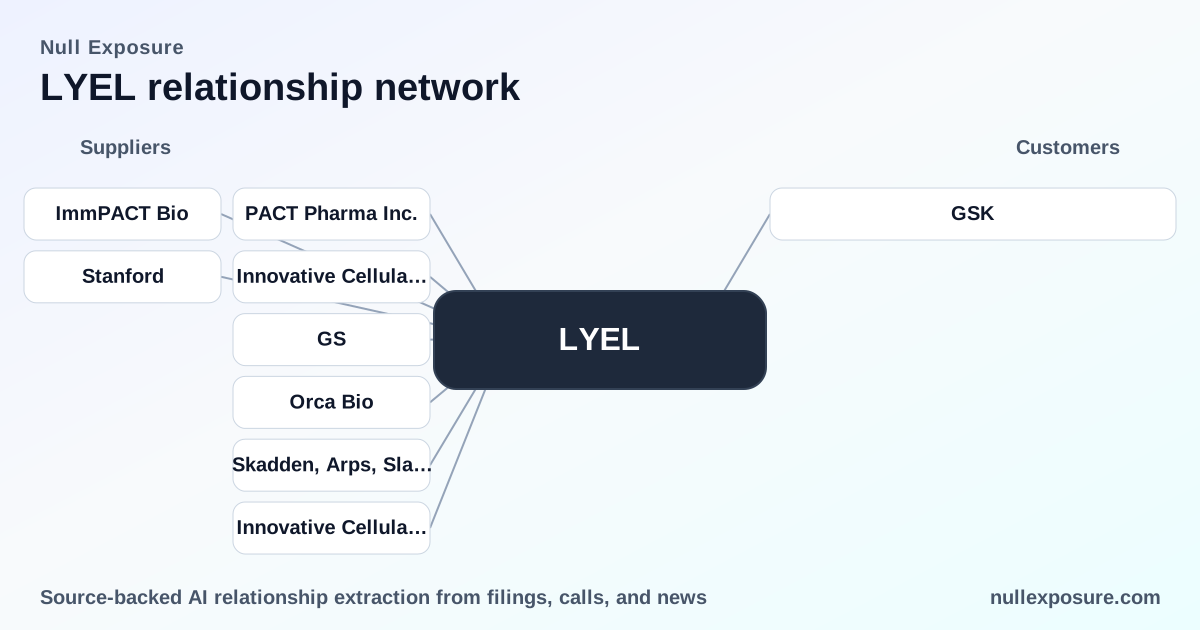
Lyell Immunopharma: supplier relationships that shape near‑term execution and value
Lyell Immunopharma operates as a clinical‑stage T‑cell reprogramming company that develops next‑generation CAR‑T and T‑cell therapies for solid tumors. The company monetizes by advancing clinical assets toward registration and commercialization, acquiring or licensing promising candidates, and structuring success‑based payments and potential future royalties or product sales—while relying on a network of CROs, manufacturers, legal and financial advisors to execute. For a systematic supplier and counterparty view that matters to underwriting and partner diligence, visit https://nullexposure.com/.
How Lyell creates value and where suppliers tie into the P&L
Lyell’s commercial value is driven by clinical progress and selective asset aggregation rather than current product revenue (Revenue TTM is $36k and operating losses are substantial). The company’s strategy since 2024 has emphasized inorganic strengthening of its solid‑tumor pipeline (notably the ImmPACT Bio acquisition and licensing deals for LYL273), and operational consolidation of manufacturing to its Bothell facility. This business model is capital intensive: near‑term value is a function of clinical readouts, successful manufacturing scale‑up, and favorable deal economics on acquired assets.
Supplier and partner map — what every listed relationship contributes
Below are the supplier and partner relationships disclosed in public filings and press releases, each summarized in plain English with source attribution.
PACT Pharma Inc.
Lyell’s FY2024 10‑K records a collaborative arrangement with PACT Pharma, indicating a prior scientific or development collaboration that contributes to Lyell’s T‑cell platform capabilities. According to Lyell’s FY2024 Form 10‑K, PACT is recorded as a party to a collaborative arrangement (FY2024 10‑K).
Innovative Cellular Therapeutics (ICT) / Innovative Cellular Therapeutics
Lyell acquired exclusive global rights (outside mainland China, Hong Kong, Macau and Taiwan) to LYL273, an autologous GCC‑targeted CAR‑T candidate for metastatic colorectal cancer, bolstering the company’s solid‑tumor pipeline. This licensing/asset acquisition was announced in November 2025 and reported across outlets including GlobeNewswire and Yahoo Finance (Nov 2025; March 2026 coverage).
Goldman Sachs & Co. LLC
Goldman Sachs acted as sole financial advisor to Lyell in the ImmPACT Bio acquisition, signaling the transaction’s strategic and financing significance and providing institutional M&A execution support. This engagement was disclosed in Lyell press material around the ImmPACT transaction (GlobeNewswire, Oct 24, 2024).
Skadden, Arps, Slate, Meagher & Flom LLP
Skadden served as legal counsel to Lyell on the ImmPACT Bio acquisition and related transactions, reflecting standard external legal support for complex biotech M&A and integration. Skadden’s role is cited in Lyell press releases announcing the ImmPACT deal (GlobeNewswire and Yahoo Finance, Oct–Nov 2024/2025).
ImmPACT Bio
Lyell entered into a definitive agreement to acquire ImmPACT Bio in October 2024 and subsequently moved manufacturing of IMPT‑314 to its Bothell, Washington facility, consolidating manufacturing responsibilities internally and reducing dependency on the acquired company’s operations. This acquisition and the manufacturing transfer were described in Lyell’s press release and subsequent SEC‑filed disclosures (Pharmaceutical‑Technology, GlobeNewswire; SEC filing referenced by Biospace, 2025–2026).
Orca Bio
Lyell announced a research partnership with Orca Bio to combine Orca’s precision T‑cell purification technology with Lyell’s T‑cell biology expertise, a collaboration intended to accelerate preclinical discovery for solid tumors. The partnership was publicly announced in a joint release in September 2020 (GlobeNewswire, Sept 2, 2020).
Stanford
Lyell recognized a success payment liability at fair value in relation to obligations tied to Stanford, indicating a milestone or success‑based arrangement where Stanford provided services that earned contingent consideration as of October 1, 2024. This accounting treatment and related arrangement were disclosed in Lyell’s business highlights and financial results (GlobeNewswire, Nov 12, 2025).
Operating model signals and supplier constraints investors should weigh
The public statements and filings produce company‑level signals about Lyell’s contracting posture and operational dependencies:
- Contracting posture: mixed — subscription and long‑term commitments. Lyell uses a range of third‑party service providers (cloud, SaaS, managed services) consistent with subscription arrangements, while its real‑estate footprint is secured by a long‑term lease on South San Francisco headquarters that runs to March 2031, creating fixed occupancy cost and relocation inertia.
- Critical reliance on service providers and CROs. Lyell explicitly relies on CROs for significant parts of IMPT‑314 Phase 1/2 trials and on third parties for infrastructure and clinical trial operations; these are critical, active relationships where underperformance would meaningfully delay development timelines.
- Manufacturing dependency and consolidation. Lyell acknowledges reliance on third‑party manufacturing generally, but has also moved to internalize manufacturing for acquired assets (Bothell consolidation), indicating a transition from outsourced manufacturing toward captive capacity for certain programs.
- Supplier concentration and small‑business risk. Specialty raw materials and niche suppliers are often small companies with limited scale, representing single‑source and operational risk in the event of supply disruption.
- Geographic exposure: North America plus APAC execution risk. Headquarters and major facilities are in North America, but Lyell engages CRO capacity in China; geopolitical tension or regional disruption introduces execution risk for trials tied to APAC partners.
- Infrastructure dependency. The company depends on cloud, encryption, and data‑processing providers for critical systems, making cyber/infrastructure resilience a priority for continuity.
Strategic implications: what investors should monitor next
- Clinical readouts and regulatory milestones for IMPT‑314 and LYL273 will directly influence value realization; timelines and CRO performance are the gating factors.
- Integration progress for ImmPACT Bio and manufacturing scale‑up at Bothell determine cost curves and readiness for late‑stage development. The use of Goldman Sachs and Skadden reinforces that Lyell treated the ImmPACT transaction as a strategic pivot (GlobeNewswire, Oct–Nov 2024/2025). Visit https://nullexposure.com/ for a tailored supplier‑risk diligence checklist investors can act on.
- Counterparty concentration with small suppliers for specialty materials and the presence of APAC CRO exposure require active mitigation planning from management and will matter to underwriters and partners.
Bottom line and investor actions
Lyell is executing a clear strategy of pipeline aggregation and manufacturing consolidation to convert clinical assets into commercial value, while relying on a network of CROs, legal and financial advisors, and specialized suppliers that are operationally critical. Key near‑term investment signals are clinical data, the pace of manufacturing integration, and the company’s management of supplier concentration and regional CRO risk.
For investors and operators conducting deeper counterparty diligence or underwriting supplier exposure, the best next step is a focused supplier risk review and track of upcoming clinical milestones—start that process at https://nullexposure.com/.