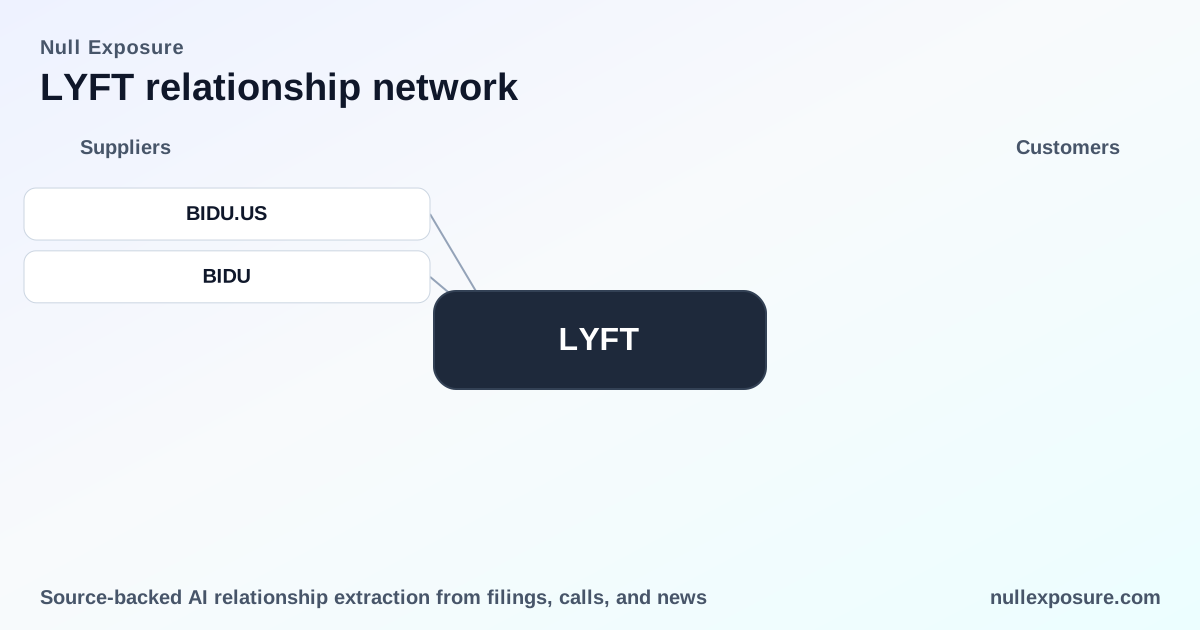
Lyft Inc — supplier relationships that reshape its operating footprint
Lyft operates a two-sided marketplace that connects riders and drivers and monetizes primarily through transactional take-rates, platform fees, and complementary services (rental vehicles through Flexdrive and advertising). The company converts marketplace volume into revenue, while outsourcing capital-intensive elements (cloud infrastructure, vehicle supply, and autonomous technology) to third parties; this supplier posture directly drives operating leverage and supplier concentration risk. For a concise, searchable view of these supplier ties visit https://nullexposure.com/.
How Lyft structures supplier exposure — the high-level view
Lyft’s operating model is a marketplace optimized to keep capital-light while controlling the customer experience. That results in a predictable set of supplier relationships:
- Long-term infrastructure commitments that lock in cloud and platform costs and create fixed-cost floors for technology operations.
- A largely individual counterparty base for service delivery (drivers) that keeps fleet capex off the balance sheet but adds labor and regulatory complexity.
- Specialized technology partners for autonomous vehicles and core systems when Lyft chooses to outsource hard engineering problems.
- Distribution reliance on mobile OS/app marketplaces, which function as gatekeepers to rider and driver acquisition.
These are not academic points — they are operational drivers. Lyft has documented a multi-year, high-dollar commitment to cloud infrastructure, it runs rental and leasing programs through a subsidiary (Flexdrive), and it contracts with technology vendors to fill capability gaps the marketplace itself cannot provide.
Constraints and what they imply for investors
The public record and company disclosures show several binding constraints that shape Lyft’s supplier risk profile and strategic options.
- Long-term contracting posture: Lyft entered a noncancellable arrangement with Amazon Web Services (AWS) that commits $562.5 million in aggregate spend between 2026 and 2030, with a minimum of $100 million per year across five contract periods. That is a material, multi-year fixed-cost obligation that locks cloud suppliers into a critical role for Lyft’s platform operations (company filing, amended arrangement covering 2026–2030).
- High spend concentration on core infrastructure: The contract size places infrastructure spend into a top-tier band for Lyft suppliers, reflecting the strategic criticality of cloud services to the business and a constrained ability to switch providers quickly given integration costs.
- Counterparty mix dominated by individuals: Lyft’s service delivery relies on driver-partners who are individuals rather than centralized fleets, which reduces capex but increases exposure to labor and regulatory swings (company disclosures on driver base).
- Global sourcing and operational footprint: Lyft transacts internationally for vehicle sourcing and related services, signaling geographic diversification in supply chains even as the platform is concentrated in North America for riders (company disclosure on international sourcing).
- Service-provider and distributor roles: Lyft identifies multiple third-party roles — cloud vendors and insurance providers as service providers, and mobile OS/app marketplaces as distribution gatekeepers, both of which are operationally critical (company disclosures referencing AWS, insurance procurement, and app store dependence).
- Operational maturity in rental fleet management: Through Flexdrive, Lyft operates a mixed model of owned and third-party leased vehicles, showing an established capability to manage vehicle supply without fully owning fleet assets (company disclosures on Flexdrive).
Each of these signals is actionable for underwriting: long-term fixed commitments create downside rigidity, while the individual-driver model and app-store distribution create operational variability that underwrites revenue volatility.
Public supplier relationships recorded (exhaustive)
Below are the relationships surfaced in the public results for Lyft; each entry is summarized in plain English with a source reference.
Baidu — autonomous vehicle collaboration (FY2025 reporting)
Lyft has an agreement to integrate Baidu’s Apollo Go RT6 driverless vehicles into its ride-hailing networks in London, with trials scheduled ahead of 2026 deployment. This ties Lyft’s urban mobility offering to a third-party autonomous vehicle supplier and positions Lyft to leverage autonomy without owning the vehicle hardware (Futunn news post reported March 10, 2026).
Baidu — cooperative operations and technology split (FY2024 reporting)
A prior report described a cooperation agreement under which Lyft handles platform operation, customer service, and fleet dispatch, while Baidu supplies the autonomous vehicles and core autonomous-technology support, creating an operational split where Lyft runs the marketplace and Baidu supplies the vehicle stack (Futunn news post referenced in March 2026 describing FY2024 cooperation).
What these supplier ties mean for risk and value
The Baidu relationship is strategically important: it externalizes the most capital- and engineering-intensive element of autonomy while keeping Lyft in control of customer experience and dispatch economics. That structure reduces capex exposure and accelerates time-to-market for autonomous rides, but it also creates a dependency on a single technology supplier for AV capability in those markets.
The AWS commitment is an equally consequential supplier tie. A multiyear, $100M+ annual floor for cloud services turns infrastructure into a quasi-fixed cost, reducing margin flexibility in downcycles and increasing the significance of efficient capacity utilization and software optimization.
The counterparty and distribution constraints (individual drivers, app stores) are operational realities that influence cost structure, regulatory risk, and margins. Investors should treat platform labor and distribution gatekeepers as structural risk factors that are harder to mitigate through procurement alone.
Actionable investor takeaways
- Baidu partnership materially accelerates Lyft’s access to AV technology while shifting vehicle risk to a supplier. Investors should watch integration milestones (trials, regulatory approvals in London) as binary events that change Lyft’s cost curve.
- The AWS multi-year commitment creates fixed-cost rigidity; efficiency gains in software and utilization are the primary levers to improve operating margins.
- Driver and distribution concentration are persistent constraints that will continue to influence unit economics more than one-off vendor negotiations.
For a deeper, supplier-focused view of Lyft and comparable companies visit https://nullexposure.com/ to see how these relationships stack across the peer set.
Final assessment
Lyft’s supplier strategy is a deliberate trade-off: outsourcing capital-intensive capabilities preserves a marketplace profile but concentrates operational risk in a small set of critical suppliers. Autonomous partnerships like Baidu’s and infrastructure deals like the AWS commitment are the most consequential supplier relationships on the books today. Monitor technology delivery milestones, regulatory approvals in target cities, and incremental disclosures about contract scope to update valuations and operating assumptions.
If you want a structured, supplier-centric lens to model Lyft’s counterparty risk versus peers, explore more at https://nullexposure.com/.